
Why “Corporate Stress” Is Causing Teeth Grinding in McKinney Executives
A surprising number of high-performing professionals in McKinney are damaging their teeth without realizing it.
Not during workouts.
Not from sports.
Not from accidents.
From stress.
More specifically: chronic jaw clenching and teeth grinding tied to high-pressure work environments, long commutes, poor sleep, and nonstop mental load.
Many executives do not notice it until:
- a spouse hears grinding at night
- a tooth cracks
- headaches become constant
- or a dentist points out severe wear patterns during a routine cleaning
By then, the damage is often already visible.
Grinding your teeth after long workdays?
McKinney executives trust professional dental care to stop damage early. Schedule your visit today.
The “Always On” Problem
North Texas professionals are carrying a different type of stress load than they were 10 or 15 years ago.
Many McKinney executives are balancing:
- hybrid work schedules
- constant notifications
- leadership pressure
- long Frisco or Plano commutes
- financial stress
- sleep disruption
- and the inability to mentally “clock out”
The body often stores that tension physically.
For many people, the jaw becomes the pressure valve. Understanding how TMJ disorders affect the nervous system can also help explain why jaw tension may be associated with headaches, facial discomfort, and other symptoms.
That can show up as:
- daytime clenching
- nighttime grinding (bruxism)
- tight facial muscles
- jaw soreness
- headaches
- cracked teeth
- neck tension
- or TMJ symptoms
Most People Don’t Realize They’re Clenching
Grinding sounds dramatic, but many patients are actually “clenchers.”
That means they keep their jaw muscles contracted for long periods without obvious tooth-on-tooth grinding sounds.
It often happens:
- during emails
- in traffic
- during meetings
- while concentrating
- at the gym
- or during sleep
One of the biggest misconceptions is:
“If I’m not in pain, it’s probably fine.”
Not necessarily.
Dentists often spot signs long before symptoms appear.
What Dentists See in High-Stress Professionals
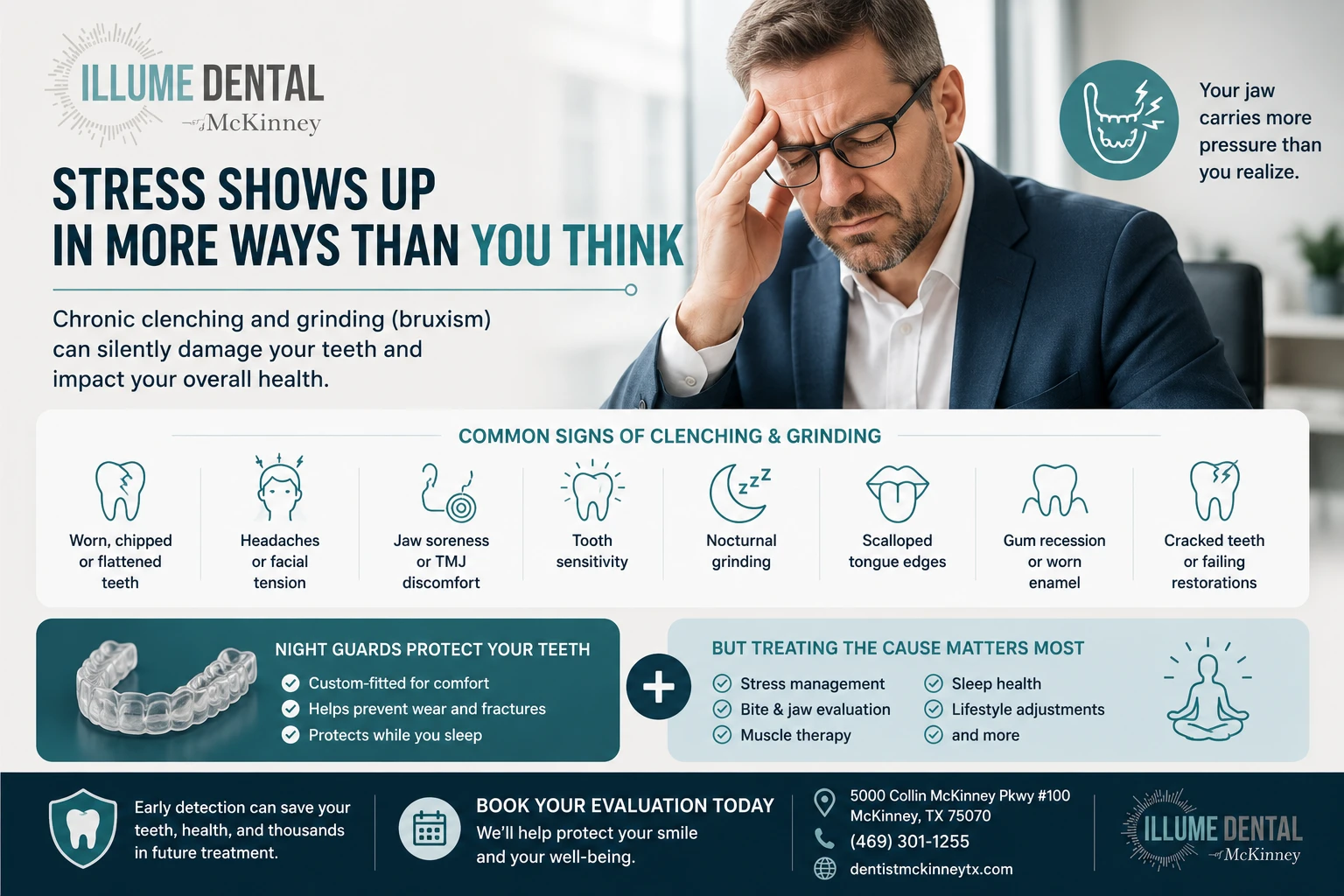
There is a recognizable pattern many dentists see in chronically stressed professionals:
- flattened teeth
- chipped enamel
- gum recession
- fractured fillings
- cracked molars
- enlarged jaw muscles
- tension headaches
- sensitive teeth
- scalloped tongue edges
- TMJ tenderness
Patients are often shocked because:
“But my teeth don’t hurt.”
Teeth can tolerate stress silently for years before failing suddenly. An nightly teeth grinding issue can damage your smile even before noticeable pain develops.
 Your general dentist plays a crucial role in keeping your smile healthy for life. As the first line of defense…

Why Night Guards Matter But Aren’t Magic
Custom night guards are often recommended because they help protect teeth from destructive grinding forces.
But patients should understand:
- a night guard protects teeth
- it does not eliminate stress
- and it does not “cure” clenching behavior
Some people still clench aggressively against the guard.
That is why treatment may also involve:
- stress management
- sleep evaluation
- bite analysis
- muscle therapy
- Botox for severe clenching cases
- or identifying contributing airway/sleep issues
The Executive Personality Pattern Is Real
There is also a behavioral component.
People who are:
- highly driven
- perfectionistic
- competitive
- chronically productive
- or mentally “on” all day
…often carry physical tension without realizing it.
The jaw is one of the most common places it shows up.
Ironically, some of the patients most affected are the ones least likely to notice until major dental work becomes necessary.
The Cost of Ignoring It
Untreated grinding can become expensive.
Long-term clenching can contribute to:
- cracked teeth
- broken crowns
- failed fillings
- gum recession
- enamel erosion
- tooth fractures requiring crowns
- root canals
- or even tooth loss in severe cases
Many patients spend years unknowingly wearing down teeth that cannot naturally regenerate.
Botox Is Becoming More Common But It’s Not for Everyone
Some McKinney professionals are now exploring Botox for jaw tension and clenching relief.
Botox can help reduce muscle intensity in certain cases, especially with overactive masseter muscles.
But it is not a universal solution.
A proper evaluation matters because:
- some patients mainly need tooth protection
- some have bite instability
- some have sleep-related grinding
- and others may have true TMJ disorders requiring broader treatment
Good treatment starts with diagnosis not trends.
What Actually Helps
The most effective approach is usually layered:
- identifying clenching habits
- protecting teeth early
- improving sleep quality
- reducing muscle overload
- and treating damage conservatively before it escalates
The earlier grinding is caught, the more tooth structure can usually be preserved.
That matters.
Natural enamel is hard to replace once it is gone.
The Bottom Line
“Corporate stress” is not just emotional. It often becomes physical and the mouth is one of the first places dentists see it.
For busy McKinney professionals, teeth grinding is increasingly becoming less of a cosmetic issue and more of a long-term health and structural problem.
If you are waking up with headaches, jaw tension, cracked teeth, or unexplained tooth sensitivity, the safest next step is a thorough dental evaluation. Illume Dental of McKinney helps patients identify early signs of clenching and grinding before minor wear turns into major restorative treatment.
Don’t let workplace stress damage your smile.
Get fast, professional help for teeth grinding in McKinney before it leads to costly dental issues. Call Now | Learn More