
How Long After a Tooth Extraction Can You Get a Dental Implant?
A dental implant can sometimes be placed the same day a tooth is extracted. In other cases, the dentist or surgeon may wait several weeks, several months, or until the extraction site and any bone graft have fully healed.
There is no single waiting period that is right for everyone.
A widely used implant-timing classification recognizes four general approaches:
- Immediate placement: the implant is placed on the day of extraction
- Early placement after soft-tissue healing: usually around 4 to 8 weeks
- Early placement after partial bone healing: usually around 12 to 16 weeks
- Late placement: after the socket has fully healed, traditionally more than 6 months after extraction
These timeframes describe different clinical strategies, not a countdown that every patient must follow.
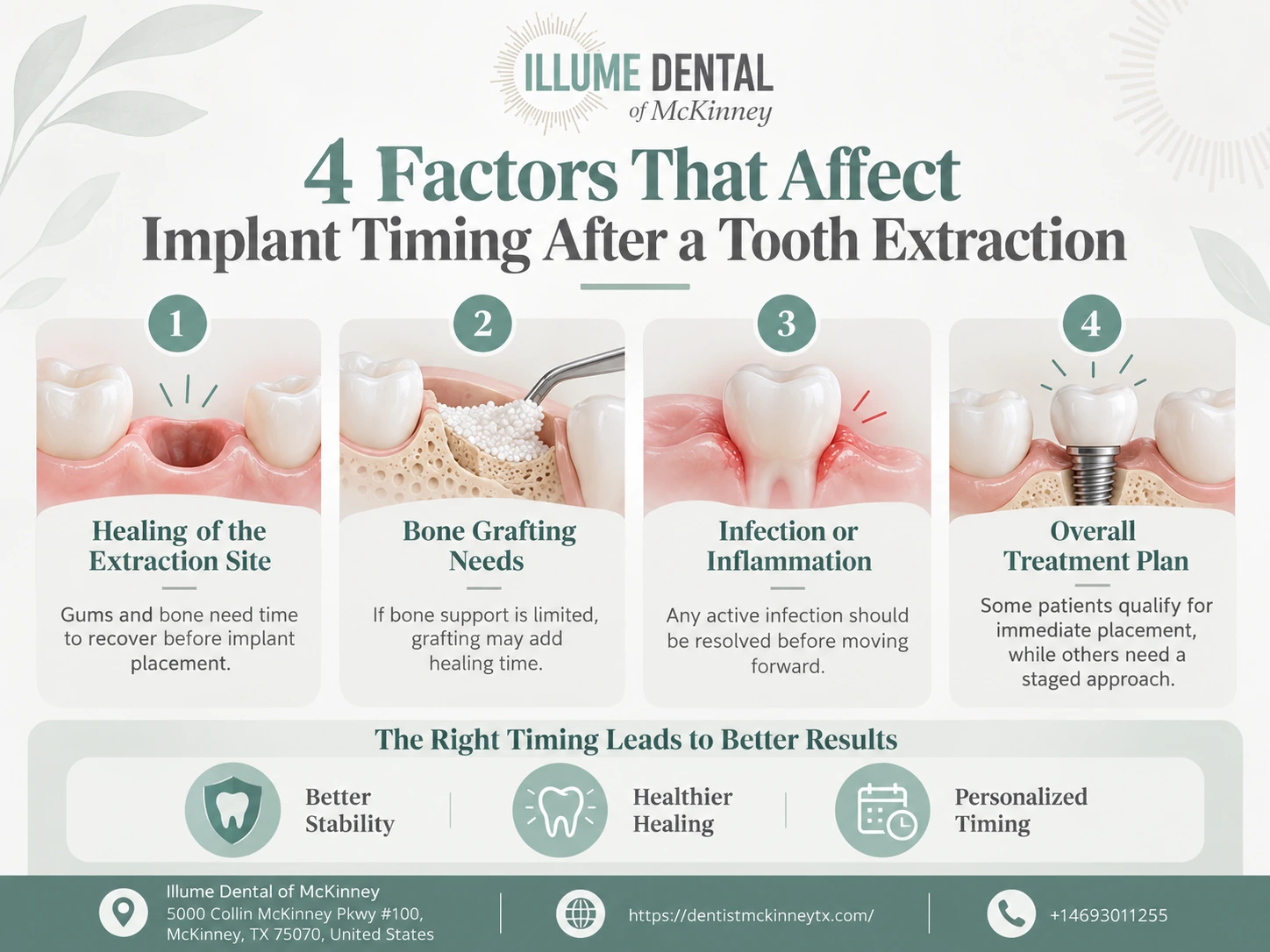
The right timing depends on the condition of the extraction socket, available bone, infection or inflammation, gum tissue, ability to achieve implant stability, grafting needs, medical factors, and the final restorative plan.
Key Takeaways
- You may not have to wait at all. Immediate implant placement can be appropriate in carefully selected extraction sites.
- Waiting approximately 4–8 weeks or 12–16 weeks represents recognized early-placement strategies that allow different degrees of soft-tissue and bone healing.
- If significant bone grafting is required, the site may need several months of healing before implant placement.
- Infection does not automatically mean an implant must be delayed, but active disease, socket damage, and the ability to thoroughly clean the site and achieve implant stability affect the decision.
- Implant placement and getting the final crown are separate stages. Even when the implant is placed immediately, bone still needs time to integrate with it.
- Current ADA/AAOMR guidance recommends 3-D CBCT imaging for presurgical implant planning.
What are the main implant-timing options after an extraction?
Rather than thinking of implant placement as either “same day” or “months later,” it is more useful to understand the recognized timing options.
Option 1: Immediate implant placement — the same day
An immediate implant is placed during the same surgical visit in which the tooth is extracted.
The advantage is obvious: one surgical stage can sometimes be eliminated, shortening the overall treatment sequence.
But immediate placement is not simply about convenience.
The clinician must be able to place the implant in the correct restorative position and obtain adequate primary stability in the available bone. The condition of the socket walls, surrounding tissues, anatomy, esthetic demands, and need for bone augmentation all matter.
Immediate placement is therefore a technique-sensitive option rather than the automatic “better” choice.
Option 2: Early implant placement after about 4 to 8 weeks
Another strategy is to remove the tooth and allow the gum tissue to heal for several weeks before placing the implant.
The International Team for Implantology classifies placement at approximately 4 to 8 weeks after extraction as early placement after soft-tissue healing.
This approach may allow:
- inflammation to resolve
- soft tissue to close over the site
- easier management of the gum tissue
- better assessment of the socket after initial healing
It is particularly well documented in anterior implant treatment.
Option 3: Early implant placement after about 12 to 16 weeks
A second early-placement approach allows more bone healing before implant surgery.
The ITI defines this as implant placement after partial bone healing, typically around 12 to 16 weeks after extraction.
This may be useful when additional healing within the extraction socket is desirable before placing the implant.
Option 4: Placement into a fully healed site
In some situations, the site is allowed to heal more completely before the implant is placed.
Within the traditional ITI classification, late implant placement refers to placement after complete bone healing, generally more than six months following extraction.
That does not mean every delayed implant needs to wait six months.
Clinical treatment may occur at other intervals depending on grafting, bone development, healing, and the specific site.
Why can’t every implant be placed immediately?
Because removing a tooth does not automatically leave behind an ideal implant site.
An implant has to be placed where the future tooth needs it to be, not merely where the old root happened to be.
Several factors can make immediate placement less predictable or inappropriate.
Not enough bone for initial stability
When an implant is first inserted, it needs enough mechanical stability in the surrounding bone.
The ITI specifically identifies lack of primary stability as a factor that can prevent an intended immediate placement or loading protocol.
If adequate stability cannot be obtained in the correct implant position, allowing the site to heal or rebuilding the bone first may be safer.
A damaged extraction socket
A badly fractured tooth, periodontal bone loss, trauma, or disease can leave portions of the socket wall missing.
Immediate implants can sometimes still be placed in defective sockets, and recent systematic reviews report favorable outcomes in selected cases. However, the treatment becomes more complex and may require simultaneous bone augmentation.
The important point is that a damaged socket does not automatically mean immediate placement is impossible but it changes the risk and treatment planning.
Esthetic concerns
Timing is particularly important for front teeth, where even a small change in gum height or tissue contour can be visible.
Immediate placement can work well in appropriate sites, while early placement after several weeks of soft-tissue healing is also a well-established strategy.
The fastest option is therefore not automatically the best esthetic option.
What if the tooth is infected?
This is one of the areas where patients often receive overly simple advice.
An infected tooth does not automatically mean you must wait months before receiving an implant.
Clinical consensus recognizes infection as an important factor in deciding the timing of implant placement, but published studies show that immediate implants can sometimes be successful in previously infected extraction sites when appropriate case selection and meticulous debridement are used.
However, the evidence is not perfectly uniform. Some systematic reviews have found increased failure risk when immediate implants are placed in infected versus non-infected sites.
That is exactly why the responsible answer is not:
“Infection means you have to wait.”
Nor is it:
“Infection does not matter.”
The type and extent of infection, condition of the bone, ability to thoroughly debride the socket, implant stability, and individual risk factors all need to be considered.
What if you need a bone graft?
Bone grafting can significantly change the timeline.
There are several possibilities.
The graft and implant may be placed together
If the implant can achieve adequate stability and the bone deficiency is manageable, graft material can sometimes be added around the implant during the same surgery.
Mayo Clinic notes that minor grafting can sometimes be performed at implant placement.
A graft may be placed when the tooth is removed
A socket- or ridge-preservation graft may be placed at the extraction appointment when the goal is to preserve bone for a future implant.
The implant is then placed after the site has healed sufficiently.
A larger graft may need to heal before implant placement
When more substantial ridge reconstruction is necessary, the healing period can be considerably longer.
The American Academy of Periodontology notes that after ridge modification, bone may be allowed to develop for approximately four to 12 months, depending on individual needs, although implants can sometimes be placed at the same time as the graft.
That is why someone who receives a simple extraction and someone who receives major bone augmentation should not expect the same timeline.
If I get an implant the same day, do I get a tooth the same day too?
Not necessarily.
This distinction is extremely important.
Implant placement describes when the implant is surgically inserted.
Implant loading or restoration describes when a tooth or prosthesis is connected to that implant and how much biting force it receives.
The ITI treats these as separate protocols. An implant can be placed immediately after extraction but still be left to heal before a functional tooth is attached.
In selected cases, a temporary tooth can be attached very quickly after implant placement.
But immediate restoration or loading requires its own clinical criteria, including adequate implant stability.
And even when you leave the office with a temporary tooth, the implant is not biologically finished healing.
How long does the implant itself take to heal?
After placement, the implant needs to become integrated with the surrounding jawbone through a process called osseointegration.
AAOMS explains that new bone grows and attaches to the implant over several months. Follow-up appointments are used to monitor healing and determine when the implant is ready for its final restoration.
The American Academy of Periodontology gives a commonly cited range of approximately two to six months for the implant and surrounding bone to bond before restorative steps in conventional treatment.
That timeline is separate from any healing that occurred before implant placement.
For example, someone might:
- have a tooth extracted,
- wait several weeks or months,
- receive the implant,
- then allow another period for osseointegration,
- and finally receive the definitive crown.
That is why the total treatment timeline can be much longer than the extraction-to-implant interval alone.
Does waiting longer always make the implant safer?
No.
More healing time is not automatically better.
After tooth extraction, the jaw ridge naturally changes in shape and dimensions during healing. Delaying treatment indefinitely may mean there is less bone available later and can sometimes increase the need for augmentation.
This is one reason implant planning ideally begins before the tooth is removed whenever the extraction can be planned in advance.
The ITI specifically recommends beginning implant treatment planning once the need for extraction has been established.
That allows the dentist to decide whether immediate placement, early placement, socket preservation, or another approach is most appropriate before the anatomy changes.
What imaging is needed before an implant?
Implant planning requires evaluation of the bone and nearby anatomy.
Updated 2026 recommendations from the American Dental Association and American Academy of Oral and Maxillofacial Radiology state that CBCT is recommended for presurgical dental implant planning.
Three-dimensional imaging can help evaluate:
- available bone volume
- implant position
- nearby nerves
- the maxillary sinus
- bone grafting needs
- previously grafted sites
Imaging should be used together with a clinical examination and restorative treatment plan—not as a substitute for them.
What should you expect during the process?
Your exact sequence may look different from another patient’s.
A straightforward case might involve:
Extraction → immediate implant → healing → final crown
Another patient might have:
Extraction → 4–8 weeks of healing → implant → osseointegration → crown
Another might require:
Extraction and socket graft → several months of graft healing → implant → osseointegration → crown
And a larger bone defect could require:
Extraction → staged ridge augmentation → extended healing → implant → additional healing → final restoration
None of these sequences is automatically superior.
The appropriate one is the sequence that allows the implant to be placed in the right position with adequate bone, healthy tissues, and an appropriate restorative plan.
What should you expect after an extraction?
In the first part of recovery, common postoperative issues can include soreness, swelling, diet modifications, and special instructions for cleaning the surgical area.
The important distinction is that feeling better does not mean the deeper bone has finished healing.
Follow the postoperative instructions from your treating dentist or surgeon and keep scheduled follow-up appointments.
Contact the treating office if you develop concerning symptoms such as:
- bleeding that cannot be controlled
- swelling that is worsening rather than improving
- severe or increasing pain
- fever or other signs of infection
- pus or significant drainage
- difficulty swallowing or breathing
- unexpected or persistent numbness
Your own clinician’s postoperative instructions should take priority over a generic timeline online.
Can you wait too long to get an implant?
You can still receive implants years after a tooth was lost, so there is not a universal deadline.
However, bone dimensions can decrease after tooth loss. A site that could have supported an implant earlier may require bone augmentation later.
That does not mean everyone should rush into implant surgery.
It means that if you think an implant may be your preferred tooth-replacement option, it is worth discussing that before or soon after extraction so the treatment team can consider bone preservation and timing.
What factors determine your individual timeline?
Your dentist or surgical provider should consider:
The condition of the extraction socket
Are the walls of the socket intact, or has bone been lost?
Available bone
Is there enough bone in the correct location to stabilize the implant?
Infection or inflammation
What type of disease is present, and can the area be adequately cleaned and managed?
Gum tissue
Is there sufficient healthy tissue for the planned implant and restoration?
Implant position
Can the implant be placed where the final crown actually needs it to be?
Esthetic demands
Front teeth often require particularly careful management of gum and bone contours.
Need for grafting
Does the site need a small simultaneous graft, socket preservation, or larger staged augmentation?
Medical history
Conditions and medications that influence wound or bone healing may affect treatment.
Tobacco use
Smoking is associated with impaired healing and implant complications and should be included in risk assessment.
The final restoration
Planning a single crown, bridge, or full-arch restoration can change the surgical strategy.
Questions to ask before your tooth is extracted
If you already know the tooth cannot be saved and you are considering an implant, it is useful to discuss these questions before extraction whenever possible:
- Am I a candidate for immediate implant placement?
- If not, what specifically makes waiting preferable?
- Is the extraction socket intact?
- Do I need socket preservation or another bone graft?
- What does my CBCT show about the available bone?
- If a graft is placed, how long do you expect it to heal?
- Are you recommending placement at 4–8 weeks, 12–16 weeks, or after more complete healing?
- Will I have a temporary tooth while the area heals?
- If the implant is placed immediately, will it receive a temporary crown or be left unloaded?
- How long do you expect osseointegration to take?
- What factors could change the timeline after treatment begins?
- What is the estimated timeline from extraction to the final crown?
How Illume Dental Can Help
If you know a tooth needs to be removed and you are considering an implant, it is useful to plan the extraction and tooth replacement together rather than treating them as unrelated decisions.
Illume Dental of McKinney’s current website describes dental implant treatment, same-day implant options, extractions, bone grafting, and related restorative planning.
An evaluation can help determine:
- whether the tooth is truly non-restorable
- whether immediate implant placement is realistic
- whether bone preservation or grafting is appropriate
- how long the site may need to heal
- what temporary replacement options are available
- when the final restoration could reasonably be completed
The goal should not be to place the implant as fast as possible.
It should be to choose a timing strategy that supports appropriate implant positioning, healthy tissues, and a predictable final restoration.
Frequently Asked Questions
How soon after an extraction can I get a dental implant?
Potentially the same day.
If immediate placement is not appropriate, recognized early-placement options include approximately 4–8 weeks after extraction or 12–16 weeks after extraction.
Other sites may be allowed to heal more completely before implant placement.
Your anatomy and treatment needs matter more than choosing a date from a generic timeline.
Is it better to get an implant immediately after extraction?
Not automatically.
Immediate placement can shorten treatment and perform well in appropriately selected cases, but it is technique-sensitive. Adequate bone, implant stability, socket condition, correct implant positioning, and tissue considerations all matter.
Waiting may be preferable when those conditions are not present.
Can you place an implant immediately if the tooth was infected?
Sometimes.
Research shows that immediate implant placement in previously infected sockets can be successful in selected cases after appropriate debridement, but the evidence is mixed regarding whether infection increases failure risk.
Infection should therefore be evaluated as part of the entire clinical picture rather than treated as an automatic yes or no.
How long after a bone graft can an implant be placed?
It varies substantially.
Small grafts can sometimes be performed at the same time as implant placement. More extensive grafting may need several months of healing.
For larger ridge-modification procedures, the American Academy of Periodontology describes healing periods of roughly four to 12 months, depending on individual needs.
If I get a same-day implant, do I get the permanent crown that day?
Usually, “same-day implant” should not automatically be interpreted as “permanent final crown the same day.”
Immediate implant placement refers to when the implant is inserted. A provisional restoration may be possible in selected cases, while the definitive restoration generally follows appropriate healing and restorative steps.
Placement and loading are separate clinical decisions.
How long does an implant take to fuse with the bone?
Osseointegration generally takes several months.
The American Academy of Periodontology describes a conventional healing period of approximately two to six months in many single-implant cases, although the exact timeline varies.
Should I get a bone graft when the tooth is extracted?
Not every extraction requires one.
Socket or ridge preservation may be considered when preserving bone for a planned future implant is important. Whether it is worthwhile depends on the extraction site, existing bone, future treatment plan, and anticipated implant position.
Discussing the implant plan before extraction makes that decision easier.
Can I get an implant years after an extraction?
Yes, many people do.
However, bone may have changed since the tooth was lost, so the site needs to be evaluated for adequate bone volume and may require grafting before implant placement.
Do I need a CBCT before a dental implant?
Current ADA/AAOMR recommendations support CBCT for presurgical dental implant planning because three-dimensional imaging helps evaluate available bone and nearby anatomical structures.
Your clinician should still perform a clinical examination and determine which imaging is appropriate for your individual situation.