How Much Does Sleep Apnea Treatment Cost Compared With a CPAP Machine?
Most people comparing a dental sleep apnea appliance with CPAP eventually notice something surprising:
The CPAP machine usually costs less upfront.
A typical new CPAP machine costs about $500 to $1,000, while professionally fitted oral appliance therapy commonly costs $1,500 to $2,500 or more. But that is not quite an apples-to-apples comparison. CPAP has ongoing costs for masks, tubing, filters, cushions, and other supplies, while a custom oral appliance has a larger upfront cost and generally fewer disposable components.
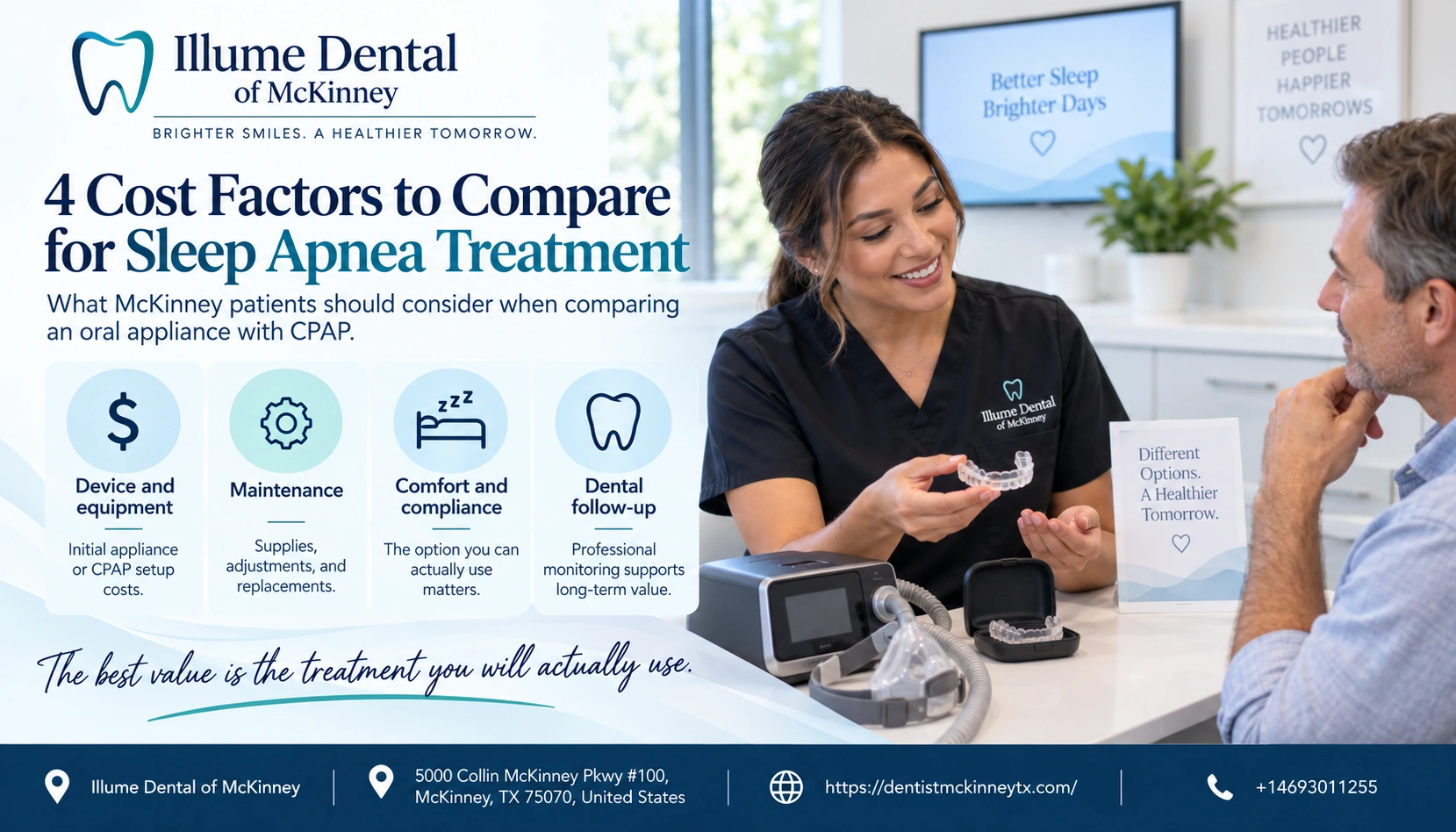
For patients considering treatment at Illume Dental of McKinney, the practice currently lists a $2,900 deposit for sleep apnea treatment and notes that it works with medical insurance. Because the published price is specifically described as a deposit, patients should confirm the total treatment fee and estimated insurance reimbursement before starting treatment.
The bigger question, though, is not simply which option is cheaper.
It is which treatment is appropriate for your type and severity of sleep apnea and which one you will actually use every night.
First, What Are We Comparing?
Technically, CPAP is sleep apnea treatment.
When a dental office talks about an alternative to CPAP, it is usually referring to oral appliance therapy for obstructive sleep apnea.
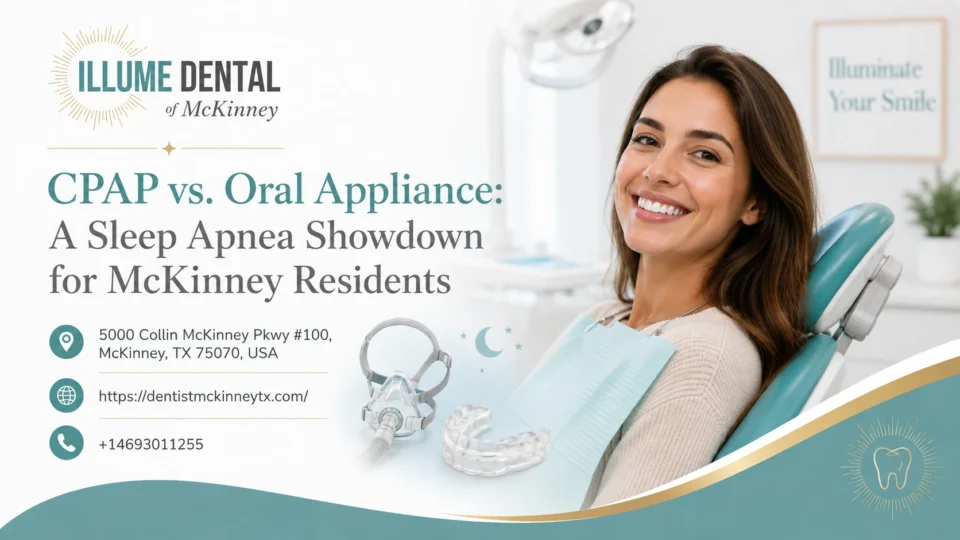
A custom mandibular advancement device fits over your teeth and gently positions your lower jaw forward while you sleep. That movement can create more room behind the tongue and help prevent the airway from collapsing.
This is very different from the inexpensive anti-snoring mouthguards sold online.
Clinical guidelines recommend a custom, adjustable or “titratable” oral appliance when oral appliance therapy is prescribed for obstructive sleep apnea.
CPAP vs. Oral Appliance Cost at a Glance
| Cost consideration | CPAP | Custom oral appliance |
| Typical upfront cash cost | About $500–$1,000 for many CPAP machines | Often about $1,500–$2,500+ |
| Illume Dental published price | — | $2,900 deposit |
| Recurring supplies | Yes | Much less equipment to replace regularly |
| Mask/tubing/filter costs | Yes | No |
| Professional fitting | Mask selection/setup | Custom dental fitting and adjustments |
| Insurance | Often medical insurance | Often medical insurance when requirements are met |
| Portable without electricity | No | Yes |
| Appropriate for every OSA patient | Yes across a wider range of severity when prescribed | No |
Current 2026 consumer pricing data puts most CPAP machines around $500 to $1,000, although the broader market can run from roughly $300 to $1,500 or more depending on the equipment.
Custom oral appliances are commonly reported around $1,500 to $2,500, although specific devices and treatment programs can cost more.
Why Does an Oral Appliance Cost More Than a CPAP Machine?
This is probably the most reasonable question patients ask.
A CPAP machine looks much more complicated. It has a motor, electronics, software, humidification, tubing, and a mask.
An oral appliance can look like a sophisticated mouthguard.
So why might the mouthpiece cost several thousand dollars?
Because with professional oral appliance therapy, you are generally paying for more than the physical plastic appliance.
Treatment can involve:
- evaluating whether your teeth and jaw can support the appliance;
- digital scans or impressions;
- fabrication of a custom medical device;
- fitting the appliance;
- gradually adjusting how far the jaw is advanced;
- monitoring jaw, tooth, and bite changes;
- coordinating care with the physician managing the sleep apnea; and
- determining whether the device is actually controlling the apnea.
Professional guidelines specifically recommend dental follow-up because oral appliances can produce side effects such as tooth movement and bite changes. Follow-up sleep testing is also recommended to confirm effectiveness.
That is why comparing an oral appliance fee with the retail price of a CPAP machine alone can be misleading.
CPAP Has a Lower Starting Price but It Has Ongoing Costs
With CPAP, buying the machine is only the beginning.
Masks, cushions, headgear, filters, hoses, and humidifier components wear out and need periodic replacement.
Current pricing estimates put:
- masks around $50 to $200;
- replacement cushions around $20 to $60;
- tubing around $5 to $35 for standard hoses;
- headgear around $15 to $40; and
- Humidifier chambers are around $20 to $50.
Depending on insurance, replacement schedule, and equipment, ongoing CPAP costs have been estimated at roughly $20 to $100 or more per month after the original machine purchase.
Insurance may pay much of that expense, so those figures should not be mistaken for what every patient actually spends.
Still, it explains why the sticker price on the machine does not necessarily represent the long-term cost of CPAP therapy.
What Does Sleep Apnea Treatment Cost at Illume Dental of McKinney?
Illume Dental’s currently published pricing lists:
Sleep apnea treatment: $2,900 deposit, with the practice stating that it will work with medical insurance.
That wording matters.
We would not tell a patient, “Your sleep apnea appliance costs exactly $2,900,” because the practice’s own published information calls that amount a deposit.
Before committing to treatment, ask:
- What is the total treatment fee?
- What exactly is included in that fee?
- Are follow-up adjustments included?
- Is follow-up sleep testing included or billed separately?
- What does my medical insurance cover?
- What is my expected out-of-pocket cost?
Those questions give you a much more useful comparison than simply looking at the price of a CPAP machine online.
Will Medical Insurance Cover an Oral Sleep Apnea Appliance?
Often, yes but coverage is not automatic.
This is another common source of confusion: sleep apnea appliance therapy is usually a medical-insurance issue, not ordinary dental-benefit coverage.
Many plans, including Medicare under qualifying circumstances, cover custom oral appliances for diagnosed obstructive sleep apnea. Medicare’s coverage policy requires specific diagnostic criteria, an appropriate sleep test and physician order, and the appliance must be provided and billed by a licensed dentist.
Private insurance plans can have their own requirements.
Your final cost may therefore depend on:
- whether your deductible has been met;
- your coinsurance;
- whether the provider is in or out of network;
- prior authorization requirements;
- your sleep study results; and
- whether the insurer requires CPAP to be attempted first.
This is why two patients receiving similar appliances can have very different out-of-pocket costs.
Does Insurance Cover CPAP?
CPAP is also commonly covered by medical insurance.
Many insurers, including Medicare, cover CPAP when there is a qualifying diagnosis, although insurers may require patients to demonstrate that they are actually using the machine in order for coverage to continue.
That can make CPAP extremely affordable for some patients.
For someone who has already met a deductible and has good durable-medical-equipment benefits, CPAP may cost considerably less out of pocket than an oral appliance.
For someone with a high deductible or poor equipment coverage, the comparison can look very different.
Which Treatment Works Better?
This is where price needs to stop being the deciding factor.
CPAP generally does a better job of reducing breathing interruptions and improving oxygen levels than oral appliance therapy, especially as obstructive sleep apnea becomes more severe.
Oral appliances can nevertheless be effective for appropriately selected patients and are commonly considered for people who cannot tolerate CPAP or who prefer another treatment option.
A custom appliance may be especially appealing if you:
- have mild to moderate obstructive sleep apnea;
- struggle to sleep with a CPAP mask;
- regularly remove your CPAP during the night;
- travel frequently;
- dislike hoses, masks, or machine noise; or
- simply will not use CPAP consistently.
But an oral appliance is not automatically a substitute for CPAP just because it is more comfortable.
Patients with more severe apnea, significant oxygen drops, certain medical conditions, dental limitations, or central sleep apnea may need a different approach.
What If CPAP Works, but You Hate Wearing It?
This is where the real-world answer becomes less obvious.
A theoretically excellent treatment that spends every night in the closet is not doing much for your sleep apnea.
CPAP is generally more effective at reducing the apnea-hypopnea index, but studies also show that some patients find oral appliances easier to use consistently.
That does not mean everyone who dislikes CPAP should immediately abandon it.
Sometimes CPAP problems can be improved by changing:
- mask design;
- mask size;
- humidity;
- pressure settings;
- machine type;
- nasal treatment; or
- sleep position.
If those changes do not solve the problem, discussing a custom oral appliance with your sleep physician and a dentist trained in sleep apnea treatment becomes reasonable.
Is a Cheap Online Sleep Apnea Mouthguard the Same Thing?
No.
This is one place where saving money can create a false comparison.
You can find mouthguards online for well under $200, but an over-the-counter snoring appliance is not equivalent to physician-directed, dentist-supervised oral appliance therapy.
Guidelines favor custom, titratable appliances over non-custom devices for patients being treated for diagnosed obstructive sleep apnea.
And snoring alone does not tell you how severe your breathing problem is.
If you have actual sleep apnea, the goal is not merely to make your snoring quieter.
The goal is to control the airway obstruction.
Which Is Cheaper Over Five Years?
There is no universal winner.
CPAP has a lower initial equipment price but recurring replacement expenses. Oral appliance therapy has a larger upfront cost and still requires follow-up care and eventual replacement.
Medicare, for example, assigns qualifying oral appliances a five-year reasonable useful lifetime for replacement purposes. That does not mean every appliance will last exactly five years, but it provides some perspective on why its cost should not be compared only with one year’s CPAP expenses.
The American Academy of Dental Sleep Medicine has also pointed out that recurring CPAP masks, filters, and tubing can make the long-term comparison different from the initial purchase price alone.
Your insurance benefits can easily matter more than either treatment’s advertised cash price.
So, Is an Oral Appliance Worth the Extra Upfront Cost?
It can be if it is appropriate for your apnea and you will use it consistently.
It may not be worth it if CPAP is working well, you tolerate it comfortably, and your insurance covers most of the ongoing expense.
Likewise, buying an oral appliance simply because it seems easier should not come before determining whether it can adequately control your specific sleep apnea.
The best value is not necessarily the cheaper device.
It is the treatment that:
controls your apnea, fits your medical needs, and is realistic enough for you to use every night.
For McKinney patients who already know they have obstructive sleep apnea but struggle with CPAP, Illume Dental can evaluate whether a custom oral appliance is a reasonable alternative and help you understand the treatment cost and medical-insurance process before you commit. Illume’s website currently lists a $2,900 sleep apnea treatment deposit and indicates that the office works with medical insurance.
Frequently Asked Questions
How much is a CPAP machine without insurance?
Most conventional CPAP machines currently cost around $500 to $1,000, although models can range from roughly $300 to $1,500 or more. Masks and replacement supplies add to the long-term expense.
How much does a custom oral appliance for sleep apnea cost?
A professionally fitted sleep apnea appliance commonly costs around $1,500 to $2,500, although fees can run higher depending on the appliance, professional services, follow-up care, location, and insurance.
How much does Illume Dental charge for sleep apnea treatment?
Illume Dental currently publishes a $2,900 deposit for sleep apnea treatment and states that it works with medical insurance. Patients should obtain an individualized estimate because a deposit should not be interpreted as the guaranteed final cost.
Is an oral appliance cheaper than CPAP?
Initially, usually not. CPAP machines generally have a lower purchase price. Oral appliances can become more competitive when recurring CPAP equipment and supply costs are considered, but insurance can completely change the comparison.
Is an oral appliance as effective as CPAP?
Not in every patient. CPAP generally reduces breathing events and oxygen disturbances more effectively, particularly in moderate or severe OSA. Custom oral appliances can still be an effective option for appropriately selected patients, especially those who cannot tolerate CPAP or prefer an alternative.
Can my dentist diagnose sleep apnea and give me an appliance?
Sleep apnea requires appropriate medical diagnosis and testing. Dentists play an important role in providing and monitoring custom oral appliances, but treatment should be coordinated with the medical professional managing the patient’s sleep apnea. Clinical guidance also recommends follow-up testing to verify that oral appliance therapy is actually working.