Oral Appliance Therapy vs. CPAP for Sleep Apnea: What’s the Difference?
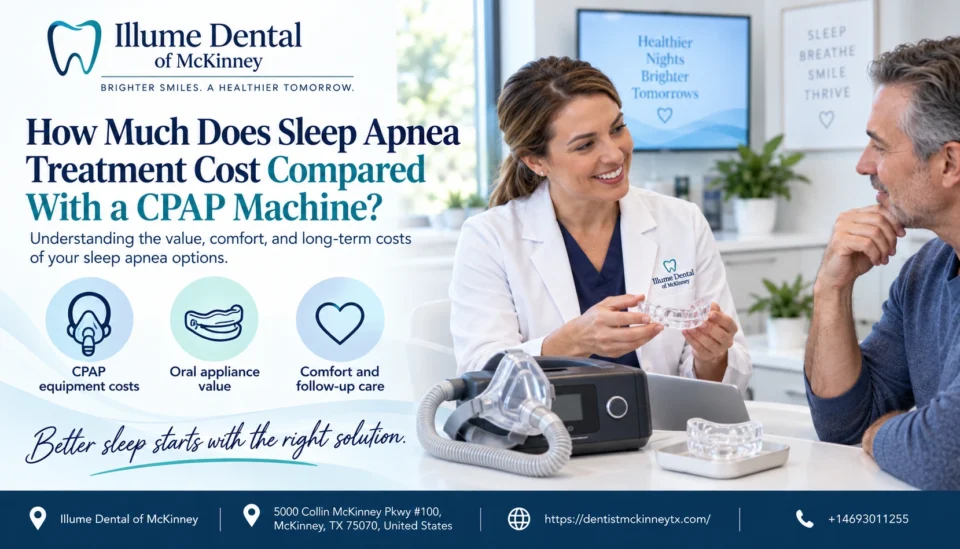
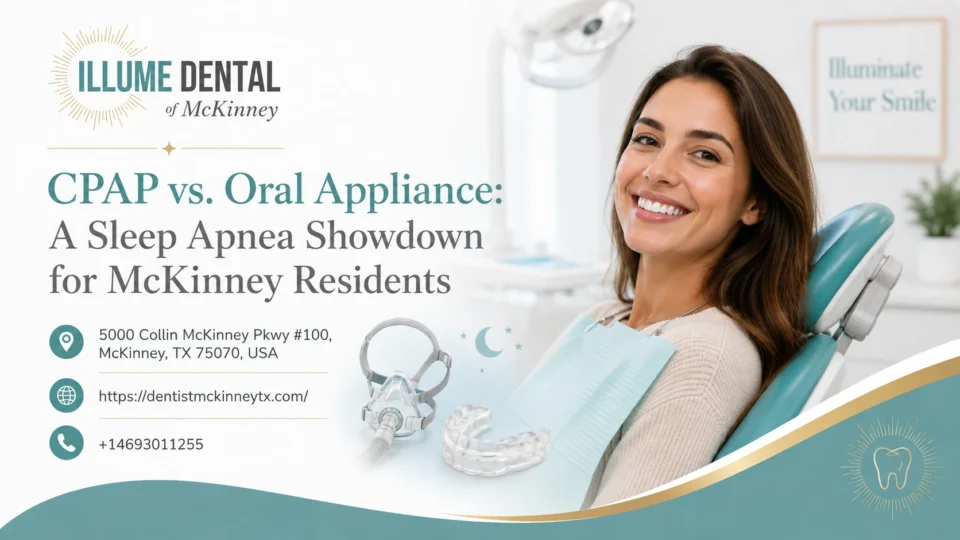
CPAP and oral appliance therapy can both treat obstructive sleep apnea (OSA), but they work very differently.
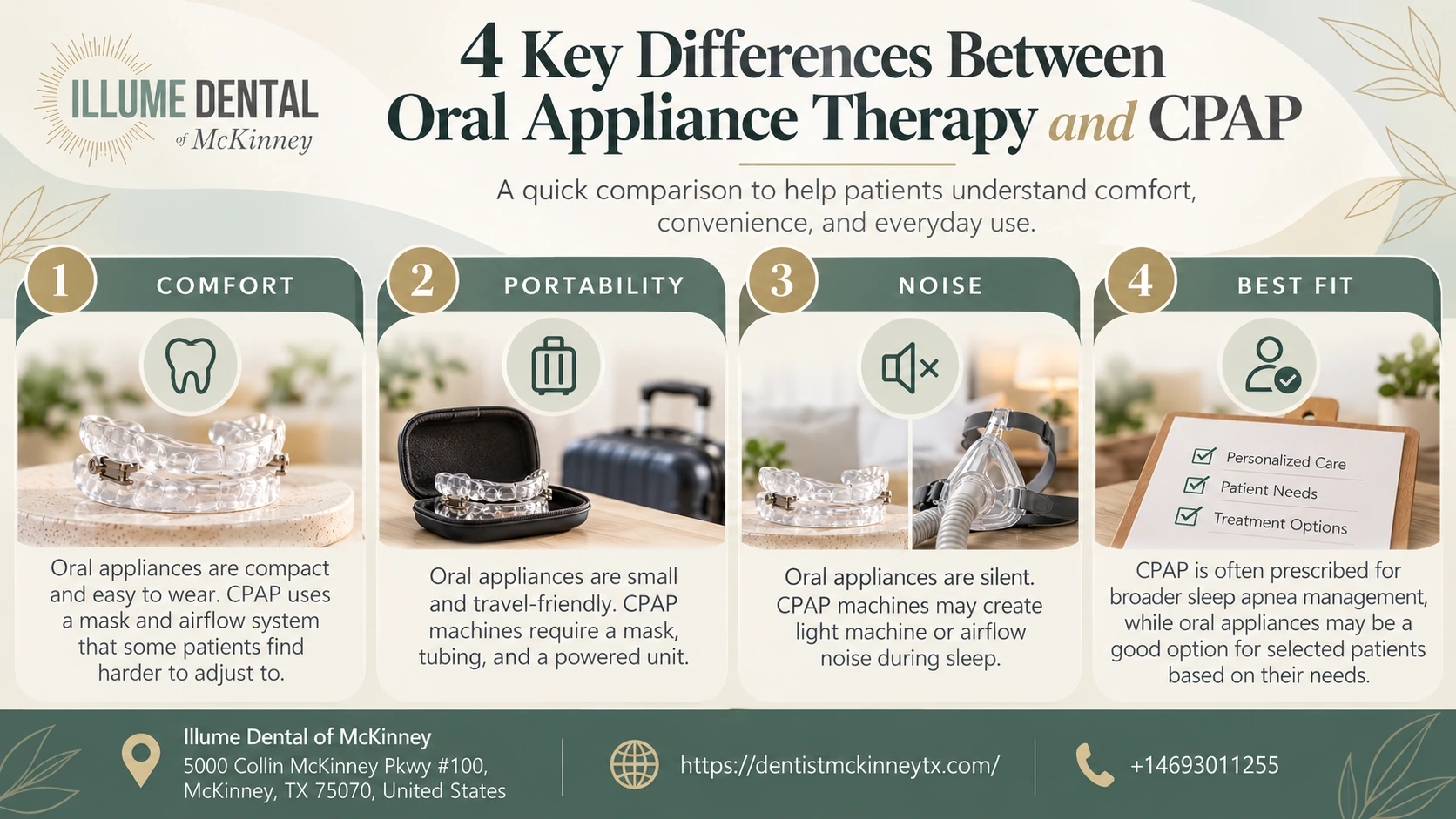
CPAP continuous positive airway pressure uses pressurized air delivered through a mask to help keep the upper airway open while you sleep. Oral appliance therapy usually uses a custom mandibular advancement device that gently holds the lower jaw forward, helping keep the upper airway from narrowing or collapsing.
CPAP generally does a better job of reducing the number of breathing interruptions measured during a sleep study and improving blood-oxygen levels. Oral appliance therapy, however, is an established treatment option for selected adults with OSA, particularly when they cannot tolerate CPAP or prefer another therapy.
The important question is not simply, “Which one is better?”
It is:
Which treatment can control your sleep apnea effectively, and which treatment can you realistically use consistently?
Key Takeaways
- CPAP is generally more effective at reducing obstructive breathing events and improving oxygenation than oral appliance therapy.
- Oral appliance therapy is an accepted treatment for adults with OSA who are unable to tolerate CPAP or who prefer an alternative after appropriate medical evaluation.
- For OSA treatment, the AASM/AADSM guideline favors a custom, titratable oral appliance provided by a qualified dentist rather than a non-custom device.
- A dentist can screen for signs of sleep-disordered breathing and provide oral appliance therapy, but OSA itself requires medical diagnosis and appropriate sleep testing. The AASM states that medical conditions such as OSA should be diagnosed by a medical provider.
- Symptoms getting better is useful, but it does not prove that sleep apnea is adequately controlled. Follow-up sleep testing is recommended to confirm the effectiveness of oral appliance therapy.
- Both treatments require follow-up. CPAP may require adjustments to the mask or pressure, while oral appliances need monitoring for fit, effectiveness, jaw symptoms, and changes in the teeth or bite.
First, what is obstructive sleep apnea?
Obstructive sleep apnea occurs when the upper airway repeatedly narrows or closes during sleep, interfering with normal breathing.
Possible symptoms include:
- loud, frequent snoring
- witnessed pauses in breathing
- waking up gasping for air
- excessive daytime sleepiness or fatigue
- difficulty concentrating
- morning headaches
- waking frequently during the night
Not everyone who snores has OSA, and symptoms alone cannot determine whether you have it or how severe it is.
A sleep study is generally needed to establish the diagnosis. Depending on your circumstances, this may involve an overnight laboratory sleep study or a home sleep apnea test ordered and interpreted as part of medical care.
How does CPAP work?
CPAP delivers continuous pressurized air through a mask worn over the nose, or sometimes over both the nose and mouth.
That air pressure acts as a pneumatic support for the upper airway, helping prevent it from collapsing while you sleep.
CPAP is one form of positive airway pressure, or PAP, therapy. Other forms include APAP, which automatically adjusts pressure during the night, and BPAP, which provides different pressure levels during inhalation and exhalation.
The American Academy of Sleep Medicine strongly recommends PAP treatment for adults with OSA who have excessive daytime sleepiness and also supports PAP in certain patients whose sleep-related quality of life or hypertension is affected.
How does an oral appliance work?
Most oral appliances used for OSA are mandibular advancement devices.
They fit over the upper and lower teeth and hold the lower jaw in a somewhat forward position while you sleep. This helps protrude and stabilize the mandible and can reduce the tendency of the upper airway to collapse.
This is not the same thing as buying a generic night guard or “anti-snoring mouthpiece” online.
When oral appliance therapy is prescribed for OSA, the joint AASM/AADSM clinical guideline recommends a custom, titratable appliance managed by a qualified dentist rather than a non-custom device. “Titratable” means the amount of mandibular advancement can be adjusted as treatment progresses.
Oral Appliance vs. CPAP: How Do They Compare?
| Question | CPAP | Oral Appliance Therapy |
| How does it work? | Uses positive air pressure to prevent airway collapse | Advances and stabilizes the lower jaw to help maintain airway patency |
| Typical equipment | Machine, tubing, and mask or nasal interface | Custom dental appliance worn inside the mouth |
| Effect on AHI and oxygenation | Generally more effective | Effective in selected patients, but generally reduces AHI and improves oxygenation less than CPAP |
| Who manages it? | Medical/sleep-care team | Medical provider and qualified dentist working collaboratively |
| Customization | Pressure and mask/interface are individualized | Appliance fit and mandibular advancement are individualized |
| Objective follow-up | PAP machines can provide treatment and usage data | Follow-up sleep testing is recommended to confirm efficacy |
| Possible problems | Mask discomfort, nasal symptoms, dry mouth, air leaks, difficulty tolerating pressure | Jaw or tooth discomfort, salivation/dryness, appliance issues, and possible bite/tooth-position changes |
| Travel | Requires PAP equipment and power | Small appliance without a machine |
| Long-term care | Equipment replacement, cleaning, monitoring and pressure/mask troubleshooting | Appliance maintenance plus ongoing dental and sleep-medicine follow-up |
Which treatment works better?
If we are talking strictly about what happens to breathing during sleep, CPAP generally wins.
The AASM/AADSM guideline found CPAP superior to oral appliances for:
- reducing sleep-disordered breathing
- reducing sleep arousals
- improving oxygen saturation
More recent reviews continue to find that CPAP generally produces larger improvements in objective measures such as the apnea-hypopnea index, or AHI, and oxygen-desaturation measures.
But that is only part of the real-world decision.
A treatment does not help much if someone consistently cannot use it.
Some clinical studies have found that oral appliance users may use their treatment more consistently, and improvements in symptoms such as daytime sleepiness or quality of life can sometimes be comparable between the treatments even though CPAP has the stronger physiological effect.
That does not make oral appliance therapy “equal to CPAP” in every respect.
It means efficacy and actual nightly use both matter.
Is CPAP always the first treatment you should try?
Not necessarily in every individual situation, although PAP remains an important and highly effective treatment for OSA.
The joint AASM/AADSM guideline describes CPAP as generally the first-line option because of its stronger effect on breathing events and oxygenation. At the same time, it specifically recommends considering oral appliance therapy for adults with OSA who are intolerant of CPAP or who prefer an alternate therapy.
The National Heart, Lung, and Blood Institute similarly states that a healthcare provider may prescribe an oral appliance when a patient does not want to use CPAP or cannot tolerate it.
Treatment decisions may also depend on:
- OSA severity
- symptoms
- oxygen levels
- other medical conditions
- airway anatomy
- body weight
- sleep position
- previous treatment experience
- dental condition
- patient preference
- ability to use treatment consistently
So “CPAP first for everyone” is too simplistic but so is telling every patient that a mouthpiece is an equivalent substitute.
Can an oral appliance treat severe sleep apnea?
Sometimes, but this requires more careful medical management.
Oral appliances have traditionally been used most often for mild to moderate OSA. The AADSM also recognizes oral appliance therapy as an option for patients with severe OSA who cannot use, do not respond to, or are unwilling to tolerate PAP therapy.
The severity label alone does not tell you whether an appliance will adequately control your OSA.
That is one reason objective testing matters.
If a patient with significant OSA chooses an oral appliance because CPAP was unsuccessful or unacceptable, it is particularly important to verify the treatment response rather than assuming that reduced snoring means the apnea has been controlled.
Does stopping your snoring mean the treatment is working?
Not necessarily.
Snoring can improve substantially while clinically important obstructive events are still occurring.
The AASM/AADSM guideline recommends follow-up sleep testing after oral appliance treatment to improve or confirm treatment efficacy.
That distinction matters.
Feeling better, sleeping more quietly, or receiving fewer complaints from your partner are encouraging signs but they do not provide the same information as measuring breathing and oxygen levels during sleep.
Can your dentist diagnose sleep apnea?
A dentist can play an important role in identifying patients who may have sleep-disordered breathing, but screening is not the same as diagnosing OSA.
The American Academy of Sleep Medicine’s current position is that OSA is a medical condition that should be diagnosed by a medical provider. A home sleep apnea test should be ordered as part of a medical evaluation and should not be interpreted solely from automatically generated results.
In coordinated oral appliance care, the roles typically look like this:
- A patient is evaluated medically and receives an OSA diagnosis.
- Oral appliance therapy is prescribed when appropriate.
- A qualified dentist evaluates whether the teeth, gums, jaws, and oral structures can support the appliance.
- A custom device is fabricated and gradually adjusted.
- Treatment effectiveness is objectively reassessed.
- The dentist and medical/sleep provider continue follow-up.
The AADSM’s current standards specifically emphasize collaborative care between dentists and physicians.
What does the dentist evaluate before making an oral appliance?
Oral appliance therapy depends on more than taking an impression of your teeth.
The dentist needs to evaluate factors that can affect appliance selection, comfort, retention, and long-term safety, including:
- number and condition of the teeth
- existing crowns, bridges, implants, or other dental work
- periodontal health
- tooth mobility
- bite
- jaw range of motion
- temporomandibular joint and muscle symptoms
- ability to move the lower jaw forward
- anticipated future dental treatment
AADSM standards specifically recommend considering oral, dental, periodontal, craniofacial, restorative, and functional factors when selecting an appliance.
What are the downsides of CPAP?
CPAP is highly effective, but some patients find adaptation difficult.
Possible issues can include:
- mask discomfort or skin irritation
- nasal congestion or runny nose
- dry mouth
- air leakage
- difficulty tolerating the pressure
- inconvenience associated with the machine and tubing
These problems do not automatically mean CPAP has failed.
Mask changes, humidification, pressure adjustments, education, troubleshooting, and other interventions can improve PAP use. In fact, the AASM recommends educational and behavioral or troubleshooting support when PAP treatment begins.
If CPAP is uncomfortable, it is worth addressing why before abandoning an otherwise effective treatment.
What are the downsides of oral appliance therapy?
Oral appliances avoid the mask, hose, and pressurized-air system, but they introduce a different set of tradeoffs.
Possible effects can include:
- temporary tooth tenderness
- jaw-muscle discomfort
- temporomandibular joint symptoms
- increased or decreased salivation
- appliance discomfort
- changes in the way the teeth contact
One particularly important issue is long-term bite change.
Research has consistently found that long-term mandibular advancement therapy can gradually alter tooth position and reduce measurements such as overbite and overjet in some patients. A 2025 systematic review and meta-analysis found progressive dental changes with longer appliance use.
That does not mean everyone develops a clinically significant problem or that oral appliance therapy should be avoided.
It means these devices should not simply be handed to a patient and forgotten.
Why does dental follow-up matter?
The AASM/AADSM guideline recommends ongoing oversight by a qualified dentist specifically to identify dental side effects and occlusal changes. It also recommends periodic visits with both the dentist and sleep physician.
During follow-up, the dentist may check:
- appliance fit and condition
- how consistently you are wearing it
- tooth and gum health
- jaw comfort and range of motion
- bite stability
- changes in dental restorations
- whether further appliance adjustment is appropriate
The AADSM’s current accreditation standards call for early follow-up during appliance adjustment and continued long-term evaluation after therapy has been established.
Can you just buy an anti-snoring mouthpiece online?
That should not be treated as equivalent to medically coordinated oral appliance therapy for diagnosed OSA.
The joint AASM/AADSM guideline specifically favors a custom, titratable appliance over a non-custom device when oral appliance therapy is prescribed for an adult with OSA.
This matters because the goal is not simply to reduce noise.
The goal is to treat a medical condition while minimizing dental and jaw complications and then confirm that the treatment actually controls the sleep apnea.
What if neither CPAP nor an oral appliance works well enough?
CPAP and oral appliance therapy are not the only OSA treatments.
Depending on the cause and severity of the condition, treatment can also involve:
- weight management when appropriate
- positional therapy
- management of contributing nasal or airway problems
- surgery in selected cases
- hypoglossal nerve stimulation in selected patients
- combinations of treatments
The NHLBI lists PAP, oral devices, lifestyle interventions, several surgical approaches, and nerve-stimulation therapy among established management options for appropriate patients.
Some people also use oral appliance therapy in combination with PAP rather than treating them as mutually exclusive options.
How should you compare CPAP and an oral appliance?
A useful decision should answer four questions:
1. How effectively does it control your OSA?
Objective treatment response matters more than marketing claims.
2. Can you actually use it every night?
A very effective therapy that sits unused beside the bed does not provide its intended benefit.
3. What are the tradeoffs for your health and anatomy?
CPAP has mask and pressure-related considerations. Oral appliances place forces on the teeth and jaw and therefore require suitable dental conditions and monitoring.
4. How will success be verified?
Do not accept “you stopped snoring” as the entire follow-up plan.
OSA treatment should have a way to determine whether breathing during sleep has actually improved.
When should you seek an evaluation?
Talk with a medical provider if you regularly experience symptoms such as:
- loud habitual snoring
- witnessed pauses in breathing
- choking or gasping during sleep
- significant daytime sleepiness
- unrefreshing sleep
- morning headaches
- impaired concentration
Excessive sleepiness also creates a practical safety concern. Untreated sleep apnea can impair attention while driving, and the NHLBI advises people not to drive when they feel tired or sleepy.
If you have already been diagnosed with OSA and cannot comfortably use your prescribed CPAP, do not simply stop treatment without discussing alternatives with the clinician managing your sleep apnea.
Questions to Ask Before Choosing CPAP or an Oral Appliance
- How severe is my obstructive sleep apnea?
- What did my sleep study show about my AHI and oxygen levels?
- Why are you recommending CPAP, oral appliance therapy, or another treatment in my case?
- If I am struggling with CPAP, have the mask, pressure, humidification, and other comfort issues been addressed?
- Am I a reasonable dental candidate for oral appliance therapy?
- Will my appliance be custom and adjustable?
- Who will adjust and monitor the appliance?
- How will we confirm that the appliance is actually controlling my sleep apnea?
- When should repeat sleep testing occur?
- What dental or bite changes should I watch for?
- How frequently will I need dental and sleep-medicine follow-up?
- What happens if the appliance improves my snoring but does not adequately control my OSA?
How Illume Dental Can Help
For McKinney patients who already have an OSA diagnosis or are exploring whether oral appliance therapy might be appropriate, dental evaluation is one part of a larger sleep-care plan.
Illume Dental of McKinney currently offers sleep-apnea oral appliance services and describes using custom-fitted mandibular advancement devices with follow-up adjustments.
The dental role is to evaluate whether your teeth, gums, existing dental work, bite, and jaw can support oral appliance therapy; select and fit an appropriate appliance when indicated; and monitor dental side effects over time.
The medical side of care remains equally important.
If you have not yet been properly evaluated for OSA, the next step should be appropriate medical assessment and sleep testing rather than simply purchasing a mouthpiece because you snore.
If you have already been diagnosed but are struggling with CPAP, a coordinated conversation between your sleep provider and a dentist experienced in oral appliance therapy can help determine whether an oral appliance is a reasonable alternative.
Frequently Asked Questions
Is an oral appliance as effective as CPAP?
Generally, not at controlling the breathing measurements themselves.
CPAP typically reduces AHI and improves oxygenation more effectively than oral appliance therapy.
However, oral appliances are effective treatments for selected patients, and some studies find similar improvements between therapies for patient-centered outcomes such as daytime sleepiness or quality of life. Actual treatment use also matters.
Can I use an oral appliance instead of CPAP?
Possibly.
The AASM/AADSM guideline recommends considering an oral appliance for an adult with OSA who cannot tolerate CPAP or who prefers alternate therapy.
Whether that is appropriate in your case depends on your sleep-study findings, health, anatomy, dental condition, preferences, and how effectively the appliance controls your OSA.
Is oral appliance therapy only for mild sleep apnea?
No, but severity matters.
Oral appliance therapy is commonly used for mild to moderate OSA. It can also be considered in patients with more severe OSA when PAP cannot be used or is declined, but objective follow-up becomes especially important.
Does a dentist need a sleep study before making an appliance?
For treatment of diagnosed OSA, appropriate medical diagnosis and sleep evaluation should come first.
The AASM states that OSA diagnosis is a medical responsibility and that sleep testing should be ordered and interpreted within appropriate medical care.
The dentist then evaluates the patient for oral appliance therapy and manages the dental component of treatment.
Do I need another sleep study after getting an oral appliance?
Follow-up objective sleep testing is recommended to confirm treatment efficacy rather than relying only on improvement in symptoms.
The exact type and timing of testing should be coordinated with the clinician managing your sleep apnea.
Can a night guard treat sleep apnea?
A conventional night guard made for grinding or clenching is not the same as an oral appliance designed to treat OSA.
An effective mandibular advancement appliance is specifically designed to advance and stabilize the lower jaw to help maintain upper-airway patency.
Will an oral appliance permanently change my bite?
Not necessarily, but long-term tooth and bite changes are documented side effects of mandibular advancement therapy.
Research shows that changes such as reduced overjet and overbite can progress with treatment duration, which is why ongoing dental monitoring is important.
What if CPAP works but I hate wearing it?
Before giving up on CPAP, tell your sleep-care team exactly what is making it difficult.
Mask fit, dryness, nasal symptoms, pressure intolerance, and other problems can sometimes be improved through changes in equipment, humidification, pressure settings, education, or troubleshooting.
If CPAP remains unacceptable despite those efforts or you strongly prefer another treatment, oral appliance therapy is one established alternative worth discussing.