
Single-Tooth vs. Multi-Tooth Dental Implants: Which Restoration Fits Your Situation?
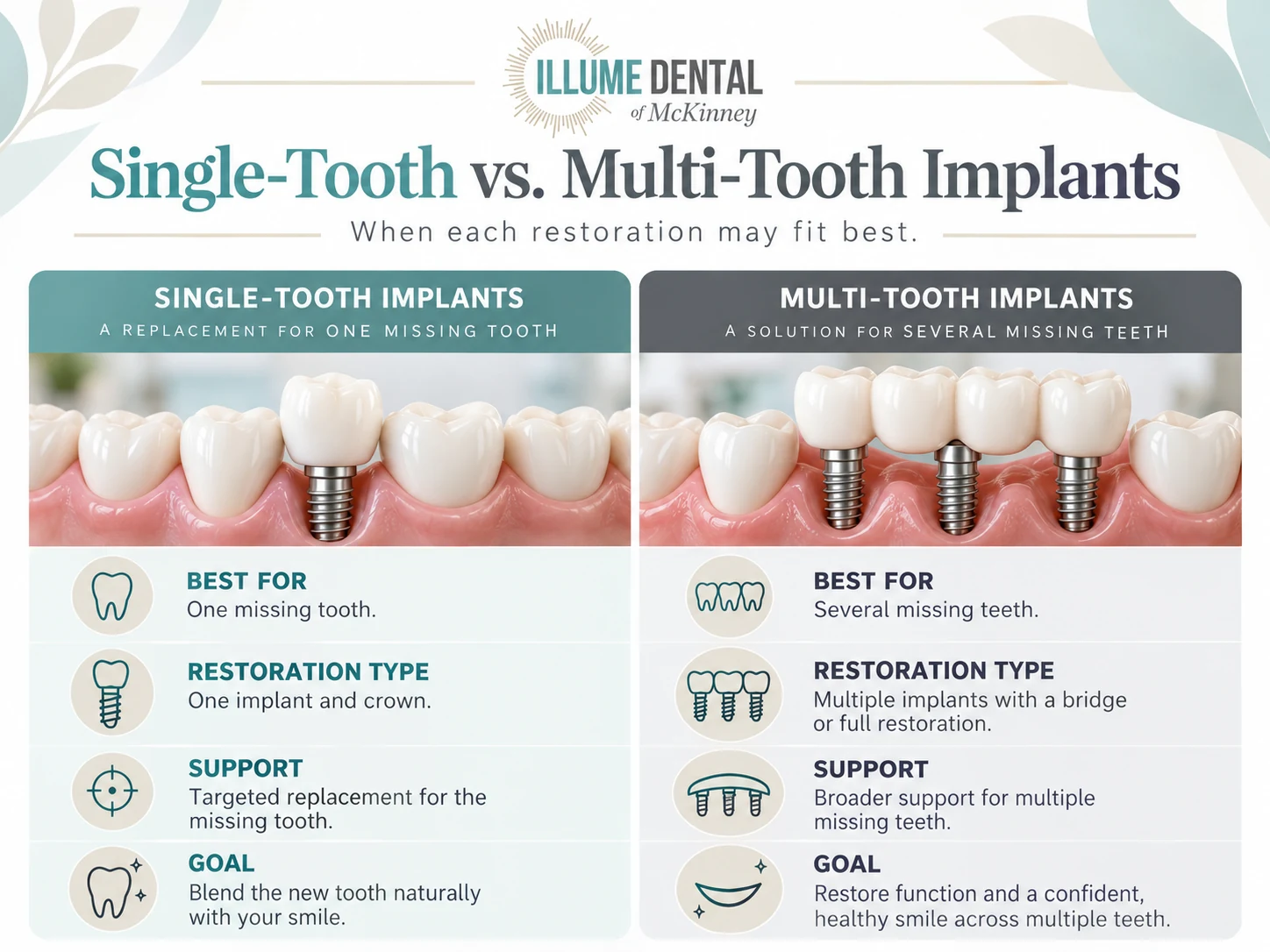
One missing tooth can often be replaced with one dental implant and a crown. Several missing teeth may be replaced with individual implant crowns, an implant-supported bridge, or an implant-supported denture. The appropriate restoration depends on the location of the gaps, available bone, oral health, and treatment goals. Replacing multiple teeth does not necessarily mean placing one implant for every missing tooth.
Key Takeaways
- A single-tooth implant restoration typically includes an implant, an abutment connecting it to the replacement tooth, and a crown.
- Multi-tooth treatment can use implants to support individual crowns, connected replacement teeth, or dentures.
- The number of implants depends on the restoration design and clinical assessment.
- Both approaches require suitable bone support, careful planning, and ongoing maintenance.
What Does This Mean for Patients?
If you have one missing tooth, an implant-supported crown may restore that space without requiring neighboring teeth to be reshaped to support a conventional bridge. However, an implant is not automatically appropriate for every gap. Bone availability, nearby structures, and the condition of your mouth must be assessed first.
For several missing teeth, the arrangement of the gaps matters. Individual implant crowns replace teeth separately, while an implant-supported bridge connects replacement teeth into one restoration supported by implants. Patients missing an entire arch may have fixed or removable implant-supported options.
The goal is to provide appropriate support for the replacement teeth while considering function, appearance, and cleaning access.
How Do the Options Differ?
| Question | Single-Tooth Implant Restoration | Multi-Tooth Implant Restoration |
| What does it replace? | One missing tooth | Several missing teeth or an entire arch |
| What restoration is used? | Usually one crown attached to one implant through an abutment | Individual crowns, an implant-supported bridge, or an implant-supported denture |
| Does every tooth need an implant? | One implant typically supports the replacement crown | Not necessarily; implants can support a restoration containing several replacement teeth |
| Are neighboring teeth used for support? | The implant supports the crown independently | An implant-supported bridge uses implants rather than neighboring natural teeth for support |
| What determines suitability? | Bone and space at the proposed implant site, oral health, and the planned crown | Bone at proposed implant sites, the extent of tooth loss, and the overall restoration design |
| Can the replacement teeth be removed at home? | The crown is generally fixed | Depends on the design; some restorations are fixed, while implant overdentures are removable |
These are different restoration approaches rather than competing treatments for an identical situation. The number and position of implants must be planned around the teeth they will support.
What Should You Expect From Treatment and Recovery?
Both approaches involve placing implants in the jawbone and allowing them to integrate with the surrounding bone, a process called osseointegration. Treatment may also involve tooth removal or bone grafting when necessary.
Healing can take several months or longer. The timeline depends on the procedure, bone healing, overall health, and whether additional treatment is needed. Having fewer implants does not by itself establish a shorter recovery time.
Temporary replacement teeth may be available during treatment, but their suitability and timing depend on clinical conditions. Your dentist should explain when the final restoration can be attached and what eating restrictions apply during healing.
When Should You See a Dentist?
Arrange an evaluation if you have missing teeth, difficulty chewing, or an existing replacement that feels uncomfortable or unstable. Implant planning includes an examination, a review of medical and dental history, and appropriate imaging to assess the proposed treatment sites.
If an existing implant feels loose or painful, contact your dental provider promptly. These symptoms warrant assessment rather than waiting for a routine checkup.
Questions to Ask at Your Visit
- Would individual crowns, an implant-supported bridge, or a denture best fit my situation?
- How many implants are recommended, and why?
- Is bone grafting necessary?
- Will the replacement teeth be fixed or removable?
- What temporary replacement options are available?
- How should I clean around and underneath the restoration?
- What does the complete treatment estimate include?
How Illume Dental Can Help
Illume Dental of McKinney lists both single-tooth dental implants and multi-tooth dental implants among its services. Its multi-tooth treatment information describes an evaluation, necessary X-rays or scans, and a personalized plan covering the restoration, implant number, and timeline.
If you are comparing single tooth vs multiple dental implants, schedule a consultation with Illume Dental to discuss the options for your missing teeth.
Frequently Asked Questions
Does every missing tooth need its own implant?
No. An implant-supported bridge or denture can replace multiple teeth without an implant beneath each replacement tooth. The appropriate number requires individualized planning.
Will I need bone grafting?
Possibly. Grafting may be recommended when the proposed implant sites do not have sufficient bone. It can be necessary for either single-tooth or multi-tooth treatment.
Are implant-supported replacement teeth always permanent and fixed?
No. Some restorations stay fixed in the mouth, while implant overdentures are designed to be removed for cleaning. The implant itself remains in the jawbone.
Do dental implants need ongoing care?
Yes. Daily cleaning and regular dental visits are important. Implants can develop complications, and crowns, bridges, or denture components may need repair or replacement over time.