
Invisalign vs. Simply Clear: Which Is Better for McKinney Adults?
For most adults comparing Invisalign vs. SimplyClear, the real question is not, “Which brand is famous?”
It is: Which clear aligner system can safely move my teeth, fit my budget, work with my schedule, and give me a result I will not regret?
The practical answer:
Invisalign is usually the stronger choice for more complex cases, especially when bite correction, rotations, crowding, spacing, or long-term orthodontic predictability matter. Invisalign has a long track record, proprietary SmartTrack material, ClinCheck digital treatment planning, and treatment options for a wide range of simple to complex cases.
SimplyClear may be a reasonable option for mild to moderate cases, especially for adults who want a dentist-supervised clear aligner option that may cost less than Invisalign. SimplyClear says its aligner system is orthodontist-designed, includes ongoing orthodontist support, and costs “on average 30% less than Invisalign.”
The better choice depends on your teeth, not the logo on the box.
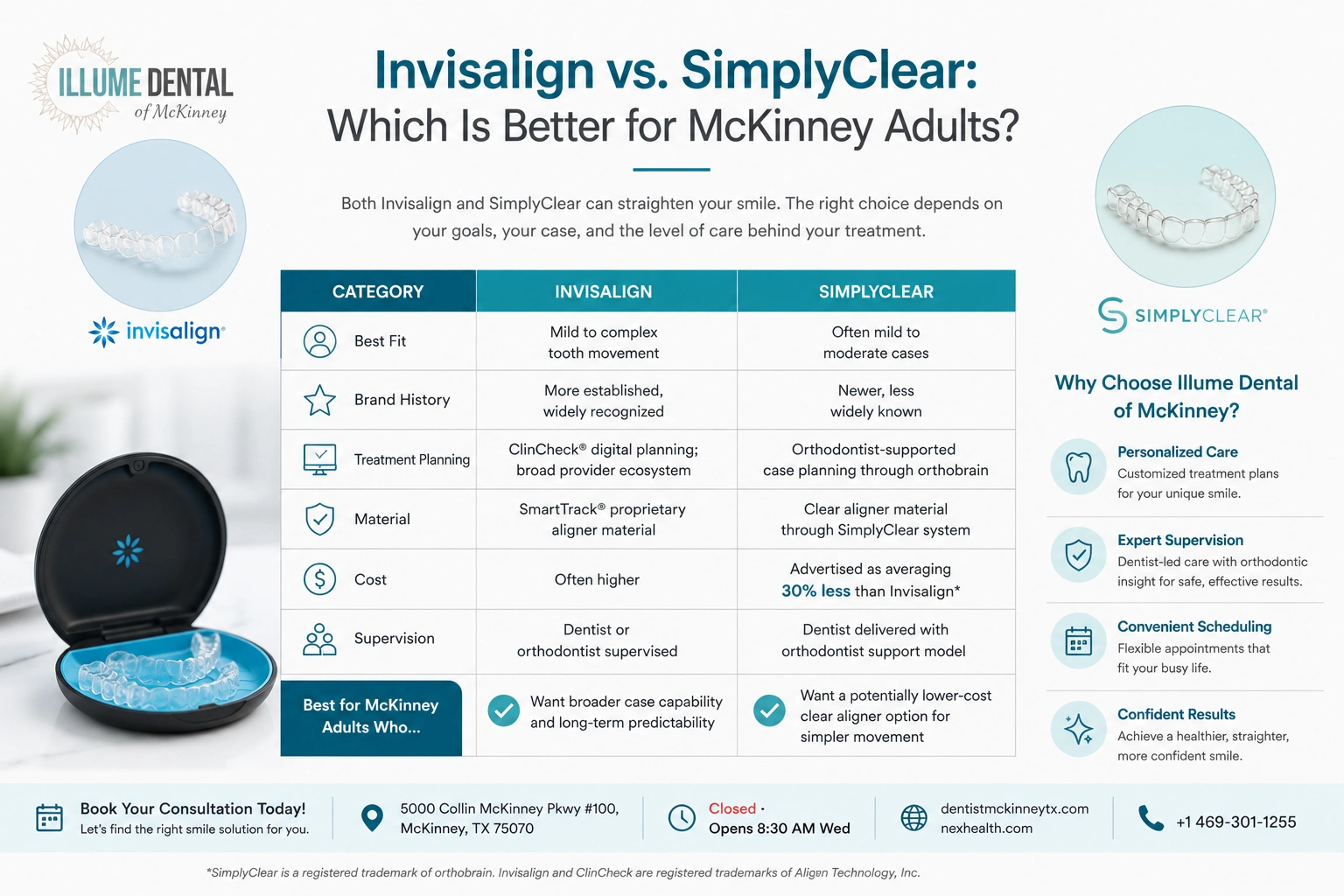
Invisalign vs. SimplyClear: Quick Comparison
| Category | Invisalign | SimplyClear |
| Best fit | Mild to complex tooth movement | Often mild to moderate cases |
| Brand history | More established, widely recognized | Newer, less widely known |
| Treatment planning | ClinCheck digital planning; broad provider ecosystem | Orthodontist-supported case planning through orthobrain |
| Material | SmartTrack proprietary aligner material | Clear aligner material through SimplyClear system |
| Cost | Often higher | Advertised as averaging 30% less than Invisalign |
| Supervision | Dentist or orthodontist supervised | Dentist delivered with orthodontist support model |
| Best for McKinney adults who… | Want broader case capability and long-term predictability | Want a potentially lower-cost clear aligner option for simpler movement |
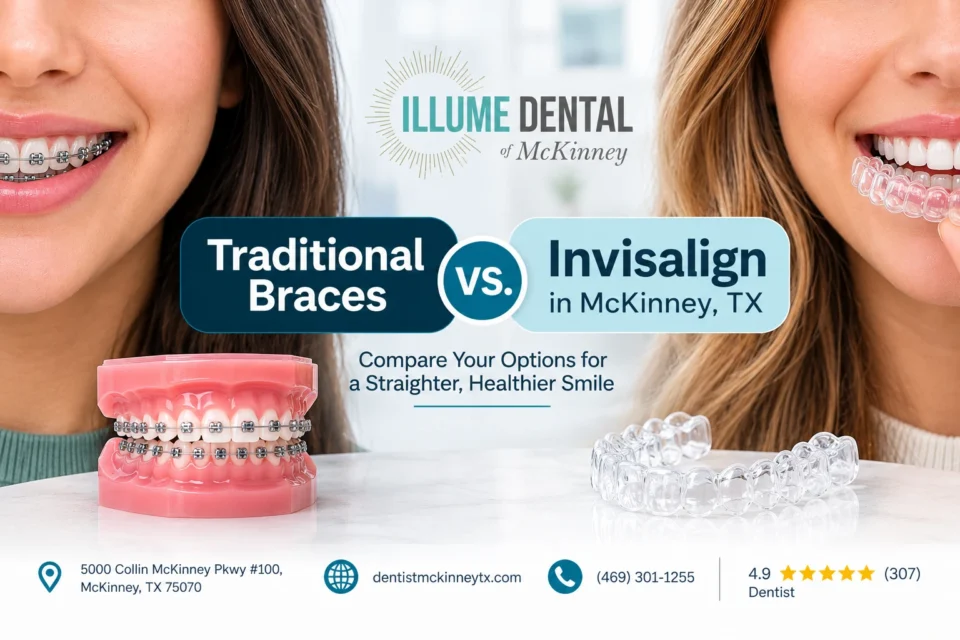
Ready for a straighter smile without metal braces?
Compare Invisalign and Simply Clear with trusted guidance from Illume Dental of McKinney. Call now to find the best clear aligner option for your lifestyle and smile goals.
What Invisalign Does Well
Invisalign is the name most adults recognize, and there is a reason for that. It has been around longer, is used broadly by dentists and orthodontists, and is built around a digital treatment planning system called ClinCheck. Align Technology describes Invisalign as a system using custom-made aligners, proprietary virtual modeling software, manufacturing processes, and patented SmartTrack material. Invisalign treatment can help your smile in several ways.
For adults in McKinney, Invisalign may be a better fit when there is:
- Moderate crowding
- Bite correction needed
- Rotated teeth
- Teeth that need vertical movement
- Previous orthodontic relapse
- A cosmetic plan involving veneers or bonding after alignment
- A need for more detailed staging and attachments
That does not mean Invisalign is perfect. It still depends heavily on diagnosis, treatment planning, patient compliance, and provider experience. A poorly planned Invisalign case is still a poorly planned case.
What SimplyClear Does Well
SimplyClear is a clear aligner system from orthobrain. Its main selling point is that it goes “beyond the plastic” by giving dentists orthodontist-designed treatment planning and support. Orthobrain describes SimplyClear as orthodontist-designed and says the system includes ongoing orthodontist support; SimplyClear’s own site also claims it costs, on average, 30% less than Invisalign.
That can matter for adults who want clear aligners but are trying to avoid overpaying for a brand name when their case is relatively straightforward.
SimplyClear may be worth discussing if you have:
- Mild crowding
- Minor spacing
- Slight orthodontic relapse after braces
- A limited cosmetic alignment goal
- A budget-conscious preference
- A desire for in-office supervision rather than mail-order aligners
The key phrase is worth discussing. It still requires an exam, X-rays, gum evaluation, bite review, and a realistic treatment plan.
Cost: Is SimplyClear Cheaper Than Invisalign?
Often, yes. SimplyClear advertises that it costs on average 30% less than Invisalign.
But patients should be careful with that number.
The total cost of clear aligner treatment depends on:
- Case complexity
- Number of aligners
- Refinements
- Retainers
- Whether attachments are needed
- Whether whitening or cosmetic work follows
- Whether insurance contributes
- How the dental office structures fees
A “cheaper” aligner system may be a good value if it handles your case well. It is not a good value if it under-treats the bite, leaves rotations unfinished, or requires retreatment later.
For McKinney adults, the right cost question is not just, “Which one is cheaper?” It is:
What is included in the fee, and what happens if my teeth do not track as planned?
Safety Matters More Than Brand
Clear aligners are not just cosmetic trays. They move teeth through bone. That means treatment needs diagnosis and supervision.
The American Dental Association has strongly opposed direct-to-consumer dentistry because of the potential for irreversible harm when patients are treated as customers rather than patients.
The American Association of Orthodontists also emphasizes the importance of in-person consultations and orthodontic X-rays for diagnosis and treatment planning.
This is one reason both Invisalign and SimplyClear should be viewed differently from unsupervised mail-order aligners. The brand matters, but the provider matters more.
Before starting any aligner treatment, adults should have:
- X-rays
- Gum health evaluation
- Cavity screening
- Bite evaluation
- Review of crowns, implants, bridges, veneers, or old dental work
- A discussion of limitations and risks
- A retention plan for after treatment
Skipping those steps to save money can backfire.
Which One Works Faster?
Neither system is automatically faster.
Treatment speed depends on:
- How far the teeth need to move
- Whether the bite needs correction
- How many hours per day you wear the aligners
- Whether teeth track properly
- Whether refinements are needed
- How healthy the gums and bone are
Most clear aligners need to be worn about 20–22 hours per day to work predictably. If you only wear them at night or take them out frequently for coffee, snacks, meetings, or travel, treatment can stall.
For busy McKinney professionals, this matters. Clear aligners are convenient, but they are not passive. You have to wear them.
Which Looks Better?
Both Invisalign and SimplyClear are designed to be clear and discreet.
Most adults choose aligners because they want to avoid the appearance of braces at work, on Zoom, in photos, or during client-facing conversations. From a social-distance standpoint, most people will not notice either brand.
What people may notice are:
- Attachments on teeth
- Tooth-colored bumps used to help movement
- Slight speech changes at first
- Removing aligners before meals
- Keeping aligners clean
The final appearance depends less on the aligner brand and more on whether the treatment plan creates the right tooth position, symmetry, bite, and smile balance.
Invisalign May Be Better If…
Invisalign may be the better choice if you:
- Have moderate or complex crowding
- Need bite correction
- Have rotated teeth
- Have had braces before and relapsed significantly
- Want the most established clear aligner brand
- Need a highly customized plan before veneers, bonding, or crowns
- Prefer a system with broad clinical history and digital planning tools
Invisalign is often the safer recommendation when the case is more involved.
SimplyClear May Be Better If…
SimplyClear may be the better choice if you:
- Have mild to moderate alignment concerns
- Want a dentist-supervised alternative to Invisalign
- Are cost-sensitive
- Want orthodontist-supported planning through the provider
- Do not need major bite correction
- Are mainly correcting minor crowding, spacing, or relapse
SimplyClear can be a smart option when the case is appropriate and the dentist is clear about what it can and cannot do.
When Neither May Be the Best Choice
Some adults are not ideal candidates for clear aligners at all.
You may need braces, periodontal care, restorative treatment, or a specialist evaluation first if you have:
- Severe crowding
- Significant bite problems
- Advanced gum disease
- Loose teeth
- Untreated cavities
- Jaw pain or TMJ complications
- Missing teeth affecting the bite
- Dental implants in areas where movement is planned
- Unrealistic expectations about speed or perfection
Clear aligners can do a lot. They cannot override biology.
The McKinney Adult Perspective
Many McKinney adults want straighter teeth, but they do not want treatment to take over their life.
They want to know:
- Will this work with my job?
- Can I speak normally in meetings?
- Can I travel with aligners?
- Will people notice?
- Will this improve my smile before veneers or whitening?
- Is the cost worth it?
- What happens if I am not perfect about wearing them?
These are fair questions. For many adults, Invisalign is easy to fit into your daily life.
Invisalign and SimplyClear can both work well for adults, but only when the treatment plan matches the case and the patient is realistic about compliance.
Questions to Ask Before Choosing Invisalign or SimplyClear
Before you say yes to either option, ask:
- Am I a better candidate for Invisalign, SimplyClear, braces, or no treatment?
- What movements are easy in my case, and what movements are difficult?
- Will this correct my bite or mainly improve appearance?
- Are refinements included?
- Are retainers included?
- What happens if my teeth do not track?
- How often will I be checked?
- Do I need fillings, gum treatment, whitening, bonding, or veneers before or after aligners?
- What is the total cost, not just the starting price?
- What are the risks if I do nothing?
A good dental team should answer these clearly without pressuring you.
Bottom Line: Which Is Better?
Invisalign is usually better for complex or highly customized cases. SimplyClear may be better for simpler cases where cost matters and dentist-supervised treatment is still important.
For McKinney adults, the best choice is the one that fits your biology, bite, budget, timeline, and long-term goals.
Do not choose clear aligners based only on advertising, monthly payment, or brand recognition. Choose based on diagnosis.
If you are unsure whether Invisalign or SimplyClear makes more sense, the safest next step is an exam, X-rays, and a clear explanation of your options. Illume Dental of McKinney, led by Dr. Eileen Chen-Mizuuchi, helps adults compare aligner choices realistically before committing to treatment.
FAQ: Invisalign vs. SimplyClear in McKinney
Is SimplyClear the same as Invisalign?
No. Both are clear aligner systems, but they are different brands with different planning systems, materials, provider workflows, and pricing structures.
Is SimplyClear cheaper than Invisalign?
SimplyClear advertises that it costs on average 30% less than Invisalign. Your actual fee depends on your case, the dental office, refinements, retainers, and treatment length.
Is Invisalign better than SimplyClear?
Invisalign is often better for more complex cases. SimplyClear may be a good option for mild to moderate cases, especially if cost is a major factor.
Can SimplyClear fix bite problems?
It may help with some mild bite concerns, but more complex bite correction may be better suited for Invisalign, braces, or specialist orthodontic care. This requires an exam and X-rays.
Which aligner is better for adults with crowded teeth?
Mild crowding may be treatable with either system. Moderate or complex crowding may favor Invisalign or orthodontic referral, depending on the bite and tooth movement needed.
Do both require retainers?
Yes. Any orthodontic treatment needs retainers afterward. Teeth can shift back if retainers are not worn.
Are clear aligners painful?
They can cause pressure or soreness, especially when switching trays. That is normal. Sharp pain, bite changes, gum problems, or loose teeth should be checked.
Can I drink coffee with Invisalign or SimplyClear?
You should remove aligners for anything other than water. Coffee can stain trays and may increase cavity risk if trapped against the teeth.
Are mail-order aligners the same thing?
No. Dentist-supervised aligner treatment is different from direct-to-consumer aligners. The ADA has warned against direct-to-consumer dentistry because treatment without proper supervision can create risk.
How do I know which option is right for me?
You need an exam, X-rays, bite evaluation, and treatment plan. The right choice depends on your tooth movement needs, gum health, dental history, budget, and expectations.
What do reviews say about SimplyClear?
Reviews of SimplyClear are mixed and vary a lot by provider, since it is offered through participating dental offices rather than sold as a single national brand. Patients often mention the lower cost compared to Invisalign, while some note that more complex cases needed additional treatment or a referral to an orthodontist. Because there is no single SimplyClear storefront with one review profile, the most reliable way to judge fit is asking your specific provider about their own patient outcomes and checking their verified reviews directly, rather than relying on searches for the brand name alone.
Thinking about Invisalign but unsure where to start?
Discover why McKinney adults are choosing Simply Clear and Invisalign for straighter, more confident smiles without the hassle of traditional braces. Schedule your consultation with Illume Dental of McKinney today.