
The ROI of a Smile Makeover: Why McKinney Professionals Are Investing in Their Teeth
For many McKinney professionals, a smile makeover is not really about vanity.
It is about walking into a client meeting without thinking about a chipped front tooth. It is about smiling in a company headshot without retaking the photo ten times. It is about feeling comfortable on Zoom, at networking events, at weddings, and in everyday conversations.
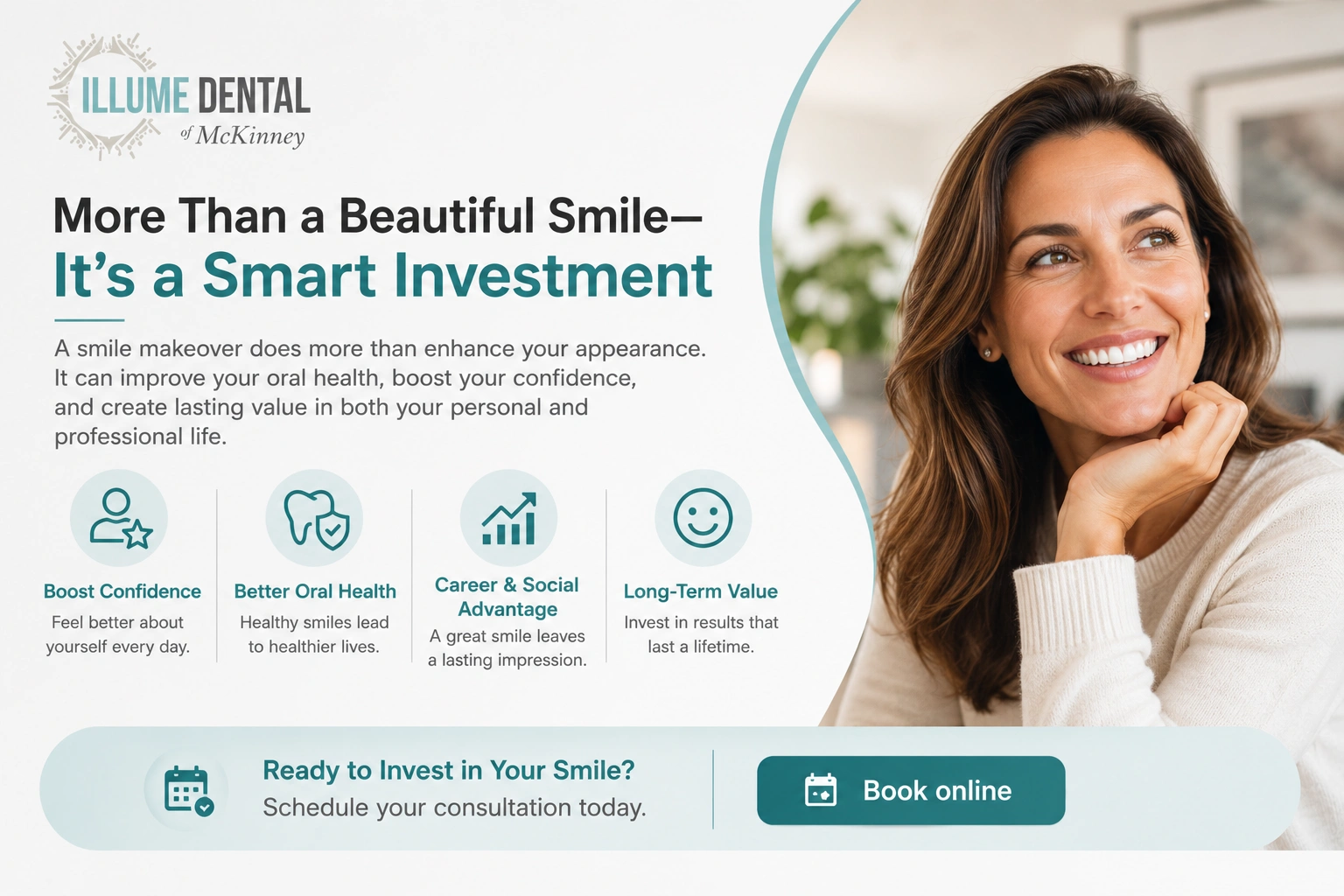
That is the real “ROI” of a smile makeover: confidence, presence, and peace of mind.
A smile makeover will not magically get you a promotion, close a deal, or change your personality. But when done thoughtfully, it can remove a source of self-consciousness that affects how people show up professionally and personally.
For busy professionals in McKinney, Frisco, Allen, Prosper, and the greater North Texas area, that can matter.
Ready to Make Your Smile Pay Off?
Invest in a confident, polished smile with a custom smile makeover in McKinney. Call today to schedule your consultation.
What Is a Smile Makeover?
A smile makeover is a customized cosmetic dental plan designed to improve the appearance of your smile.
It may include one treatment or several, such as:
- Professional teeth whitening
- Porcelain veneers
- Cosmetic bonding
- Invisalign or clear aligner therapy
- Tooth-colored crowns
- Replacement of old dental work
- Gum contouring
- Dental implants or bridges for missing teeth
The right plan depends on what bothers you, what is healthy, what is realistic, and how much tooth structure should be preserved.
A good smile makeover should not make everyone look the same. It should make your smile look healthier, more balanced, and still like you.
Why Professionals Are Paying More Attention to Their Smile
McKinney has a large population of professionals, executives, business owners, salespeople, healthcare workers, educators, and parents who are constantly interacting with others.
And today, your face is visible in more places than ever:
- LinkedIn profiles
- Zoom calls
- Company websites
- Speaking events
- Social media
- Client meetings
- Dating profiles
- Family photos
- Professional headshots
If your teeth make you feel hesitant to smile, that hesitation can show up repeatedly throughout your day.
That does not mean every professional needs veneers. Many do not. But it does explain why more adults are asking serious questions about whitening, Invisalign, bonding, veneers, and full cosmetic smile design.
The Real ROI: Confidence You Actually Use
The biggest return on a smile makeover is not financial in a direct, measurable way.
It is functional confidence.
Patients often describe it in simple terms:
“I do not cover my mouth anymore.”
“I smile in photos now.”
“I feel more polished at work.”
“I finally look the way I feel.”
That may sound small until you realize how often people smile, speak, laugh, present, negotiate, and introduce themselves. With the right cosmetic treatment, you may feel more comfortable when it is time to say cheese with Illume Dental.
If a dental concern is constantly in the back of your mind, fixing it can free up mental space. That is a real quality-of-life improvement.
Professional Presence Matters, But It Should Not Be Oversold
Let’s be blunt: no dentist should promise that a smile makeover will make you more successful.
That would be irresponsible.
But appearance does influence first impressions. In professional settings, people often notice posture, grooming, eye contact, clothing, and smile before they know anything else about your skill or character.
A healthier-looking smile can help you appear more:
- Approachable
- Confident
- Energetic
- Put-together
- Comfortable in conversation
The goal is not to create a fake “perfect” smile. The goal is to make sure your teeth are not distracting from the way you want to present yourself.
Smile Makeover ROI Is Different for Every Patient
For one person, the best investment may be whitening before new headshots.
For another, it may be replacing old stained bonding on the front teeth.
For someone else, Invisalign may be the smarter long-term move before considering veneers.
The highest-value treatment is not always the most expensive treatment. It is the one that solves the right problem with the least unnecessary dentistry.
That is an important distinction.
A patient with healthy teeth and mild staining may not need porcelain veneers. Whitening may be enough.
A patient with worn, chipped, uneven front teeth may benefit more from veneers or crowns.
A patient with crowded teeth may get a better result by straightening first instead of masking the problem with restorations.
A trustworthy cosmetic dentist should be willing to say, “You do not need that,” when a simpler option will work.
Common Smile Concerns for McKinney Professionals
Many adults considering a smile makeover are not looking for a dramatic Hollywood smile. They usually want to fix a few specific things.
Common concerns include:
Yellow or dull teeth. Coffee, tea, wine, aging, and enamel changes can make teeth look darker over time.
Chipped front teeth. Small chips can make a smile look older or less polished. Cosmetic treatment can help you show off a better smile after fixing a chipped tooth.
Crowding or spacing. Minor alignment problems can affect both appearance and cleanability.
Old dental work. Aging crowns, fillings, and bonding may look discolored compared with natural teeth.
Worn teeth. Grinding and clenching can flatten edges and make teeth look shorter.
Uneven smile line. Teeth that are different lengths or shapes can make the smile look unbalanced.
Missing teeth. A missing tooth can affect confidence, chewing, speech, and neighboring teeth.
Each problem has a different solution. That is why cosmetic treatment should start with diagnosis, not a menu of procedures.
How Much Does a Smile Makeover Cost?
Smile makeover costs vary widely because the treatment plan can be very simple or very complex.
A modest cosmetic update may involve whitening and bonding. A more comprehensive makeover may include Invisalign, veneers, crowns, implants, or replacement of older dental work.
General planning ranges may look like this:
| Smile Makeover Option | Typical Cost Range |
| Professional whitening | Lower-cost cosmetic option |
| Cosmetic bonding | Often hundreds to $1,500+ per tooth |
| Invisalign or clear aligners | Often several thousand dollars |
| Porcelain veneers | Commonly $900–$2,500+ per tooth |
| Cosmetic crowns | Often similar to crown pricing per tooth |
| Dental implants | Usually higher investment per missing tooth |
| Full smile makeover | Can range from several thousand to tens of thousands |
The honest answer is that no one can price a smile makeover accurately without seeing your teeth, gums, bite, old dental work, and goals.
A proper consultation should help you understand:
- What is optional
- What is medically necessary
- What can be phased over time
- What your insurance may or may not cover
- What financing options exist
- Which treatment gives the best long-term value
The least expensive plan is not always the best plan. But the most expensive plan is not automatically the best either.
What Makes a Smile Makeover a Good Investment?
A smile makeover is more likely to be worth it when it is:
Planned around your face, not a template. Teeth that are too white, too bulky, or too uniform can look artificial.
Built on healthy gums and teeth. Cosmetic work placed over untreated decay or gum disease is asking for trouble.
Designed with your bite in mind. If you grind, clench, or have bite problems, cosmetic dentistry must account for that.
Conservative when possible. Preserving healthy tooth structure matters.
Realistic about maintenance. Veneers, bonding, crowns, and implants all require care over time.
Aligned with your actual goals. Some patients want subtlety. Some want brighter. Some want major change. The plan should match the person.
Good cosmetic dentistry should make you feel more like yourself, not like you borrowed someone else’s smile.
When a Smile Makeover May Not Be Worth It Yet
Sometimes the smartest move is to wait.
A smile makeover may not be the right first step if you have:
- Active cavities
- Untreated gum disease
- Uncontrolled grinding or clenching
- Severe bite issues
- Unrealistic expectations
- A desire for permanent treatment before exploring simpler options
- Financial pressure that makes the treatment stressful
This is especially true with porcelain veneers. Veneers can be beautiful, but they are not casual dental accessories. They often involve permanent changes to the teeth and will need maintenance or replacement in the future.
If whitening, bonding, or orthodontics can solve the problem more conservatively, those options should be discussed first.
The Career Confidence Factor
Many professionals do not want to admit their teeth bother them.
They may say things like:
“It is not a big deal.”
“I have just learned not to smile with my teeth.”
“I hate my headshot, but it is fine.”
“I notice it more than anyone else probably does.”
Maybe that is true. Maybe other people do not notice as much as you do.
But if you think about your teeth every time you smile, speak, or take a photo, then the concern is costing you something emotionally.
For professionals who are client-facing, public-facing, or frequently photographed, improving the smile can feel like upgrading a part of their personal presentation they use every day.
That is why the ROI can feel high even when it is not easily measured on a spreadsheet.
Smile Makeover Options Ranked by Commitment
Not every smile improvement needs to be major. Here is a practical way to think about treatment intensity.
Lowest Commitment: Whitening
Best for healthy teeth that are generally straight but look dull or stained.
Whitening is often the first step because it is conservative and relatively affordable. It may also help determine whether you really need more treatment.
Moderate Commitment: Bonding
Best for small chips, minor gaps, and slight shape changes.
Bonding is usually less expensive than porcelain veneers but stains and wears faster. It can be a good option for patients who want improvement without a larger investment.
Moderate to Higher Commitment: Invisalign
Best for crowding, spacing, or bite-related cosmetic issues.
Straightening teeth can improve both appearance and cleanability. It may also reduce the need for more aggressive cosmetic dentistry later.
Higher Commitment: Porcelain Veneers
Best for patients who want to improve tooth shape, size, color, symmetry, or worn edges.
Veneers can create a major cosmetic change, but they are a long-term commitment and are usually not reversible.
Higher Commitment: Crowns, Implants, or Full Restorative Work
Best when teeth are damaged, missing, heavily restored, or structurally weak.
These treatments are not just cosmetic. They may improve chewing, stability, and long-term dental function.
Why “Natural” Costs More Than “White”
A bright smile is easy to ask for. A natural-looking bright smile is harder to create.
Natural cosmetic dentistry considers:
- Tooth length
- Tooth shape
- Gum line
- Facial proportions
- Lip movement
- Skin tone
- Translucency
- Bite forces
- How teeth look in motion, not just in photos
This is why smile makeover planning matters. The goal is not simply to make teeth whiter. It is to make the smile look balanced, healthy, and believable.
For many McKinney professionals, the best result is the one where people say, “You look great,” not, “Did you get your teeth done?”
How to Evaluate the ROI Before You Start
Before investing in a smile makeover, ask yourself:
What exactly bothers me about my smile?
Color, shape, chips, crowding, gum line, old dental work, missing teeth, or all of the above?
Is there a simpler option?
Whitening or bonding may solve the issue without veneers.
Will this treatment hold up with my bite?
If you grind or clench, you may need a nightguard or bite management.
How long do I expect the result to last?
Different treatments have different lifespans.
What maintenance will I need?
Cosmetic dentistry still requires cleanings, home care, and occasional repairs or replacement.
Am I doing this for myself?
The best cosmetic treatment decisions usually come from personal confidence, not pressure from someone else.
What to Expect at a Smile Makeover Consultation
A thoughtful smile makeover consultation should not feel like a sales pitch.
It should include:
- A conversation about what you like and dislike
- Photos of your teeth and smile
- Evaluation of your gums and bite
- Review of old fillings, crowns, or dental work
- Discussion of whitening, bonding, veneers, Invisalign, crowns, or implants if appropriate
- Clear explanation of risks and limitations
- A phased plan if doing everything at once is not practical
- Transparent pricing before treatment begins
The dentist should also tell you what not to do. That is often where trust is built.
Bottom Line: Is a Smile Makeover Worth It?
A smile makeover can be worth it when it solves a real concern, fits your budget, protects your long-term dental health, and helps you feel more comfortable in your everyday life.
For McKinney professionals, the return is often less about direct dollars and more about confidence, polish, and not having to think about your teeth every time you speak, smile, or take a photo.
The key is choosing the right treatment—not automatically choosing the biggest one.
If you are unsure whether you need whitening, bonding, Invisalign, veneers, crowns, or something else, the safest next step is a cosmetic consultation. Illume Dental of McKinney, led by Dr. Eileen Chen-Mizuuchi, helps patients understand what is possible, what is realistic, and what is worth doing before they commit to treatment.
FAQ: Smile Makeover ROI for McKinney Professionals
Is a smile makeover actually worth the money?
It can be, but only if the treatment solves a real concern and is planned properly. The value often comes from confidence, comfort in photos, professional presence, and long-term satisfaction—not a guaranteed financial return.
What is the best smile makeover option for professionals?
There is no single best option. Whitening may be best for discoloration. Invisalign may be best for crowding. Bonding may be best for small chips. Veneers may be best for larger cosmetic changes. The best option depends on your teeth and goals.
Do I need veneers for a smile makeover?
Not always. Many patients can improve their smile with whitening, bonding, Invisalign, or replacement of old dental work. Veneers are powerful, but they are not necessary for every cosmetic case.
How much does a smile makeover cost in McKinney?
Costs vary widely. A small cosmetic improvement may cost hundreds to a few thousand dollars. A more involved makeover with veneers, Invisalign, crowns, or implants can cost several thousand to tens of thousands of dollars.
Can I do a smile makeover in phases?
Yes. Many patients phase treatment to manage cost, timing, or priorities. For example, you might whiten first, then replace old bonding, then consider veneers later.
Will a smile makeover look fake?
It should not. Fake-looking results usually come from poor planning, overly white shades, bulky restorations, or ignoring facial balance. Natural-looking cosmetic dentistry is customized to your face and smile.
How long does a smile makeover take?
It depends on the treatment. Whitening may take days to weeks. Bonding can often be completed quickly. Veneers may take several appointments. Invisalign may take months. Implants or full restorative care can take longer.
Is cosmetic dentistry painful?
Most cosmetic dental treatment is manageable with local anesthetic when needed. Some patients experience temporary sensitivity, especially after whitening, veneers, or crown work.
Can a smile makeover help with old crowns or fillings?
Yes. Replacing outdated, stained, mismatched, or worn dental work is often part of a smile makeover. The goal is to improve both appearance and function.
What should I ask before starting?
Ask what treatment is truly necessary, what is optional, how long results should last, what maintenance is required, what risks exist, and whether a more conservative option could work first.
Your Smile Is Part of Your Professional Image
Upgrade your confidence with cosmetic dentistry designed for busy McKinney professionals. Call now to get started.