
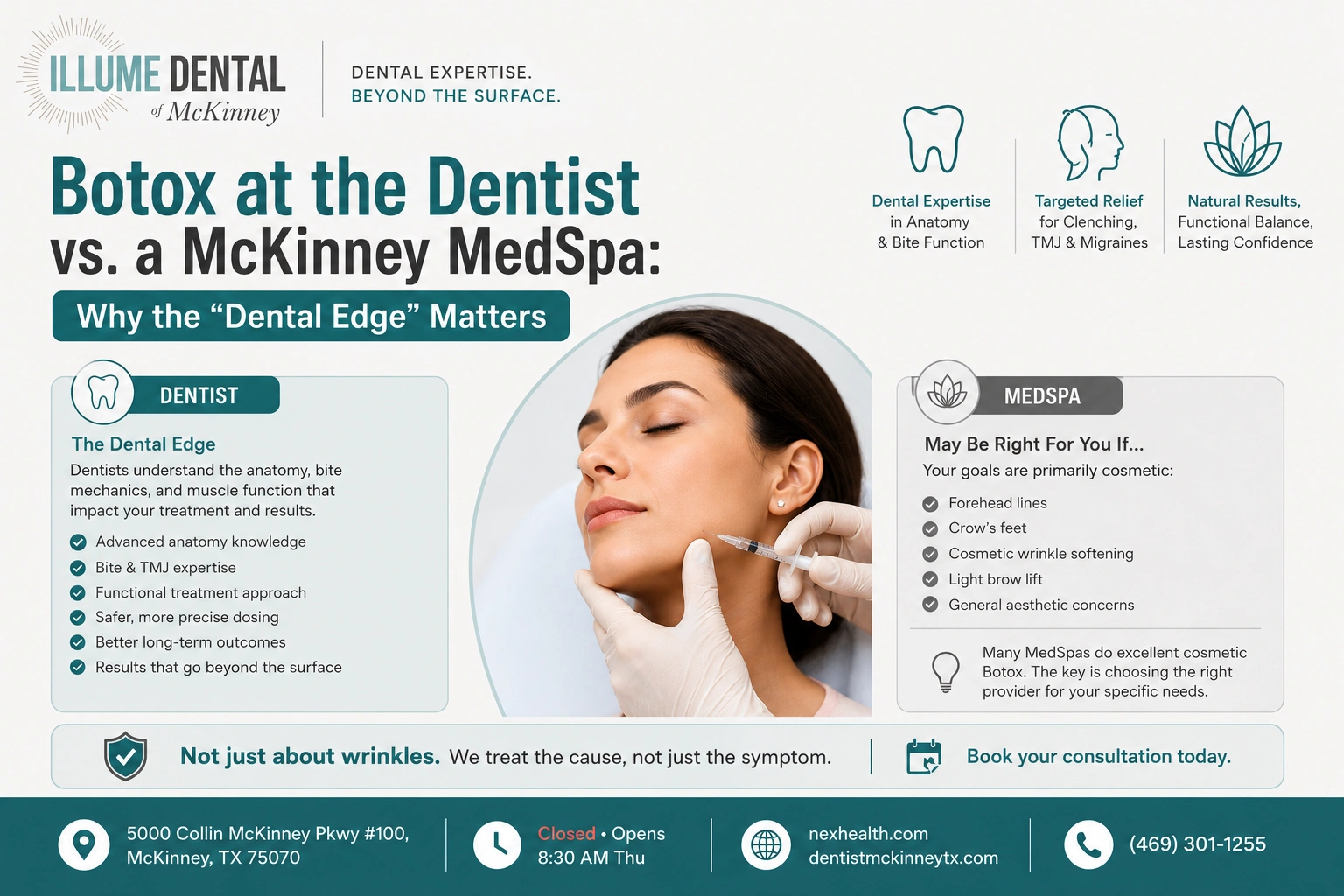
Botox at the Dentist vs. a McKinney MedSpa: Why the “Dental Edge” Matters
Botox is no longer just a cosmetic treatment for forehead lines.
Many patients in McKinney are now getting Botox for:
- jaw clenching
- TMJ discomfort
- facial tension
- migraine-related muscle strain
- gummy smiles
- facial slimming
- and cosmetic wrinkle reduction
But patients often ask an important question:
“Does it really matter whether I get Botox at a dental office or a MedSpa?”
Sometimes, no.
Sometimes, absolutely.
The difference usually comes down to anatomy, diagnosis, and treatment goals not just who can legally inject.
Thinking about Botox in McKinney?
Skip the typical medspa experience and trust a provider who understands facial anatomy, muscle balance, and precision injections at a clinical level. Discover why patients choose the dental advantage for smoother, more natural-looking results.
The Short Answer
If your Botox goals involve:
- jaw pain
- clenching
- TMJ dysfunction
- bite-related muscle tension
- facial asymmetry
- headaches
- or functional muscle problems
A dentist often has a significant anatomical advantage.
Why?
Because dentists spend years studying:
- facial muscles
- jaw mechanics
- bite relationships
- occlusion (how teeth fit together)
- TMJ function
- and muscle patterns related to chewing and facial balance
That background matters when Botox is being used for more than surface-level wrinkle reduction.
Botox Is Not Just About Injecting Wrinkles
A lot of people think Botox is simply:
“Put a few units here and smooth the skin.”
But therapeutic Botox is more nuanced than that.
The masseter muscles the powerful jaw muscles commonly treated for clenching and facial slimming directly affect:
- bite force
- chewing function
- jaw balance
- facial symmetry
- and TMJ loading
Over-treating them can create:
- chewing fatigue
- smile asymmetry
- hollowing of the face
- or changes in facial balance
Under-treating them may do very little.
This is where understanding functional anatomy becomes important.
 If you're weighing traditional braces against clear aligners, you're not alone. It's one of the most common questions we hear…
The “Dental Edge” in TMJ and Clenching Cases
Dentists routinely evaluate:
- muscle tenderness
- tooth wear
- grinding patterns
- bite instability
- cracked teeth
- jaw tracking
- and TMJ stress
That means they are often diagnosing the source of muscle overactivity not just treating the visible symptom.
For example:
A patient may think they want Botox for:
- migraines
- jaw tension
- or facial slimming
But the underlying issue may actually involve:
- nighttime grinding
- an unstable bite
- a cracked tooth
- airway issues
- or stress-related clenching patterns
Botox can help reduce muscle intensity, but understanding why the muscle is overloaded matters too.
When a MedSpa May Be Perfectly Fine
To be fair, many experienced aesthetic injectors do excellent cosmetic Botox work.
If your goals are primarily:
- forehead lines
- crow’s feet
- cosmetic wrinkle softening
- light brow lift
- or purely aesthetic concerns
An experienced MedSpa injector may be completely appropriate.
Some MedSpas also have highly skilled nurse injectors with years of facial aesthetics experience.
The issue is not:
“Dentists good, MedSpas bad.”
The issue is whether the provider understands:
- deeper facial anatomy
- muscle function
- bite mechanics
- and therapeutic treatment planning when the jaw is involved
Those are not always the same thing.
Botox for Clenching Is Not a Permanent Fix
This part matters.
Botox can reduce muscle activity. It does not cure:
- stress
- bruxism habits
- sleep disorders
- airway issues
- bite problems
- or TMJ disease
Some patients experience tremendous relief. Others notice only partial improvement.
Results typically last:
- around 3–4 months for many patients
- sometimes longer with repeat treatment
Maintenance is usually required.
Cost Differences in McKinney
Botox pricing varies widely depending on:
- provider experience
- units used
- treatment area
- product brand
- and whether treatment is cosmetic or therapeutic
Masseter Botox for clenching often requires significantly more units than cosmetic forehead treatment.
That means patients are sometimes surprised by the total cost.
Cheaper pricing is not always better if:
- the injector underdoses
- over-dilutes product
- or lacks anatomical precision
At the same time, expensive pricing alone does not guarantee expertise.
The best question is:
“Does this provider regularly evaluate and treat the exact issue I have?”
Questions to Ask Before Choosing a Provider
Before getting Botox for jaw tension or TMJ-related concerns, ask:
- How often do you treat clenching or masseter hypertrophy?
- How do you determine dosage?
- What are the risks of over-treatment?
- Could my symptoms be related to bite or grinding issues?
- What happens if Botox alone does not solve the problem?
- Will this affect my smile or chewing?
Those answers matter more than Instagram before-and-after photos.
The Bottom Line
Botox is becoming increasingly common in both dental offices and MedSpas across McKinney.
But when treatment involves:
- jaw muscles
- TMJ dysfunction
- clenching
- headaches
- bite force=
- or facial muscle imbalance
The “dental edge” is real.
A dentist trained in facial anatomy and occlusion may be better positioned to evaluate not just where to inject, but why the muscles are overloaded in the first place.
If you are considering Botox for clenching, jaw tension, or TMJ-related symptoms, Illume Dental of McKinney can help you understand whether Botox makes sense, what realistic results look like, and whether there may be underlying dental factors contributing to the problem.
Botox at a Dentist Office Hits Different
When Botox is performed by a dentist, you’re getting treatment from someone who works with facial muscles, symmetry, and aesthetics every single day. Experience precision-focused care designed for confidence and comfort.