
Traditional Braces vs. Invisalign in McKinney, TX
If you’re weighing traditional braces against clear aligners, you’re not alone. It’s one of the most common questions we hear from both teens and adults exploring orthodontic treatment in McKinney, TX.
Both options can create a straighter, healthier smile, but they get there in different ways, and the right choice really depends on your bite, your lifestyle, and your personal preferences. Here’s an honest, side-by-side look to help you think it through.
How Each Option Works
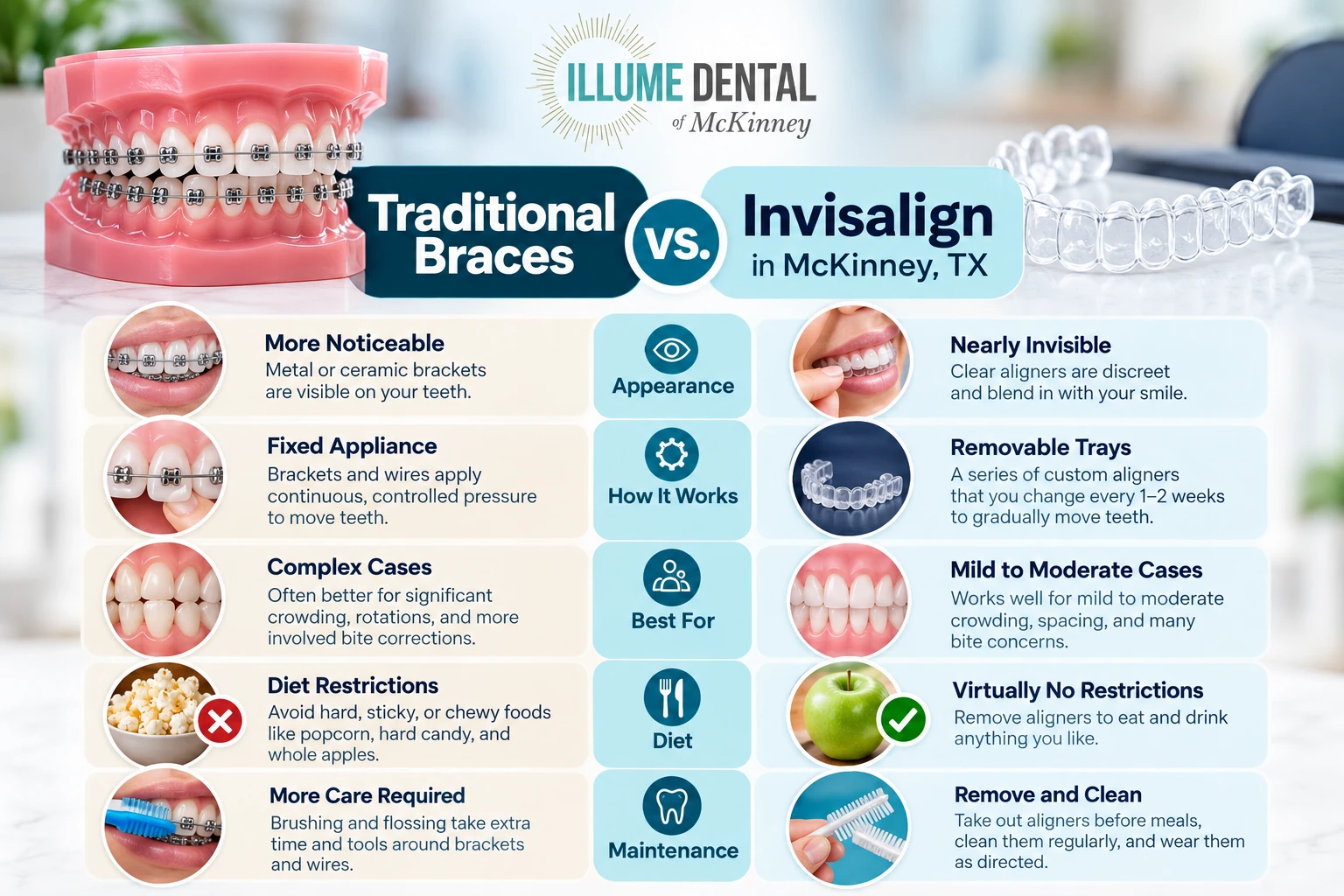
Traditional braces use metal or ceramic brackets bonded to each tooth, connected by an archwire that your dentist gradually adjusts over time to guide teeth into position. Because the brackets are fixed in place, they apply continuous, controllable pressure around the clock, which is part of why braces remain a reliable option for more involved bite corrections.
Clear aligners, by contrast, are a series of custom, removable plastic trays that you swap out every one to two weeks, each one nudging your teeth slightly closer to their final position. Because they’re removable, they offer more flexibility day to day, but that flexibility depends on you wearing them for the recommended number of hours to stay on track.
Candidacy: Which Cases Fit Which Option
Traditional braces tend to have the edge when it comes to more complex bite issues, like significant crowding, teeth that need to be rotated substantially, or bite problems that involve moving teeth vertically as well as side to side. Because the brackets and wire apply constant force, braces can often manage these more involved cases more predictably.
Clear aligners work very well for mild to moderate crowding, spacing issues, and many bite concerns that don’t require complex tooth movement. Your dentist will evaluate your bite, take a look at your specific alignment goals, and let you know honestly which option, or whether both, could work well for your smile.
Appearance and Daily Comfort
This is often the deciding factor for a lot of patients. Clear aligners are nearly invisible and are a popular choice for adults who want to avoid the more noticeable look of metal brackets, especially in professional or social settings. Ceramic braces offer a lower-profile alternative to metal for patients who prefer a fixed appliance but want it to blend in more with their natural tooth color.
In terms of physical comfort, both options can cause some soreness, particularly right after adjustments or when switching to a new aligner tray, as your teeth adjust to new pressure. Traditional braces have brackets and wires that can occasionally irritate the inside of the cheeks or lips, especially early on, while aligners are generally smoother against soft tissue since there’s no metal hardware involved.
Diet and Daily Maintenance
Braces come with some diet restrictions worth taking seriously — sticky, hard, or very chewy foods can bend wires or pop off brackets, so popcorn, hard candy, and whole apples typically need to be off the table or cut into smaller, safer pieces for the duration of treatment. Brushing and flossing also take a bit more care and time with brackets and wires in the way, though modern flossing tools can help.
- Braces: diet restrictions on hard/sticky foods; brushing and flossing require extra tools and attention around brackets
- Aligners: virtually no diet restrictions since trays come out to eat; but they must be removed before every meal and snack, then cleaned before going back in
Aligners remove the food restriction issue almost entirely, since you take them out to eat and drink anything you like. The tradeoff is discipline — trays need to come out for meals and snacks, get cleaned regularly, and go back in for the recommended wear time each day (often close to all day and night) in order to stay on schedule.
Typical Treatment Length
Treatment length varies quite a bit based on how much correction is needed, not just which option you choose, so it’s hard to give a single number for either. In general, mild to moderate cases can sometimes move a bit faster with aligners since adjustments happen every couple of weeks on a predictable schedule, while more complex bite corrections often take longer regardless of the method, and may be better suited to traditional braces in the first place. Your dentist can give you a much more specific estimate once they’ve evaluated your particular bite.
Cost Factors to Consider
Cost for both braces and aligners depends heavily on the complexity of your case, the length of treatment, and the specific materials used; there isn’t a flat number that applies to everyone. Generally speaking, more involved cases requiring longer treatment cost more regardless of which method is used, and features like ceramic brackets or accelerated aligner programs can add to the cost of either option. The best way to get a real, personalized number is a consultation, where your dentist can evaluate your bite and walk you through what’s included.
So, Which One Is Right for You?
There’s no universally “better” option between braces and clear aligners. The right choice comes down to your specific bite, your lifestyle, and what you value most, whether that’s discretion, flexibility, or the reliability of a fixed appliance for a more complex correction. Many patients are genuinely good candidates for either option, in which case the decision often comes down to personal preference.
The best next step is a consultation where your dentist can evaluate your teeth and bite in person and talk through the pros and cons for your specific situation, including a closer look at our clear aligner treatment option if that direction appeals to you.
Ready to explore your options? Call our McKinney office or request an appointment online to schedule an orthodontic consultation with Illume Dental. We’ll help you find the path to a straighter smile that fits your life.