
Why Your Breath Still Smells Under Your Mask: Understanding Oral Biofilm in 2026
You brush twice a day.
You use mouthwash.
You chew gum before meetings.
And yet somehow, when you put on a mask, take a sip of coffee, or breathe into your hand, you’re convinced your breath still smells bad.
If that sounds familiar, you’re not imagining it.
In 2026, one of the biggest shifts in how dentists think about bad breath isn’t just bacteria, it’s biofilm.
And for many patients, biofilm is the hidden reason that brushing alone isn’t solving the problem.
The Short Answer
Bad breath (halitosis) is often caused by bacteria living inside a sticky, organized layer called oral biofilm.
Unlike food debris or temporary morning breath, biofilm continuously produces odor-causing compounds throughout the day.
If the biofilm isn’t disrupted regularly, mouthwash may temporarily mask the smell without addressing the underlying cause.
What Is Biofilm?
Think of biofilm as a bacterial city.
It’s not just individual bacteria floating around your mouth.
Biofilm is a structured community of microorganisms that attach to surfaces such as:
- Teeth
- Gums
- Tongue
- Dental implants
- Crowns
- Dentures
- Orthodontic appliances
These bacteria create a protective matrix that allows them to survive and multiply.
In simple terms:
Plaque is a type of biofilm.
But biofilm can also form in places most people never clean effectively.
Why Bad Breath Often Comes From Your Tongue
When patients complain about persistent bad breath, one of the first places we look is the tongue.
The back portion of the tongue contains thousands of microscopic crevices.
Those crevices trap:
- Dead cells
- Food particles
- Bacteria
As bacteria break down proteins, they release sulfur compounds.
These sulfur compounds are largely responsible for the classic “bad breath” smell.
Many patients brush their teeth carefully but never clean their tongue.
As a result, the source of the odor remains untouched.
The Mask Effect
One unexpected consequence of widespread mask use was that people became much more aware of their own breath.
Before masks, your breath dispersed into the environment.
A mask creates a feedback loop.
You’re essentially re-breathing your own exhaled air, making odors much easier to notice.
Many McKinney patients first discovered they had chronic bad breath because of this effect.
The mask didn’t create the odor.
It revealed it.
Why Mouthwash Often Doesn’t Fix the Problem
Mouthwash can be helpful.
But many patients use it like air freshener.
The smell temporarily improves, but the biofilm remains intact.
Imagine spraying perfume in a room without removing the trash.
The underlying source is still there.
If biofilm is causing the odor, treatment usually requires physically disrupting it through:
- Brushing
- Flossing
- Tongue cleaning
- Professional dental cleanings
Not simply covering it up.
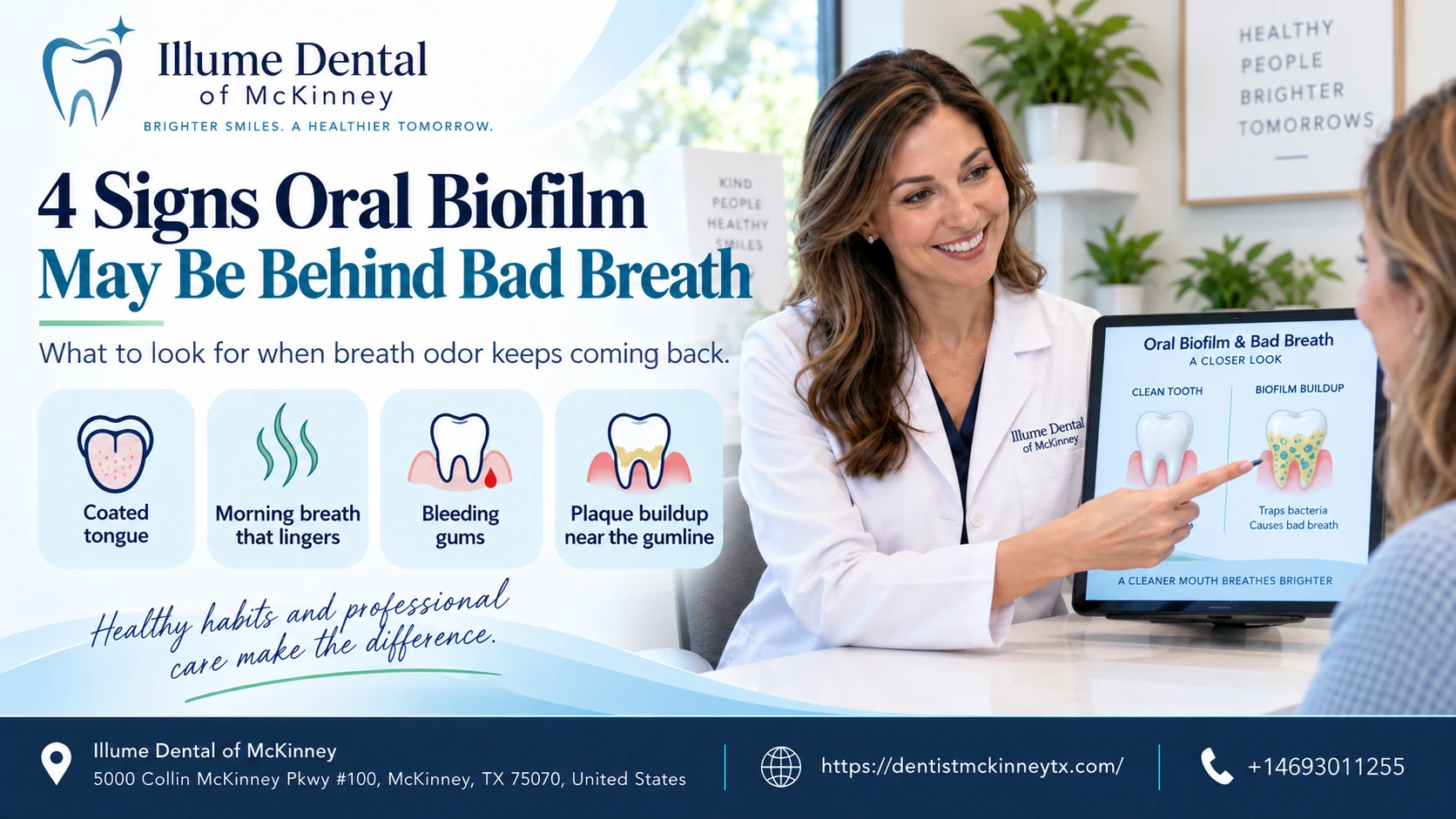
Signs Biofilm May Be Causing Your Bad Breath
You may be dealing with biofilm-related halitosis if:
- Your breath returns quickly after brushing
- You notice a bad taste in your mouth
- Your tongue appears white or coated
- You have bleeding gums
- You haven’t had a professional cleaning recently
- Other people have mentioned your breath
These are clues that bacteria are accumulating somewhere in the mouth.
The Gum Disease Connection
One of the most common causes of chronic bad breath is gum disease.
When bacteria collect beneath the gumline, they create an environment where odor-producing organisms thrive.
Common warning signs include:
- Bleeding while brushing
- Swollen gums
- Receding gums
- Persistent bad breath
- Loose teeth in advanced cases
Many patients focus on the breath itself while missing the underlying periodontal problem.
The Dry Mouth Problem
In North Texas, dry mouth is another major contributor.
Saliva naturally helps control bacterial growth.
When saliva decreases, bacteria gain an advantage.
Common causes include:
- Stress
- Certain medications
- Mouth breathing
- CPAP use
- Dehydration
- Excessive caffeine consumption
Many busy professionals unknowingly create the perfect environment for odor-causing bacteria simply by staying dehydrated throughout the workday.
What Actually Helps?
Clean Your Tongue
A tongue scraper often removes more odor-producing material than mouthwash.
Floss Daily
Many odor-causing bacteria live between teeth where toothbrushes cannot reach.
Stay Hydrated
Saliva is one of your body’s best natural defenses against bad breath.
Get Professional Cleanings
Hardened plaque and tartar cannot be removed effectively at home.
Treat Gum Disease If Present
If periodontal disease is the source, no amount of breath mints will solve the problem.
The New Conversation in 2026
Dentistry is increasingly focused on managing the oral microbiome rather than simply killing bacteria.
Not all bacteria are harmful.
The goal is to reduce harmful biofilm while supporting a healthier balance of microorganisms throughout the mouth.
That’s a more sophisticated and often more successful approach than relying solely on antiseptic rinses.
When Bad Breath Is Not a Dental Problem
Not all bad breath originates in the mouth.
Persistent odor can sometimes be associated with:
- Sinus infections
- Tonsil stones
- Acid reflux
- Certain medical conditions
- Some medications
If your oral health appears healthy but the problem continues, additional evaluation may be warranted.
The Bottom Line
If your breath still smells despite brushing, the problem may not be your toothbrush.
It may be oral biofilm.
Biofilm is a structured bacterial community that can accumulate on teeth, gums, and especially the tongue, producing odor throughout the day. Mouthwash may temporarily improve the smell, but long-term improvement usually requires identifying and disrupting the source.
If you’ve been struggling with persistent bad breath, a professional dental evaluation can help determine whether the issue is related to biofilm buildup, gum disease, dry mouth, or another underlying condition.
At Illume Dental of McKinney, Dr. Eileen Chen-Mizuuchi and the team can evaluate the health of your gums, teeth, and oral microbiome to help identify what’s really causing the problem, not just cover it up.
Frequently Asked Questions
What is oral biofilm?
Biofilm is a structured community of bacteria that adheres to surfaces in the mouth, including teeth, gums, and the tongue.
Is plaque the same as biofilm?
Plaque is one type of oral biofilm, but biofilm can also form in other areas throughout the mouth.
Why does my breath smell even after brushing?
The source may be biofilm on the tongue, gum disease, trapped debris between teeth, or dry mouth rather than the tooth surfaces themselves.
Does mouthwash eliminate biofilm?
Mouthwash can reduce bacterial levels temporarily, but physical disruption through brushing, flossing, and tongue cleaning is usually necessary.
Can bad breath be a sign of gum disease?
Yes. Persistent bad breath is one of the most common symptoms of gum disease and should not be ignored.