
Digital Impressions vs. “Goop” Trays: The Comfort Comparison
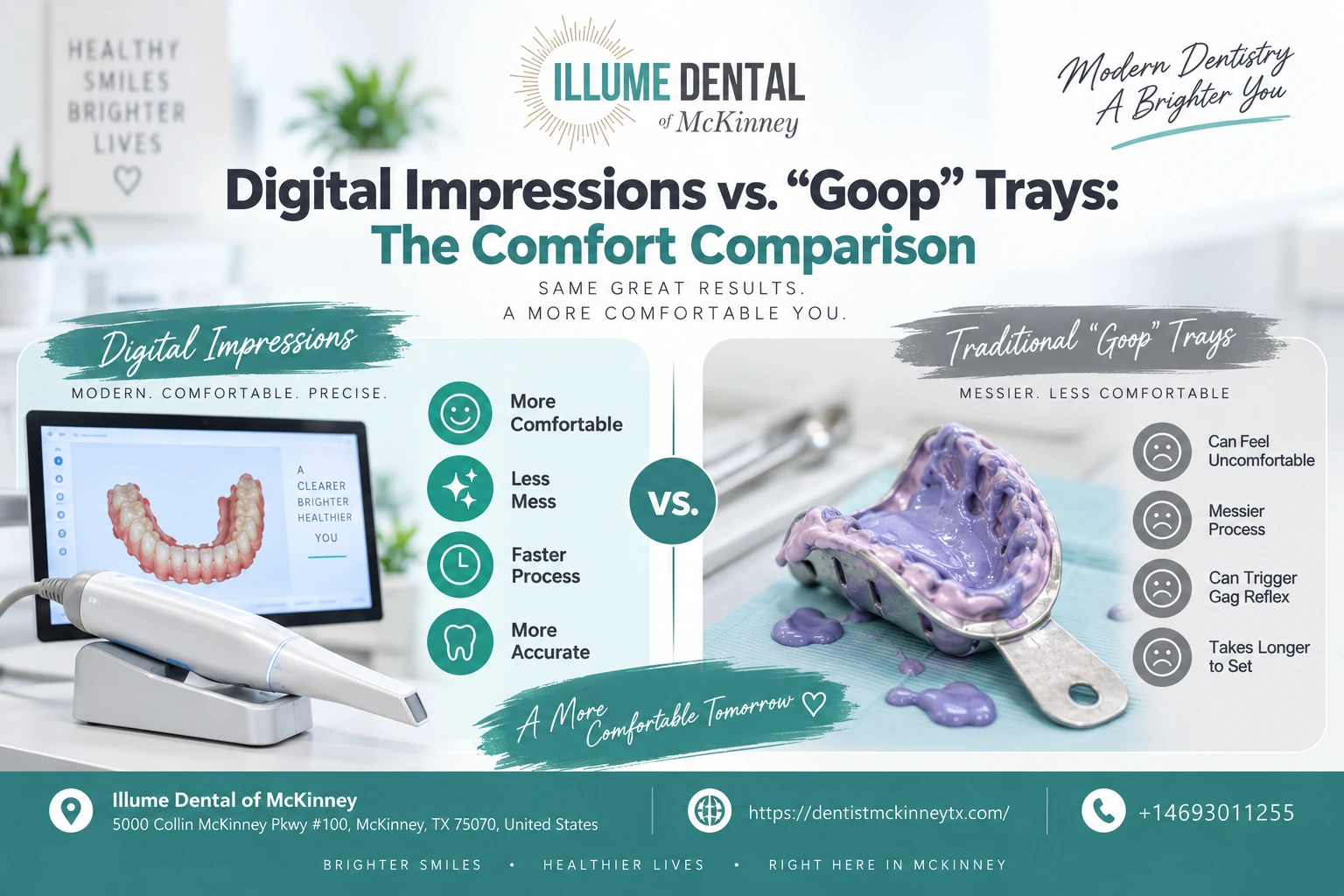
If you have ever had a traditional dental impression, you probably remember the tray.
It goes into your mouth filled with thick impression material that many patients simply call “the goop.” Then you wait while it sets, trying not to gag, swallow awkwardly, or wonder whether the tray will ever come back out.
Digital impressions work differently.
Instead of filling a tray with impression material, the dentist uses a small handheld scanner to capture thousands of images of your teeth and build a three-dimensional model on a computer.
For many patients, especially those with a strong gag reflex or dental anxiety, digital scanning is significantly more comfortable.
But comfort is not the only difference.
Digital impressions can also change how quickly a dentist can evaluate a scan, communicate with a dental lab, and correct an area if something did not capture properly.
Here is what actually matters when comparing the two.
Ready for a More Comfortable Scan?
Ask about digital impressions for a faster, easier dental experience without traditional “goop” trays.
The Short Answer: Which Is More Comfortable?
For most patients, digital impressions win on comfort.
There is no mouthful of impression material.
There is no tray sitting over your teeth while material hardens.
And if the dentist misses a small area, the entire impression usually does not have to be repeated. The scanner can often return to that specific spot and capture the missing information.
That is a meaningful improvement for patients who:
- Gag easily
- Feel claustrophobic with trays in their mouth
- Have trouble breathing comfortably through their nose
- Have dental anxiety
- Have a smaller mouth
- Dislike the taste or texture of impression material
- Need several impressions during restorative or orthodontic treatment
That does not mean digital scanning is completely sensation-free.
You still have an instrument moving around your teeth, cheeks, and tongue. Some areas in the very back of the mouth can still be awkward.
But the experience is generally very different from sitting with a tray full of impression material while waiting for it to set.
What Is a Traditional Dental Impression?
A traditional impression uses a tray filled with a material that begins soft and then sets around your teeth.
Depending on the procedure, dentists may use different types of impression materials.
The purpose is to create an accurate negative reproduction of your teeth and surrounding tissues. That impression can then be used to create a physical model for things such as:
- Crowns
- Bridges
- Dentures
- Nightguards
- Retainers
- Orthodontic treatment
- Implant restorations
- Other dental appliances
Traditional impressions have been used successfully for decades.
They are not inherently outdated or inaccurate.
In skilled hands, high-quality impression materials can produce extremely precise results.
The downside is mostly the patient experience and the number of ways an impression can become distorted before it reaches the dental laboratory.
What Is a Digital Impression?
A digital impression uses an intraoral scanner.
The dentist or dental assistant moves a scanning wand across the teeth while software creates a three-dimensional representation of your mouth.
You can often watch the model appear on the screen in real time.
Instead of placing a physical impression into a box and shipping it to a laboratory, the digital file can often be transmitted electronically.
For the patient, that usually means one very noticeable difference:
No tray full of impression material has to sit in your mouth while it hardens.
Why Do People Gag During Traditional Impressions?
A gag reflex is not something patients should feel embarrassed about.
Some people simply have a much more sensitive reflex than others.
Traditional trays can trigger gagging because they may:
- Extend toward the back of the mouth
- Press against the palate
- Make the mouth feel unusually full
- Allow impression material to move toward the throat
- Create the sensation that swallowing is difficult
Anxiety can make the sensation worse.
The more someone thinks, “I am going to gag,” the harder it can become to relax through the impression.
A digital scanner does not eliminate every possible gag trigger, but it removes the large tray and bulk of impression material.
For many patients, that is the biggest difference.
Digital Scans Can Be Stopped and Started
This advantage does not get discussed enough.
With a traditional impression, timing matters.
Once the impression material is mixed and placed, the dentist generally has to complete the process before it sets.
If the impression is distorted, pulls away incorrectly, contains an important void, or otherwise does not capture what the laboratory needs, the entire impression may have to be repeated.
Digital impressions are more forgiving.
If one section of a tooth did not scan properly, the dentist can often:
- Identify the missing or inaccurate area on the screen.
- Return the scanner to that location.
- Capture the additional information.
- Allow the software to integrate it into the existing scan.
For a patient with a sensitive gag reflex, avoiding a complete second impression can be a very big deal.
Which One Is More Accurate?
This is where the comparison becomes more nuanced.
You may see marketing that suggests digital impressions are always dramatically more accurate than conventional impressions.
That is too simplistic.
Both methods can produce excellent results when they are used correctly.
Accuracy depends on factors such as:
- Which teeth are being scanned or impressed
- The location of the restoration
- Moisture control
- Gum tissue around the tooth
- Blood or saliva near the preparation
- The scanner being used
- The impression material being used
- The clinician’s technique
- The type of restoration being made
- The dental laboratory’s workflow
For many crowns, bridges, implants, aligners, nightguards, and other common procedures, digital impressions can provide excellent accuracy.
There are also clinical situations where a dentist or specialist may prefer a conventional impression.
Technology should support clinical judgment not replace it.
Why Moisture Still Matters With Digital Impressions
Digital scanning gets rid of the impression material.
It does not get rid of the need to see the tooth clearly.
If a dentist is scanning a tooth for a crown, the scanner needs to capture the edge of the tooth preparation accurately.
If that edge is hidden beneath:
- Saliva
- Blood
- Inflamed gum tissue
- Excess moisture
the scanner cannot magically see through it.
This is why dentists may still need to use suction, cotton, retraction cord, or other techniques to temporarily manage the gum tissue around a tooth before scanning.
If you are having a crown made, the quality of the preparation and tissue management can matter just as much as whether the impression is digital.
Digital Does Not Automatically Mean “Perfect Crown”
This is another important distinction.
A digital scanner is a tool.
It does not make every crown fit perfectly simply because a computer was involved.
The final result still depends on:
- How the tooth was prepared
- Whether the margins were captured clearly
- The quality of the scan
- The design of the restoration
- The material chosen
- The dental laboratory or milling process
- The dentist’s final evaluation of the fit
- Your bite
A beautifully scanned poorly prepared tooth is still a poorly prepared tooth.
Likewise, sophisticated technology cannot compensate for uncontrolled bleeding or a crown margin that was never visible to the scanner.
The scanner can improve the workflow, but the clinician still matters.
Is Digital Scanning Faster?
Often, yes but not always in the way patients expect.
The actual scanning process can be relatively quick, particularly when only part of the mouth needs to be captured.
Digital workflows can also eliminate several traditional steps.
There may be no need to:
- Mix impression material
- Wait for it to set
- Remove and inspect the physical impression
- Disinfect it
- Package it
- Ship it to a laboratory
The scan can often be reviewed immediately.
If something is missing, the dentist knows while you are still sitting in the chair.
That can be more important than shaving a few minutes off the appointment.
Can You See Your Teeth on the Screen?
Usually, yes.
This is one of the less obvious benefits of digital scanning.
A 3D model allows patients to see their mouth from angles they normally cannot.
A dentist may be able to show you:
- Worn teeth
- Crowding
- Chips
- Tooth position
- Missing teeth
- Bite relationships
- Areas being restored
That can make treatment conversations easier because you are not being asked to imagine what the dentist sees.
You can often look at it together.
For patients considering Invisalign or restorative dentistry, that visual component can make complicated dental explanations much easier to understand.
When Might Traditional Impressions Still Be Used?
Digital technology has not made conventional impressions useless.
There are situations where a dentist may still choose traditional materials because they are better suited to that particular clinical problem or workflow.
Certain complex restorative, removable, or surgical cases may require techniques that differ from a straightforward crown scan.
Some dental laboratories or appliance manufacturers may also have specific requirements.
And not every dental office has adopted an entirely digital workflow.
That does not automatically mean the dentistry is inferior.
The more useful question is:
Is the impression technique being used appropriate for the treatment I need?
 Biting into a sandwich shouldn't feel like a challenge. But when your teeth are crowded, even everyday things like chewing…
What About Dentures?
Dentures are a good example of why “digital vs. traditional” is not always a simple either-or decision.
Capturing teeth digitally is relatively straightforward.
Capturing movable soft tissues the gums, vestibules, and other areas that influence how a complete denture fits can be more complicated.
Depending on the clinical situation and the dentist’s workflow, denture treatment may use digital scans, conventional impressions, or a combination of both.
If you need dentures, the goal should not simply be “make everything digital.”
The goal is to accurately capture the anatomy required to make the denture comfortable and functional.
What About Invisalign and Clear Aligners?
This is one area where patients often notice the digital difference immediately.
Historically, orthodontic records frequently involved impressions of the upper and lower teeth.
Digital scanners can now capture those arches without traditional trays.
The scan can then become part of the digital planning process for clear aligner treatment.
For an adult considering Invisalign who already dislikes dental impressions, removing the “goop tray” portion of the experience can make treatment feel considerably less intimidating.
What About Crowns?
Digital impressions are particularly useful in crown workflows.
After preparing the tooth, the dentist can scan:
- The prepared tooth
- Nearby teeth
- The opposing teeth
- Your bite
Those digital records can then be used to design the restoration.
In some offices, digital scanning is also combined with in-office milling technology, making certain same-day crown workflows possible.
But again, technology is only one part of the equation.
The best crown is not automatically the crown made with the most computers.
It is the crown that is appropriately designed, fits the tooth well, works with your bite, is made from an appropriate material, and can be maintained predictably.
Are Digital Impressions Better for Dental Anxiety?
They can be.
For someone who has had a bad experience with traditional impressions, simply knowing that a tray will not be filled and held inside the mouth can remove a major source of anxiety.
Digital scanning also gives the dental team more flexibility.
Need a second to swallow?
The scanner can stop.
Need to take a short break?
The scanner can come out.
Have one small section that needs to be repeated?
The dentist may be able to scan just that area.
That sense of control can matter considerably for nervous patients.
Are There Any Downsides to Digital Impressions?
Yes.
No technology is perfect.
Digital scanners are expensive equipment, and their effectiveness still depends heavily on operator training and clinical technique.
Scanning can also become difficult when:
- There is significant bleeding
- Gum tissue blocks the area being captured
- The patient has difficulty opening
- A restoration extends far below the gumline
- Certain soft-tissue anatomy needs to be recorded
- The clinical situation requires an impression technique better handled conventionally
A responsible dental office should be willing to use whichever method is most appropriate rather than choosing a technique simply because it sounds more modern.
Does Digital Scanning Cost More?
Often, patients are not charged a separate “digital impression fee” for routine restorative treatment.
The scan is simply part of the treatment workflow.
However, dental pricing varies by procedure, office, insurance plan, and the type of restoration or appliance being made.
If you are comparing the price of a crown or clear aligner treatment, it usually makes more sense to compare the total treatment cost rather than focusing on whether the impression itself is digital.
A cheaper impression does not necessarily mean cheaper treatment.
And a digital scan does not automatically justify a dramatically higher fee.
Digital vs. Traditional Impressions: The Practical Comparison
| Question | Digital Impression | Traditional Impression |
| Mouth full of impression material? | No | Yes |
| Good for sensitive gag reflexes? | Often easier | Can be challenging |
| Can the dentist stop during the process? | Usually | More limited once material is setting |
| Can one small area be rescanned? | Often yes | Frequently requires another impression |
| Creates an immediate 3D model? | Yes | No |
| Can produce highly accurate results? | Yes | Yes |
| Useful in every dental situation? | No | No |
| Technique still matters? | Absolutely | Absolutely |
Which One Should You Choose?
If both techniques are clinically appropriate, most patients will probably prefer the digital scanner.
The comfort advantage is real.
But do not choose a dentist solely because the website says “digital impressions.”
A better set of questions is:
Will this method accurately capture what you need?
Can you show me what you are seeing?
What happens if part of the scan is unclear?
Is this the best impression technique for my particular treatment?
Those questions tell you much more about the quality of care than the equipment alone.
For McKinney Patients Who Hate Dental Impressions
If your previous dental impression involved gagging through several uncomfortable minutes while someone told you to “just breathe through your nose,” it makes sense that you would not be excited to repeat the experience.
Digital scanning can make restorative and cosmetic dentistry considerably easier for many McKinney patients especially adults with strong gag reflexes, nervous patients, and people who simply dislike the feeling of conventional impression material.
At Illume Dental of McKinney, the point of using digital technology is not to make dentistry sound futuristic.
It is to solve practical problems.
If a digital impression can provide the information needed while making treatment more comfortable and easier to understand, that is a meaningful improvement for the patient.
Frequently Asked Questions
Do digital dental impressions hurt?
Digital scans generally should not hurt. You will feel the scanner moving around your teeth and may feel some pressure against the cheek or tongue, but there is no impression material setting around the teeth.
Will a digital scanner make me gag?
It is still possible, especially when scanning far back in the mouth, but many patients with sensitive gag reflexes find digital scanning easier because there is no large impression tray filled with material.
How long does a digital impression take?
It depends on how much of the mouth needs to be scanned and the complexity of the case. A scan may take only several minutes, although additional time can be needed to manage moisture, gums, or difficult-to-see areas.
Are digital impressions as accurate as regular impressions?
For many common dental procedures, digital impressions can be highly accurate. Conventional impressions can also be extremely accurate. The better method depends on the clinical situation and how well the technique is performed.
Can digital impressions be used for crowns?
Yes. Digital scanning is commonly used to capture teeth for crowns and other fixed restorations.
Can digital impressions be used for Invisalign?
Digital intraoral scans are widely used as part of clear aligner and orthodontic workflows.
Will I ever need the “goop” again?
Possibly.
Digital scanning has replaced conventional impressions in many situations, but traditional materials still have valid uses. A dentist may recommend a conventional impression when it captures the information needed more predictably.
Is a dentist better because they use a digital scanner?
Not automatically.
Technology can improve comfort, communication, and workflow, but it does not replace diagnosis, clinical skill, treatment planning, or careful execution.
The Bottom Line
If you are comparing digital impressions with traditional “goop” trays purely on comfort, digital scanning is usually the easier experience.
No tray full of material.
No waiting for it to harden.
No complete redo just because one small area did not capture correctly.
But the larger advantage is not simply that digital dentistry feels more modern.
It gives the dentist an opportunity to immediately inspect what was captured, correct missing information, and often show you exactly what they are seeing.
If dental impressions have made you gag or avoid treatment in the past, tell your dentist before the appointment. Illume Dental of McKinney can explain whether digital scanning is appropriate for the treatment you need and what the experience will actually be like before anything goes into your mouth.
Skip the Messy Impression Trays
Experience a cleaner, more comfortable digital impression process. Call today to schedule your dental visit.