
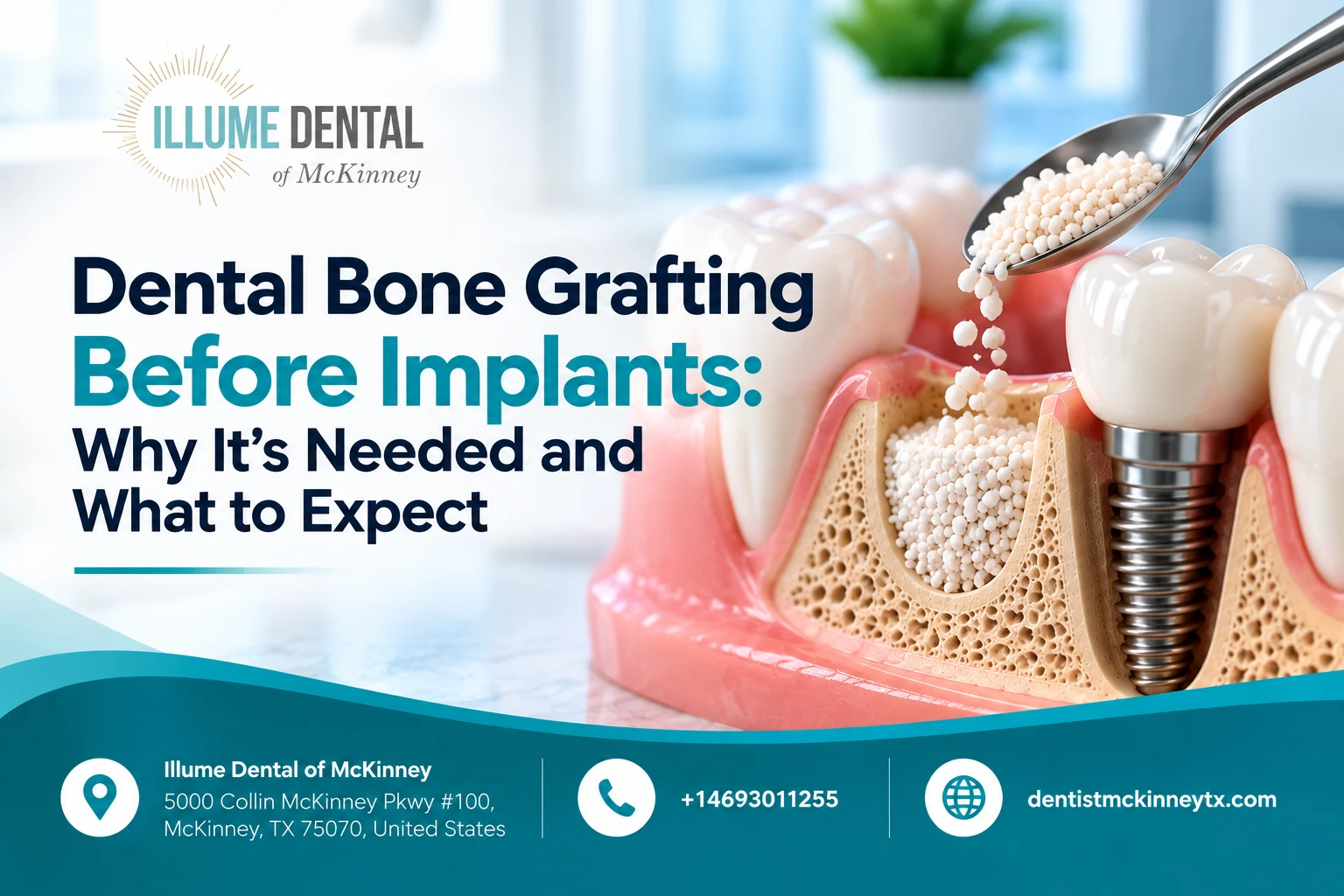
Dental Bone Grafting Before Implants: Why It’s Needed and What to Expect
Dental implants need enough healthy jawbone in the right position to support the implant. If an implant site has lost too much bone, a bone graft may be recommended to preserve or rebuild the area before or sometimes at the same time as implant placement.
Not every dental implant patient needs a bone graft.
The decision depends on the amount and shape of the available bone, where the missing tooth is located, nearby structures such as the maxillary sinus or nerves, the planned implant and final restoration, gum health, and individual medical factors.
Need Bone Grafting Before Implants?
Prepare your smile for a stronger dental implant foundation. Call today to schedule your evaluation.
Key Takeaways
- Not everyone getting a dental implant needs bone grafting.
- Bone grafting may be recommended when there is not enough bone in the correct location to predictably support the planned implant.
- Bone loss can occur after tooth loss and may also be associated with periodontal disease, trauma, developmental conditions, or other defects in the jaw.
- A graft may be performed when a tooth is removed, months or years after tooth loss, or sometimes at the same appointment as implant placement.
- Larger grafts generally require additional healing time before implant placement. Smaller defects may sometimes be grafted when the implant is placed.
- Implant planning should include a clinical examination and appropriate imaging. Current ADA/AAOMR recommendations support CBCT imaging for presurgical dental implant planning and 3-D assessment when bone grafting or reconstruction is anticipated.
Why might you need a bone graft before a dental implant?
A dental implant is placed into the jawbone and depends on that bone for support.
After placement, the implant must heal in close contact with the surrounding bone through a process called osseointegration. Adequate bone volume and appropriate implant positioning are therefore important parts of treatment planning.
Sometimes there simply is not enough bone where the implant needs to go.
That can happen for several reasons.
Bone changes after tooth loss
The bone that previously supported a tooth changes after the tooth is removed. Research shows that the extraction site undergoes dimensional changes during healing, including reductions in ridge width and height.
A procedure called alveolar ridge preservation or socket preservation can be performed around the time of extraction to limit some of these changes. It cannot guarantee that the ridge will remain completely unchanged, but evidence suggests it can help preserve ridge dimensions and may simplify later implant treatment.
Periodontal disease
Advanced periodontal disease can destroy bone around natural teeth. If the affected tooth eventually has to be removed, the implant site may have less supporting bone available.
The American Academy of Periodontology specifically identifies periodontal disease as one possible cause of ridge defects requiring augmentation.
Trauma or an existing jaw defect
Previous injury, developmental abnormalities, infection-related damage, or other defects can leave an area narrower or shorter than needed for the planned implant.
Limited bone below the maxillary sinus
The back of the upper jaw can be particularly challenging because the roots of the upper teeth are located near the maxillary sinus.
When there is insufficient bone height in this area, a procedure called a sinus augmentation or sinus lift may be considered. The procedure creates additional space for graft material below the sinus membrane so adequate bone can develop for implant placement.
Does every implant patient need bone grafting?
No.
If you already have sufficient bone in the appropriate location, there may be no clinical reason to add a graft.
That is why an online checklist cannot tell you whether you need one.
Your dentist or surgical provider needs to evaluate not simply whether bone exists, but whether there is enough bone in the correct three-dimensional position for the implant and planned replacement tooth.
Current ADA/AAOMR recommendations state that CBCT is recommended for presurgical implant planning, including 3-D assessment of bone volume and relevant anatomical structures. CBCT is also recommended when clinical findings indicate that bone reconstruction or grafting may be needed.
What types of bone grafting are used for dental implants?
“Bone graft” is a broad term rather than one single procedure.
What you need depends on when the tooth was lost, how much bone is missing, and where the implant will eventually be placed.
Socket or ridge preservation
This is performed around the time a tooth is extracted.
Graft material is placed in the extraction site to help reduce the amount of ridge shrinkage that normally occurs during healing.
Ridge preservation does not completely stop normal bone remodeling, nor does it guarantee that no additional grafting will ever be needed. A 2024 systematic review found that ridge preservation had favorable short-term effects on ridge dimensions and could reduce the complexity of future implant treatment.
Ridge augmentation
If a tooth has been missing for some time or a larger defect is already present, additional bone may need to be built up in the ridge.
The American Academy of Periodontology describes ridge modification as filling deficient areas with bone or a bone substitute to develop adequate bone for implant treatment.
Sinus augmentation
A sinus lift is used in selected implant sites in the back of the upper jaw when there is insufficient bone between the mouth and the maxillary sinus.
Graft material is placed beneath the elevated sinus lining to create additional bone height for implant placement.
Grafting at the time of implant placement
A separate grafting surgery is not always necessary.
When the defect is suitable and adequate implant stability can be achieved, grafting may sometimes be performed during implant placement. In other situations, the graft needs to heal first and the implant is placed later.
What is the bone graft made from?
There are several categories of graft materials.
Depending on the procedure, graft material may come from:
- your own bone, known as an autogenous or autologous graft
- processed human donor bone
- processed animal-derived material
- synthetic bone-substitute materials
These materials do not all work in exactly the same way, and there is no single graft material that is automatically best for every patient or every defect.
AAOMS notes that graft material can replace missing bone or provide a framework that supports new bone growth. The appropriate material depends on the clinical situation, size and location of the defect, surgical technique, and treatment goals.
A membrane may also be used in some grafting procedures to help protect the grafted area and guide healing.
Can the bone graft and implant be done at the same time?
Sometimes.
This is one of the most important questions to ask because it can significantly change your treatment timeline.
For a relatively small defect, your clinician may be able to place the implant and add graft material during the same procedure.
If the available bone cannot adequately support the implant in the intended position, grafting may need to be completed first. The graft is then allowed to heal before implant placement.
Larger ridge augmentation and sinus augmentation procedures can also require staged treatment, although implants can be placed simultaneously in selected cases.
There is no responsible way to promise the timing without examining the site.
 Biting into a sandwich shouldn't feel like a challenge. But when your teeth are crowded, even everyday things like chewing…
How long does a dental bone graft take to heal?
Expect the answer to be months rather than days when the question is how long the graft needs to develop before the next surgical stage.
The exact timeline varies considerably.
Mayo Clinic notes that some bone grafts require several months to produce enough new bone for implant placement, while smaller grafts may sometimes be completed during implant surgery itself.
The American Academy of Periodontology describes healing periods that can range from several months and reports that some ridge or sinus augmentation cases may be allowed to develop for approximately four to 12 months before implant placement. That is a broad clinical range—not a prediction for every patient.
Healing time can depend on:
- the size of the bone defect
- the type of augmentation performed
- where the graft is located
- the material used
- whether the implant is placed simultaneously
- your overall health and healing capacity
- tobacco use and other individual risk factors
Your clinician should give you a site-specific timeline rather than relying on a generic number found online.
What should you expect after bone grafting?
The experience depends heavily on how extensive the procedure is.
A small socket graft after an extraction is different from a major ridge reconstruction or sinus augmentation.
After oral bone grafting, some discomfort, swelling, bruising, or minor bleeding can occur as the surgical area heals. You will receive instructions covering areas such as oral hygiene, diet, activity, medications, and follow-up care.
The graft itself also continues to remodel long after the initial soreness has improved. Feeling better after several days does not mean the bone has completed the biological healing needed for implant treatment.
Follow the postoperative instructions provided for your specific procedure rather than using a general online recovery schedule.
What are the risks of dental bone grafting?
Bone grafting is an established dental and oral-surgical procedure, but it is still surgery.
Possible complications include:
- infection
- bleeding
- problems with wound healing
- injury to nearby nerves or structures
- failure or inadequate development of the graft
- complications associated with anesthesia or sedation when used
The specific risks vary with the location and extent of the graft.
Tobacco use can interfere with healing, and medical conditions or medications that affect bone healing may also change the treatment plan. These factors should be reviewed before surgery rather than discovered afterward.
Can a bone graft fail?
Yes.
No bone graft should be presented as guaranteed.
Sometimes the graft does not develop enough usable bone, becomes infected, or requires additional treatment before implant placement.
Contact your dental provider if recovery is moving in the wrong direction particularly if pain or swelling is increasing instead of improving, you develop pus or unusual drainage, fever occurs, or you experience numbness or other unexpected symptoms.
Is bone grafting always worth doing?
Not necessarily.
Bone grafting makes sense when the additional bone is needed to achieve the planned implant position or another clearly defined treatment goal.
But implants are not the only way to replace a missing tooth.
Depending on your situation, alternatives can include:
- a traditional dental bridge
- a removable partial denture
- a complete denture
- leaving the space untreated in selected circumstances
There may also be implant designs or treatment approaches that change the amount of grafting required in selected patients.
The important question is not, “Can bone be grafted?”
It is:
“What treatment gives me an appropriate balance of function, predictability, surgery, cost, healing time, and long-term maintenance?”
That conversation should happen before you agree to a graft.
What should be evaluated before you agree to bone grafting?
Your treatment plan should answer several questions clearly.
How much bone is actually missing?
This should come from a clinical examination and appropriate imaging rather than guesswork.
For implant surgery, current ADA/AAOMR consensus recommendations support CBCT for presurgical planning and 3-D evaluation of implant sites, including sites requiring augmentation.
Why does the missing bone matter?
Ask whether the graft is needed for implant stability, correct implant positioning, esthetics, protection of nearby structures, or a combination of factors.
Can the implant be placed without grafting?
Sometimes yes.
If not, your clinician should be able to explain why the alternative implant position or approach would be less appropriate.
Will the graft and implant be performed together or separately?
A staged graft adds another healing period and can affect cost and overall treatment time.
What type of graft material will be used?
Ask what the material is, where it comes from, why it was selected, and whether alternatives are reasonable.
What happens if the graft does not heal as planned?
Understanding the backup plan before treatment is better than learning about it after a complication.
When should you be evaluated for bone grafting?
If you are thinking about replacing a missing tooth with an implant, the evaluation ideally happens before the implant surgery is scheduled.
It can be especially useful to discuss implant plans before a hopeless tooth is removed because ridge-preservation treatment may be considered at the extraction appointment.
That does not mean every extraction needs a bone graft.
A 2024 systematic review found benefits to ridge preservation in appropriate extraction sites, but the available evidence does not support treating every extraction socket exactly the same way.
The decision should be based on what will happen to that site next.
Questions to ask at your implant consultation
- Do I actually need a bone graft for the implant position you are planning?
- How much bone is available now?
- What does my 3-D imaging show?
- Is this ridge preservation, ridge augmentation, a sinus lift, or another procedure?
- Can the implant and graft be placed at the same appointment?
- If not, how long do you expect the graft to heal before implant placement?
- What type of graft material are you recommending and why?
- Are there reasonable alternatives that require less grafting?
- How does grafting change the total treatment timeline?
- What are the most relevant risks in my particular case?
- What happens if the graft does not produce enough bone?
- Who will perform each surgical and restorative stage of my treatment?
How Illume Dental can help
If you are considering a dental implant in McKinney, the first step should be determining what the implant site actually needs not assuming that every missing tooth requires the same sequence of procedures.
Illume Dental of McKinney can evaluate your teeth, gums, bite, existing dental work, health history, and available imaging as part of planning your tooth-replacement options. The practice’s current website also provides patient information about dental implants and bone grafting.
If grafting is being considered, your treatment plan should explain why it is recommended, what type is being proposed, whether it changes the timing of implant placement, and who will complete each stage of treatment before you commit.
Frequently Asked Questions
Does everyone need a bone graft before a dental implant?
No.
Many implant sites already have sufficient bone. Bone grafting is considered when the available bone is inadequate for the planned implant or when augmentation is needed to obtain an appropriate functional or esthetic result.
How does a dentist know whether I need a graft?
The decision is based on your dental and medical history, clinical examination, restorative plan, and imaging.
Current ADA/AAOMR recommendations state that CBCT is recommended for presurgical implant planning and for three-dimensional evaluation when bone grafting or reconstruction is anticipated.
Can I get a bone graft when my tooth is extracted?
Yes, in appropriate cases.
Ridge or socket preservation can be performed at extraction to reduce some of the bone and soft-tissue changes that occur while the site heals. It does not guarantee that additional grafting will never be necessary.
Can the implant be placed at the same time as the bone graft?
Sometimes.
Smaller deficiencies may be grafted at the time of implant placement. Larger defects may require grafting first, followed by several months of healing before implant surgery. The condition of the site determines which approach is appropriate.
How long after a bone graft can I get an implant?
There is no single timeline.
Depending on the type and extent of grafting, healing may take several months. Some larger ridge and sinus augmentation procedures may require considerably longer, while selected minor grafts can be done at the same appointment as implant placement.
Is the graft made from my own bone?
It can be, but it does not have to be.
Dental bone-grafting materials can include bone obtained from your own body, processed human donor material, animal-derived material, and synthetic substitutes. The choice depends on the defect and treatment plan.
Does bone grafting guarantee my implant will succeed?
No.
Bone grafting can create or improve the bone foundation needed for implant treatment, but neither grafting nor implant surgery comes with a guarantee. Healing, medical factors, tobacco use, oral hygiene, implant positioning, and long-term maintenance can all influence the result.
What happens if I do not have enough bone and choose not to graft?
Your options depend on the specific defect.
In some cases another implant strategy may be possible. In others, a bridge or removable prosthesis may be a more appropriate way to replace the missing tooth. The tradeoffs should be discussed before deciding on additional surgery.
Ready to Start Your Implant Journey?
Find out if dental bone grafting is needed before your implant procedure. Call now for a personalized evaluation.