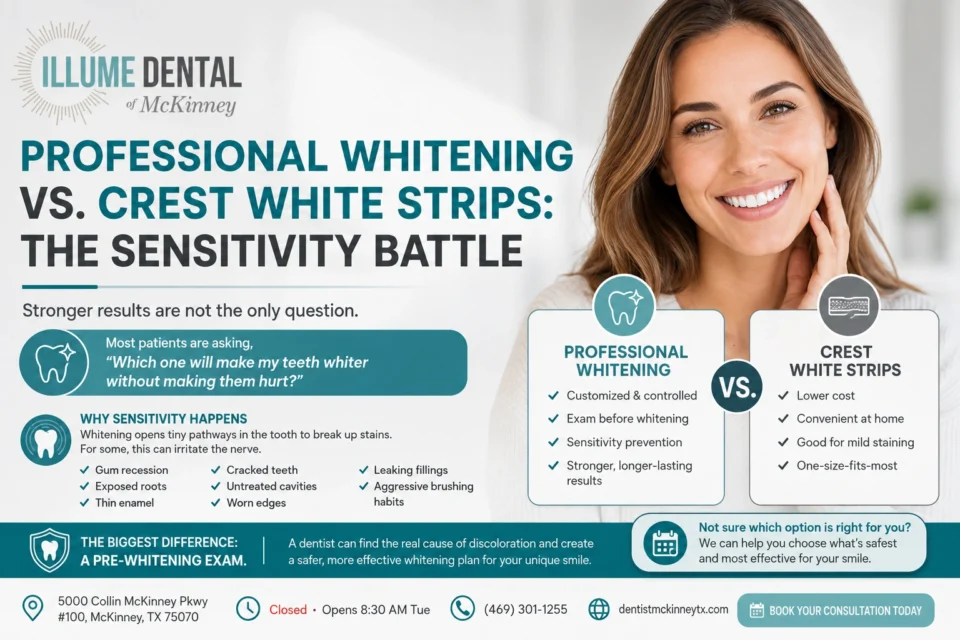

Why Professional Teeth Whitening Is a Better Value Than $100 “Amazon Kits”
Spend $50 to $100 on a teeth-whitening kit online, or roughly $450 on professional whitening at the dentist?
On price alone, the Amazon kit wins.
But that is not the whole comparison.
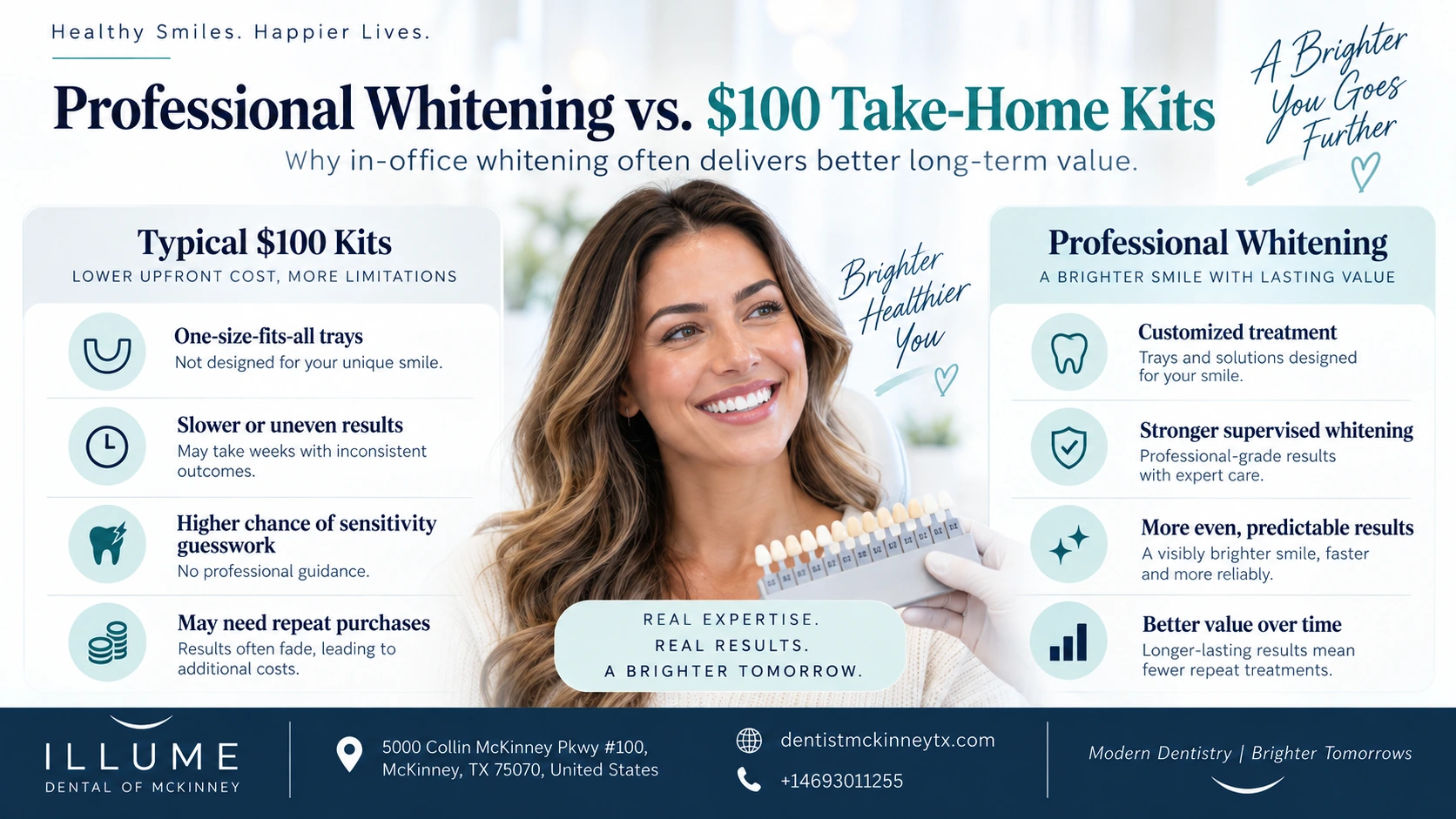
Professional teeth whitening can be the better value when you want a noticeable, predictable result and do not want to spend months experimenting with products that may or may not work for your particular discoloration.
The extra money is not really paying for a fancy blue light.
It is paying for someone to determine:
- why your teeth look dark in the first place;
- whether whitening will actually change them;
- which teeth and restorations will not whiten;
- what bleaching protocol makes sense;
- how to protect your gums;
- how to manage sensitivity; and
- when whitening is the wrong treatment entirely.
That distinction matters.
At Illume Dental of McKinney, the currently published fee for professional teeth whitening is $450. Current U.S. estimates generally put dentist-provided in-office whitening around $400 to $1,000 and professionally supervised take-home systems around $250 to $600.
So is $450 worth paying when you can click “Buy Now” on a whitening kit for a fraction of that?
Sometimes yes.
Sometimes no.
Here is how to tell the difference.
Get a Brighter Smile That Lasts
Skip disappointing $100 whitening kits. Choose professional teeth whitening for safer, more noticeable results.
First: A $100 Amazon Whitening Kit Is Not Necessarily Bad
This is important.
We would not tell patients that every over-the-counter whitening product is ineffective or unsafe simply because it came from Amazon.
Some legitimate consumer whitening products use the same general category of active ingredients used in professional bleaching: hydrogen peroxide or carbamide peroxide.
The American Dental Association notes that over-the-counter whiteners can be effective. Whitening strips, gels, and trays can all lighten teeth when used appropriately.
And many recognizable LED kits do not even cost $100.
For example, a Colgate Optic White ComfortFit LED kit was recently listed around $39 on Amazon, while Auraglow’s complete LED kit currently lists for about $60 directly from the manufacturer. Prices change frequently.
So the argument for professional whitening should never be:
“Cheap kits don’t work.”
Some do.
The better question is:
How confident are you that the product you buy will work on your teeth?
That is where professional care starts earning its higher price.
The $100 vs. $450 Comparison
Using $100 as a simple example:
| What you are buying | $100 OTC whitening kit | $450 professional whitening at Illume |
| Initial cost | $100 | $450 |
| Dental evaluation | No | Dentist-supervised care |
| Determines cause of discoloration | No | Yes |
| Knows which restorations won’t whiten | No | Yes |
| Professional bleaching protocol | No | Yes |
| Gum protection/clinical isolation | Limited by product design | Professionally managed |
| Sensitivity management | Self-managed | Professionally monitored |
| Customized treatment decisions | No | Yes |
| Ability to change the cosmetic plan if whitening won’t work | No | Yes |
The professional option costs $350 more in this example.
The question is whether the additional information, supervision, and predictability are worth $350 to you.
For many cosmetic patients, especially those whitening before photographs, a wedding, veneers, bonding, or another important event, they can be.
Reason #1: You Find Out Whether Whitening Will Work Before Spending Money on It
This is probably the biggest value difference.
Not every dark tooth needs bleach.
Teeth can appear discolored because of:
- coffee, tea, red wine, or tobacco stains;
- natural aging;
- internal discoloration;
- previous dental trauma;
- medications;
- old fillings;
- crowns or veneers;
- decay; or
- changes inside an individual tooth.
Different problems respond differently.
The ADA distinguishes between external and internal discoloration and notes that whitening procedures can address both to varying degrees. But restorations are another issue entirely: tooth-colored fillings, crowns, and veneers do not bleach like natural enamel.
That creates a common DIY whitening disappointment.
Imagine you have six visible front teeth, but one has a porcelain crown.
You whiten the five natural teeth aggressively.
They get brighter.
The crown stays exactly the same color.
You may now notice the crown more than you did before you started.
The whitening technically worked.
Cosmetically, you may like your smile less.
A dental evaluation catches that problem before treatment begins.
Reason #2: Professional Whitening Can Avoid Expensive Trial and Error
A $50 or $100 kit is inexpensive if it gives you the result you wanted.
It becomes less inexpensive when the sequence looks like this:
Kit #1: disappointing result.
Kit #2: different brands.
Whitening strips: another attempt.
Whitening toothpaste: ongoing use.
Sensitivity toothpaste: because now your teeth hurt.
Professional whitening: because you still are not happy.
You could easily narrow much of the original price gap without actually solving the cosmetic problem.
That does not mean everyone who buys an OTC kit ends up spending hundreds of dollars.
Many people get perfectly acceptable results from one inexpensive product.
The point is that low upfront cost and good value are not automatically the same thing.
If you already know you want a significant cosmetic change, figuring out the correct treatment first can be cheaper than experimenting until something works.
Reason #3: Your Gums Matter Too
Bleaching gel works because of its chemistry.
That chemistry does not suddenly know the difference between your tooth and your gum tissue.
The ADA identifies tooth sensitivity and gum irritation as two of the most common adverse effects of whitening. Gum irritation can occur when peroxide-containing gel contacts the tissue, including when trays fit poorly or whitening gel is improperly applied.
Professional whitening allows the clinical team to control where whitening material goes and protect surrounding tissue.
That does not make professional whitening completely sensitivity-free.
It is not.
In fact, stronger whitening protocols can cause temporary sensitivity too.
The advantage is that someone trained to recognize the problem is controlling the process and can modify treatment instead of leaving you to decide whether the burning or sensitivity you are experiencing is normal.
Reason #4: More Peroxide Is Not Automatically Better
This is another area where marketing gets messy.
Consumers sometimes shop for whitening gel the way they shop for horsepower:
Higher percentage = better product.
That is not necessarily true.
The ADA notes that sensitivity can become more common with greater exposure to whitening agents.
And a 2026 umbrella review of professional bleaching research found moderate-certainty evidence that low-to-medium hydrogen peroxide concentrations of roughly 25% to 35% can produce whitening results comparable with higher concentrations while reducing sensitivity.
So the goal should not be to buy the strongest chemical you can find online.
The goal is to use enough bleaching activity to get the desired color change without unnecessarily irritating the teeth and gums.
That balance is part of what professional treatment is supposed to provide.
Reason #5: The Blue LED Light Is Not the Premium Part
This may be the most useful thing to understand before buying any whitening system.
A glowing blue mouthpiece looks impressive.
It photographs well.
It makes a $60 kit look much more technological than a box of whitening strips.
But do not assume the light is doing all the work.
Systematic reviews of clinical whitening studies have repeatedly found that adding light activation to in-office peroxide bleaching often does not produce a meaningful improvement in final tooth color compared with similar bleaching protocols without light.
A newer 2026 umbrella review reached a similar conclusion: light activation generally did not improve whitening effectiveness and may influence sensitivity depending on the protocol.
This does not mean every whitening light is useless in every protocol.
It does mean:
Do not pay extra just because a kit has more LEDs.
Whether you are buying online or whitening at a dental office, the bleaching chemistry and treatment protocol matter more than how futuristic the mouthpiece looks.
Reason #6: Professional Whitening Can Be Faster
One of the strongest arguments for professional whitening is not necessarily that OTC products can never reach a similar shade.
It is speed and control.
The ADA notes that professional whitening can involve concentrated bleaching gels used during an office visit, while at-home products generally rely on lower-concentration peroxide products or longer treatment schedules.
That matters when someone tells us:
“I have engagement photos next week.”
“I have a wedding coming up.”
“I have an important presentation.”
“I want to whiten before we match the shade of my new crown.”
In those situations, spending weeks trying products can be more frustrating than paying for a controlled treatment from the beginning.
If you have no deadline and only want your teeth a little brighter, an OTC option may make much more financial sense.
Reason #7: Whitening Should Sometimes Be Done Before Other Dental Work
This is where inexpensive DIY whitening can create an expensive timing mistake.
Imagine that you need a new crown on a front tooth.
Your dentist matches the porcelain to your current tooth shade.
Two months later, you decide to whiten your natural teeth significantly.
Your natural teeth get lighter.
Your new porcelain crown does not.
Now you have a beautifully made crown that no longer matches the surrounding teeth.
If significant whitening is part of your cosmetic plan, dentists will often want to discuss shade timing before permanent tooth-colored restorations are made.
The same consideration can affect:
- veneers;
- cosmetic bonding;
- visible fillings; and
- crowns.
That planning has real financial value.
It is much cheaper to choose the right shade at the correct stage of treatment than to replace good dental work simply because you later changed the color of everything around it.
So Is Professional Whitening Really 4.5 Times “Better”?
No.
That would be a ridiculous claim.
A $450 whitening treatment is not automatically 4.5 times as white, 4.5 times as long-lasting, or 4.5 times as effective as a $100 kit.
Value does not work that way.
You are paying for a different service.
With an online kit, you are primarily buying whitening material and a delivery system.
With professional whitening, you are paying for whitening plus clinical judgment.
Whether that clinical judgment is worth the additional money depends on your situation.
When the $50–$100 Kit Is Probably the Better Value
Professional whitening is not necessary for everyone.
An OTC product may be the more sensible choice if your teeth and gums are healthy, your staining is relatively mild, you do not have visible restorations complicating the shade, you are not in a hurry, and you are comfortable accepting a more gradual or modest result.
If you go the OTC route, looking for products that carry the ADA Seal of Acceptance is one reasonable way to narrow the field. The ADA notes that qualifying OTC products with its seal have demonstrated safety and effectiveness according to the program’s requirements.
Spending $450 when a $40 box of whitening strips would make you completely happy is not better value.
It is just spending more money.
When Professional Whitening Becomes the Better Value
The professional route makes more sense when the cosmetic stakes are higher.
For example, if you want a substantial change, have an important deadline, have significant sensitivity, have crowns or fillings in your smile, have one tooth that is much darker than the others, have tried whitening products without success, or are planning veneers, crowns, or cosmetic bonding, professional evaluation becomes much more valuable.
The more complicated the starting situation, the less useful a generic whitening kit becomes.
How Much Does Professional Teeth Whitening Cost in McKinney?
Illume Dental of McKinney currently publishes a $450 fee for professional teeth whitening. The practice offers both in-office and at-home whitening options, although your individual treatment recommendation depends on your teeth and goals. Prices are subject to change and patient-specific considerations.
For context, current 2026 U.S. estimates generally put professional in-office whitening around $400 to $1,000, with professionally supervised take-home whitening commonly around $250 to $600.
That places Illume’s published $450 fee within the normal range for professional whitening.
Why Isn’t Teeth Whitening Usually Covered by Insurance?
Because whitening is generally considered cosmetic rather than medically necessary.
That means the cost typically comes directly from the patient.
And that makes the value conversation even more important.
If you are paying with your own money, you deserve to know whether you really need a $450 treatment—or whether a much less expensive product would probably accomplish what you want.
A patient-first dentist should be willing to tell you both.
Before You Spend $100 Online, Ask Yourself These Five Questions
- Are all of the teeth I want whitened natural teeth, or do I have crowns, veneers, bonding, or fillings that will not change color?
- Do I know why my teeth are discolored?
- Am I looking for a small improvement or a significant cosmetic change?
- Have I had problems with tooth sensitivity before?
- Will I be having crowns, veneers, bonding, or other cosmetic dental work soon?
If your answers are straightforward, OTC whitening may be entirely reasonable.
If several of them make you pause, professional whitening becomes easier to justify.
The Bottom Line: You’re Paying for Predictability, Not an LED Light
A $50 to $100 Amazon whitening kit can absolutely be the better deal for someone with healthy teeth, straightforward staining, modest expectations, and enough patience to whiten gradually.
Professional whitening earns its higher price when the situation is more complicated—or when getting the result right the first time matters.
At Illume Dental of McKinney, professional whitening is currently listed at $450. That is several times the price of many consumer kits, so we would not pretend the difference is insignificant.
What the additional money buys is not simply “stronger bleach.”
It buys the opportunity to determine whether whitening is the right treatment before you start, select an appropriate protocol, protect the surrounding tissues, manage sensitivity, account for existing dental restorations, and coordinate whitening with any cosmetic dentistry you may need later.
For the right patient, that makes $450 a better value than repeatedly spending $50 or $100 trying to solve the wrong problem.
For another patient, a reputable OTC whitening product may be all they need.
Knowing which patient you are is where the dentist adds value.
If you are not sure why your teeth are discolored or whether whitening will work on your smile, an exam at Illume Dental of McKinney can help you understand your options before you spend money on either professional treatment or another kit.
Frequently Asked Questions
Is professional teeth whitening actually better than an Amazon kit?
Professional whitening generally provides more clinical supervision, customization, and control. However, legitimate OTC peroxide products can also whiten teeth. The better choice depends on the type of staining, your desired result, sensitivity, existing dental work, and how quickly you want the change.
How much does professional teeth whitening cost at Illume Dental?
Illume Dental of McKinneycurrently lists professional teeth whitening at $450. Prices can change and individual treatment needs vary.
How much do Amazon teeth-whitening kits cost?
Prices vary widely. Many recognizable consumer LED kits currently sell below $100. Recent examples have included the Colgate Optic White ComfortFit LED system around $39 on Amazon and Auraglow’s LED whitening kit around $60 from the manufacturer. Prices and promotions change frequently.
Do LED whitening lights actually make your teeth whiter?
The light itself is not necessarily what produces the result. Peroxide-based bleaching agents perform most of the chemical whitening. Multiple systematic reviews have found that adding light activation often does not significantly improve color change compared with comparable in-office bleaching without light.
Will whitening work on crowns, veneers, or fillings?
Whitening products work on natural teeth but do not bleach tooth-colored restorations in the same way. This can create a shade mismatch if you whiten natural teeth beside visible crowns, veneers, bonding, or fillings.
Does professional whitening cause sensitivity?
It can. Temporary tooth sensitivity is one of the most common side effects of both professional and home whitening. Concentration, exposure time, existing restorations, and individual sensitivity can all influence the experience.
Are stronger whitening gels always better?
No. A 2026 umbrella review found that low-to-medium concentrations of hydrogen peroxide used professionally could achieve comparable whitening to higher concentrations while producing less sensitivity. More powerful chemistry is not automatically a better treatment.
Should I whiten my teeth before getting a crown or veneers?
If you want your overall smile lighter, it is worth discussing whitening before the final shade of visible restorations is selected. Porcelain and composite restorations will not later whiten along with your natural teeth, so treatment sequencing can affect the final color match.
Want Whiter Teeth Without the Guesswork?
Professional whitening delivers controlled, customized treatment that store-bought kits simply can’t match.