
Can I Wear a Night Guard After a Dental Implant?
Yes, many people can wear a night guard after receiving a dental implant, and it may be particularly useful for someone who clenches or grinds their teeth. The American College of Prosthodontists recommends fabrication of an occlusal device to protect implant-borne fixed restorations when clinically indicated. However, the guard needs to fit correctly around the new restoration and work appropriately with the patient’s bite.
An old night guard should not simply be forced into place after an implant crown or other restoration changes the shape of the dental arch. A dentist should check the fit and determine whether the existing appliance can be adjusted or whether a new one should be made.
Key Takeaways
- A night guard may be recommended after dental implant treatment, especially for patients who clench or grind their teeth.
- Bruxism has been associated with a higher risk of implant failure and mechanical complications in implant-supported restorations, although individual risk varies.
- A night guard is primarily used to protect teeth and restorations from excessive forces. It does not necessarily eliminate the underlying grinding or clenching behavior.
- The appliance must fit the current shape of the teeth and implant restoration correctly.
- An existing night guard may need adjustment or replacement after an implant crown, bridge, or full-arch restoration changes the bite.
- There is no universal day after implant surgery when everyone should begin wearing a guard. Timing depends on the surgical site, healing stage, restoration, and instructions from the treating dentist.
Protect Your Dental Implant While You Sleep!
Grinding your teeth at night? Schedule a professional night guard evaluation to protect your dental investment.
What does this mean for patients?
Receiving a dental implant does not automatically mean that a night guard is necessary.
The question becomes more important when a patient already clenches or grinds, shows significant wear on the teeth, has fractured previous restorations, or has an implant-supported restoration that could be exposed to substantial nighttime forces.
Bruxism involves involuntary clenching or grinding that can occur during sleep or while awake. The ADA notes that repeated grinding can damage teeth and that a dentist may recommend a night guard to protect them while the patient sleeps.
Dental implants create a somewhat different mechanical situation from natural teeth because the implant restoration is supported through an implant anchored in bone. Excessive forces can affect prosthetic components such as the crown, abutment, or retaining screw.
Recent systematic reviews have found an association between bruxism and increased mechanical complications in implant-supported restorations. A 2023 systematic review and meta-analysis also found a higher implant-failure risk among patients classified as probable bruxers compared with non-bruxers. These findings support taking bruxism seriously during implant treatment planning and long-term maintenance, although they do not mean that every person who grinds will experience implant failure.
Why might a dentist recommend a night guard after an implant?
To reduce damage from grinding and clenching
A night guard, also called an occlusal splint in some clinical settings, provides a protective surface between the upper and lower teeth.
The American College of Prosthodontists describes occlusal splints as customized appliances used for people who grind their teeth and notes that they can protect the teeth from destructive habits.
For implant patients, the goal is generally to help manage the forces being placed on the teeth and implant-supported restoration rather than claiming that the device completely stops bruxism.
To protect the implant restoration
The visible tooth attached to a dental implant is a prosthetic restoration. Depending on the case, the restoration may include a crown, bridge, or larger implant-supported prosthesis.
Bruxism has been associated particularly with mechanical problems involving implant restorations, including prosthetic fractures and screw-related complications. A 2025 systematic review and meta-analysis reported an increased risk of several mechanical complications among patients with bruxism.
That does not mean a night guard guarantees that those problems will never occur. It is one possible protective measure within a broader maintenance plan.
To protect natural teeth as well
An implant is often surrounded by natural teeth.
Someone who grinds can wear down, crack, or otherwise damage those natural teeth as well as dental restorations. The ADA notes that dentists may recommend a night guard to help protect teeth from grinding-related damage.
A properly designed guard therefore considers the entire bite rather than protecting only the implant crown.
Can you use your old night guard after getting an implant?
Possibly, but it should be checked first.
A night guard is made to fit a specific arrangement of teeth. When an implant crown, bridge, or other restoration is added, the contours of the teeth and the way the upper and lower arches contact each other may change.
The American College of Prosthodontists describes occlusal splints as custom-made appliances based on the patient’s dental relationships and jaw movements.
If an older guard:
- No longer seats completely
- Feels unusually tight over the implant crown
- Rocks or moves
- Creates a new pressure point
- Causes pain
- Changes the way the teeth meet
- Requires force to put on or remove
stop using it and have the dentist examine it.
Do not force a poorly fitting appliance over a new implant restoration.
In some cases, a dentist may be able to adjust the existing night guard. In others, making a new appliance after the definitive restoration is placed may provide a more accurate fit.
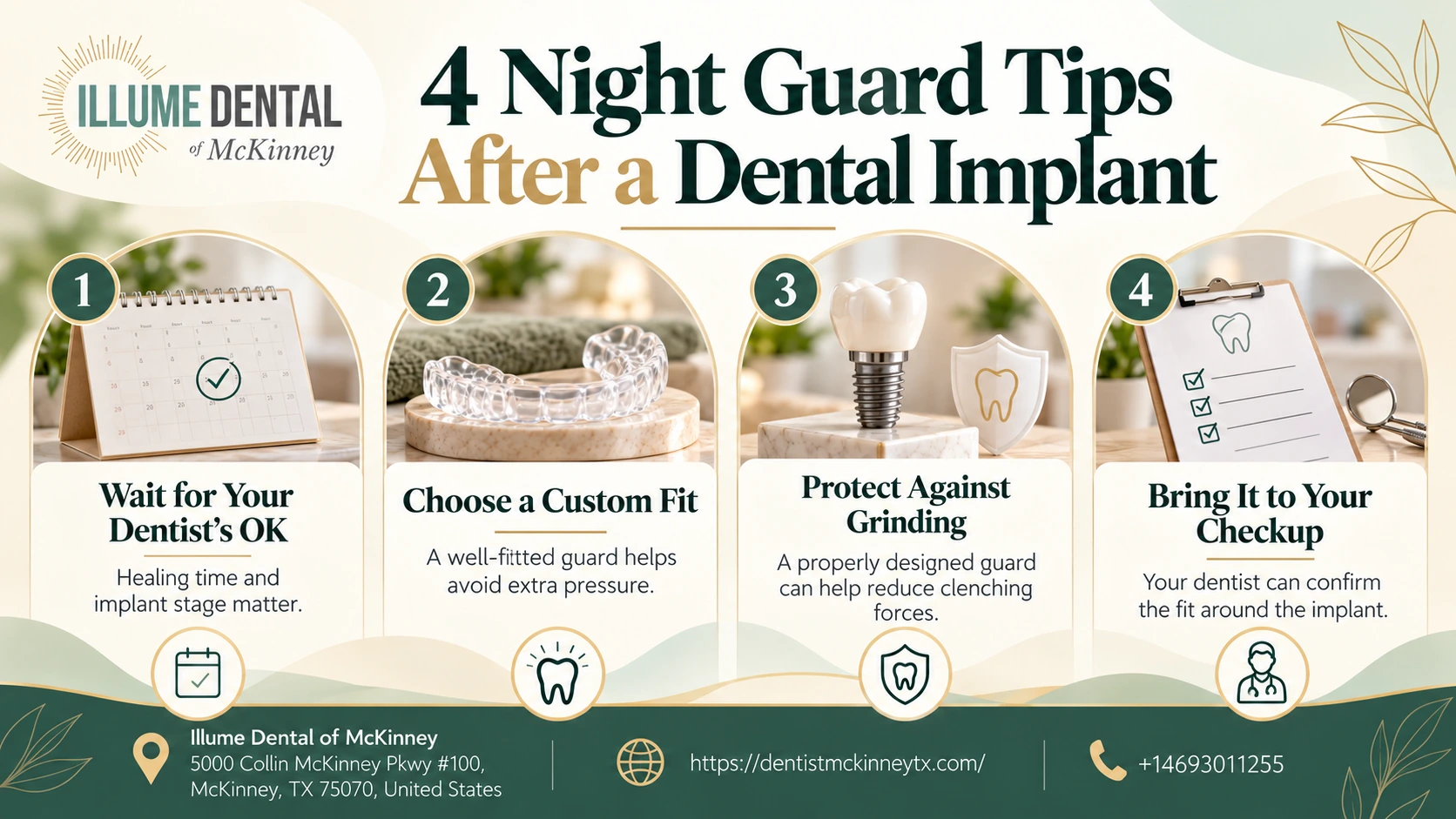
When can you start wearing a night guard after implant surgery?
There is no universal timeline that applies to every implant patient.
Dental implant treatment occurs in stages. Immediately after surgical placement, the patient may have healing gum tissue, sutures, a healing abutment, a temporary restoration, or another configuration depending on the procedure.
A night guard should not place unwanted pressure on a fresh surgical area or interfere with postoperative healing.
Illume Dental’s published night-guard instructions emphasize that the appliance should fit comfortably without creating pressure points and that patients should follow individualized instructions about when and how to wear it.
Therefore, after implant surgery:
- Follow the implant surgeon or dentist’s postoperative instructions.
- Do not assume that a pre-existing night guard is safe to wear immediately.
- Ask whether the appliance clears the surgical site and healing components.
- Have the guard reassessed after the implant crown or final restoration is placed.
Someone receiving only an implant crown after the implant has already healed may have a very different timeline from someone who has just undergone implant surgery, bone grafting, or full-arch reconstruction.
Does a night guard prevent dental implant failure?
It should not be described that way.
A night guard can be used to manage excessive occlusal forces and protect restorations, but implant success depends on many factors, including implant position, bone conditions, healing, oral hygiene, smoking or tobacco exposure, periodontal history, systemic health, restorative design, and long-term maintenance.
Research does show an association between bruxism and implant complications. For example, a 2023 systematic review and meta-analysis found that implants in patients classified as probable bruxers had a higher risk of failure than implants in non-bruxers.
A more recent systematic review also found increased mechanical complication rates involving implant-supported prostheses in people with bruxism.
These studies support managing grinding forces, but they do not prove that wearing a night guard will prevent every implant complication.
The American College of Prosthodontists therefore uses appropriately qualified language, recommending an occlusal device to protect implant-borne fixed restorations when indicated.
What type of night guard is appropriate after an implant?
The appropriate design depends on the patient’s bite, remaining natural teeth, implant position, restoration type, and grinding pattern.
For people who grind their teeth, the ADA notes that dentists may recommend a night guard and that a custom-made appliance provides a close, comfortable fit.
The American College of Prosthodontists similarly describes occlusal splints as individually designed devices based on detailed dental records and jaw relationships.
This is particularly relevant after implant treatment because the dentist may need to consider:
- Whether the implant supports a single crown, bridge, or full arch
- Where the strongest bite contacts occur
- Which teeth or restorations oppose the implant
- Evidence of grinding-related wear
- Previous fractures or restoration failures
- Jaw movement and bite relationships
- The condition of the remaining natural teeth
There is no single night-guard material or design that is automatically appropriate for every implant patient.
How should you care for a night guard after implant treatment?
A night guard also needs ongoing maintenance.
The American College of Prosthodontists recommends that patients with occlusal devices wear them as directed during sleep and clean them before and after use using an appropriate cleaning method.
Illume Dental advises patients to monitor their night guards for wear, cracks, or changes in fit and to contact the dental office when a guard becomes uncomfortable or no longer fits properly.
Practical care includes:
- Clean the appliance according to your dentist’s instructions.
- Store it in its protective case when it is not being worn.
- Avoid exposing a thermoplastic appliance to excessive heat unless its manufacturer specifically permits it.
- Check periodically for cracks, thinning, rough surfaces, or other damage.
- Bring the night guard to dental appointments when requested so its fit can be checked.
- Have it reassessed after substantial restorative dental work.
A guard that fitted correctly before an implant crown was placed may not continue fitting correctly afterward.
When should you see a dentist?
Schedule an evaluation if:
- Your night guard no longer fits after implant treatment.
- You have to force the guard over the implant crown.
- The implant restoration feels different when you bite.
- A crown or bridge feels loose.
- The guard repeatedly cracks or wears through.
- You develop new jaw pain or significant tooth sensitivity.
- You notice chipped or fractured restorative material.
- You suspect that nighttime grinding has become more severe.
A loose implant restoration should also be professionally evaluated rather than ignored.
Routine implant maintenance remains important even when everything feels comfortable. The American College of Prosthodontists emphasizes ongoing professional maintenance for implant-supported restorations because mechanical and biological complications can develop over time.
Questions to ask at your visit
- Do I show signs of grinding or clenching?
- Would a night guard be useful for protecting my implant restoration?
- Can I continue wearing my current guard?
- Does my existing guard need to be adjusted or replaced?
- When can I safely resume wearing it after implant surgery?
- Should a new night guard be made after my final implant crown is placed?
- Does the guard distribute my bite appropriately?
- What signs of wear should I watch for?
- How should I clean and store the appliance?
- How often should my implant restoration and night guard be checked?
How Illume Dental can help
Illume Dental of McKinney provides both dental implant treatment and dental night guards. Its published implant services include implant placement and implant-supported tooth replacement, while its night-guard instructions emphasize proper fit, monitoring for wear, and professional adjustment when the appliance becomes uncomfortable or changes fit.
For someone who already wears a night guard, an examination after implant treatment can determine whether the appliance still seats correctly and whether changes to the bite or implant restoration require adjustment or replacement.
For someone who does not currently use a guard but has signs of clenching or grinding, the dentist can evaluate the pattern of wear, existing restorations, implant restoration, and bite before deciding whether an occlusal appliance is appropriate.
A night guard should therefore be considered part of an individualized maintenance plan rather than an automatic requirement for every dental implant patient.
Frequently Asked Questions
Can I wear my night guard immediately after dental implant surgery?
Not necessarily. Implant procedures vary, and a guard that contacts the surgical site, sutures, healing abutment, or temporary restoration may need to be avoided or adjusted. Follow the specific instructions of the dentist or surgeon who placed the implant. Illume Dental’s night-guard instructions similarly emphasize individualized timing and proper fit.
Do I need a night guard if I have a dental implant?
Not everyone does. A night guard may be particularly useful when there is evidence of bruxism, substantial clenching, previous restoration damage, or another reason to control excessive bite forces. The American College of Prosthodontists recommends an occlusal device to protect implant-borne fixed restorations when clinically indicated.
Can grinding damage a dental implant?
Bruxism has been associated with an increased risk of mechanical complications in implant-supported restorations and, in recent systematic reviews, with increased implant failure risk. This does not mean that grinding automatically causes an implant to fail, but it is an important factor for the dentist to consider.
Does a night guard stop teeth grinding?
A night guard is mainly used to protect the teeth and restorations and manage the effects of grinding. The American College of Prosthodontists notes that there is no simple cure for bruxism but that a splint can protect the teeth from destructive forces.
Will I need a new night guard after getting an implant crown?
Possibly. Because the new crown changes the shape of the dental arch and may affect bite contacts, an existing guard should be checked after the restoration is placed. If it no longer fits correctly, the dentist may adjust it or recommend fabrication of a new appliance.
Can I force my old night guard over my new implant crown?
No. A guard that requires force to seat, produces pressure around the implant restoration, or no longer fits completely should be evaluated before further use. Occlusal splints are intended to be fitted to an individual’s current dental anatomy and bite.
Can You Wear a Night Guard After Dental Implants?
Protect your new smile with expert guidance. Call now to ensure your night guard fits safely and comfortably.