The “Dry Socket” Nightmare: How to Avoid It After a 75070-Area Extraction
If you are having a tooth pulled in McKinney, you have probably heard at least one dry-socket horror story.
The good news: dry socket is not an inevitable part of having a tooth extracted. Most extraction sites heal normally. Your job during the first few days is surprisingly simple—protect the blood clot that forms in the empty socket and follow the specific instructions your dentist gives you.
That clot matters because it covers the underlying bone and nerves while new tissue begins to form. When the clot breaks down or becomes dislodged too early, the bone can become exposed. That painful complication is called alveolar osteitis, better known as dry socket.
Here is what patients around McKinney’s 75070 area should know before heading home after an extraction.
First: How Common Is Dry Socket?
It depends heavily on which tooth was removed and how difficult the extraction was.
A Cochrane review reported dry socket rates of roughly 1% to 5% after routine extractions, while rates can be considerably higher after surgically removing certain third molars, particularly lower wisdom teeth.
So having a simple tooth removed does not mean you should spend the next week worrying that every ache is dry socket.
Some soreness, swelling, tenderness, and even a mild blood taste can be completely normal after an extraction.
The pattern that gets a dentist’s attention is usually different: pain that becomes severe or suddenly worsens within the days following the extraction rather than gradually improving.
What Does Dry Socket Actually Feel Like?
Patients sometimes assume that any post-extraction pain means something went wrong. Usually, it doesn’t.
Normal healing discomfort should generally become more manageable as recovery progresses.
Dry socket is more likely to cause:
- Significant or worsening pain a few days after the extraction
- Pain that travels toward the ear, temple, eye, neck, or jaw on the same side
- An unpleasant taste or odor
- A socket that appears unusually empty
- Visible bone in some cases
Those are reasons to call the dentist who performed the extraction rather than trying to diagnose the socket in your bathroom mirror.
And one important distinction: dry socket is not simply another name for an infection. Infection can occur after an extraction, but it has different warning signs and may require different treatment.
Fever, pus, progressively increasing swelling, or other concerning symptoms warrant a dental evaluation as well.
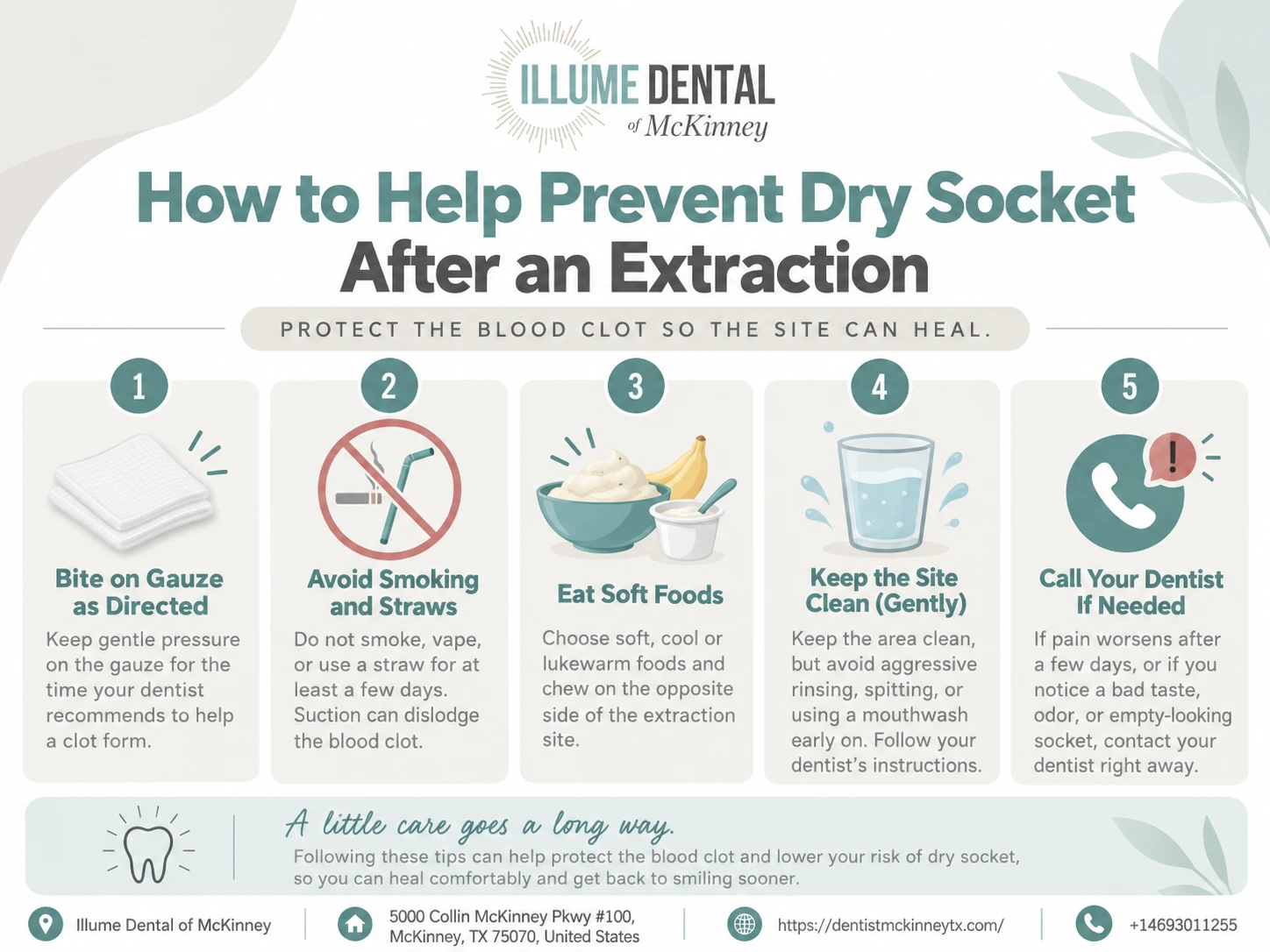
The Most Important Rule: Protect the Blood Clot
For the first day or two, think of that blood clot as nature’s temporary bandage.
You do not need to obsess over it. You do need to avoid repeatedly disturbing it.
1. Don’t smoke or vape
This is one of the biggest avoidable risks after an extraction.
Smoking and vaping can interfere with healing, and the combination of suction, heat, chemicals, and in nicotine products reduced blood flow is particularly unhelpful when your body is trying to stabilize a fresh surgical site. AAOMS advises avoiding smoking, vaping, and other tobacco use during recovery.
Illume Dental’s current post-extraction instructions advise patients to avoid smoking for at least the first 48 hours. Depending on the extraction, your dentist may recommend avoiding it for longer.
If stopping nicotine is difficult, tell your dentist before the extraction. That conversation is far more useful than pretending it will not be an issue.
2. Skip the straw
The concern is not the straw itself. It is the suction created when you drink through one.
That pressure can disturb a newly forming clot. AAOMS recommends avoiding straws for at least the first 24–48 hours after an extraction, and some surgical cases may require a longer restriction.
Drink directly from a cup instead.
And yes, that means your smoothie should be eaten with a spoon for now.
3. Don’t aggressively rinse or spit
A common mistake is trying to keep the socket too clean immediately after surgery.
Hard swishing and forceful spitting can disturb the very clot you are trying to protect.
Illume Dental advises avoiding vigorous rinsing or spitting during the first 24 hours. After the initial period, your dentist may recommend gentle warm salt-water rinses or a prescribed mouthwash.
Gentle is the important word.
This is not the time to gargle like you are trying to remove a stain from the kitchen sink.
4. Brush your teeth—but leave the socket alone
You still need oral hygiene after an extraction.
You just need to modify it temporarily.
Brush the rest of your teeth carefully and avoid scrubbing directly over the extraction site during the early healing period. AAOMS recommends extra care around the surgical area during the first 24–48 hours.
Your dentist will tell you when normal brushing around the area can resume.
5. Choose boring food for a couple of days
Recovery food does not have to be exciting.
For the first 24–48 hours, think:
- Yogurt
- Applesauce
- Mashed potatoes
- Scrambled eggs
- Soft pasta
- Lukewarm soup
- Smoothies eaten without a straw
Avoid hard, crunchy, very chewy, spicy, or extremely hot foods while the area is tender. Food fragments from things like popcorn, seeds, or chips are particularly annoying around a fresh socket.
You can gradually return to your normal diet as comfort and your dentist’s instructions allow.
6. Don’t turn extraction day into workout day
Patients sometimes feel surprisingly good once the numbness wears off and decide they can go back to the gym.
That is not necessarily the best test of toughness.
Oral surgery guidance recommends rest initially and avoiding strenuous exercise or heavy lifting during the early recovery period because vigorous activity can interfere with healing and bleeding control.
How long you should wait depends on whether you had a straightforward extraction, multiple teeth removed, wisdom-tooth surgery, sedation, or another more involved procedure.
What About Chlorhexidine Mouthwash?
There is evidence that chlorhexidine rinses or gels can reduce the risk of dry socket, particularly after higher-risk molar and wisdom-tooth extractions. Systematic reviews have found a preventative benefit.
That does not mean everyone should immediately buy a bottle and aggressively rinse with it after surgery.
The product, concentration, timing, and method matter. If your dentist thinks chlorhexidine makes sense for your extraction, follow the prescribed instructions.
More mouthwash is not automatically better after oral surgery.
What If I Already Used a Straw or Accidentally Spit?
Don’t panic.
Using a straw once does not guarantee you will develop dry socket. Neither does accidentally touching the area with your toothbrush.
From that point forward, protect the site and pay attention to how you feel.
If discomfort continues improving, that is reassuring. If pain suddenly intensifies over the next several days, especially if it radiates toward the ear or temple or is accompanied by an unpleasant taste or odor, call your dentist.
If You Get Dry Sockets, Can It Be Treated?
Yes.
Dry sockets can hurt considerably, but dentists deal with it routinely.
Treatment may involve gently cleaning the extraction site and placing a medicated dressing to protect the exposed area and reduce discomfort. Pain medication may also be recommended depending on the situation.
What you should not do is pack the socket yourself with aspirin, oils, homemade remedies, or random materials you found suggested online.
If the pain is bad enough that you suspect a dry socket, it is bad enough to have the socket examined.
Dry Socket vs. Normal Extraction Pain: A Practical Rule
Here is an easier way to think about it.
Normal recovery:
“I had a tooth pulled. It is sore, but overall I seem to be heading in the right direction.”
Possible dry socket:
“I was expecting to feel better, but now the pain is becoming dramatically worse.”
That distinction is not perfect, but it is much more useful than staring at the extraction site and trying to decide what color it is supposed to be.
After an Extraction in McKinney’s 75070 Area
Illume Dental of McKinney’s office at 5000 Collin McKinney Pkwy, Suite 100, McKinney, TX 75070 provides patients with post-operative instructions covering clot protection, diet, oral hygiene, bleeding, swelling, and when to call after an extraction.
The most important instruction, however, is this:
Follow the directions given for your specific extraction.
A straightforward premolar extraction is not necessarily managed exactly like an impacted lower wisdom tooth. Your medical history, medications, smoking status, complexity of the extraction, and condition of the surgical site can all change the advice your dentist gives you.
If something on a generic internet checklist conflicts with the instructions from the dentist who actually treated you, call the office and ask.
When Should You Call Illume Dental After an Extraction?
Contact the office if you experience severe or increasing pain, persistent heavy bleeding, concerning swelling, or other symptoms that do not seem consistent with the recovery instructions you were given. Illume Dental specifically advises patients with severe pain, heavy bleeding, or other extraction-related emergencies to contact the office for guidance.
If you had your extraction somewhere else but are now experiencing significant pain in McKinney, having the area examined is safer than waiting several miserable days hoping it resolves on its own.
Frequently Asked Questions About Dry Socket
How soon after an extraction does dry socket happen?
It most commonly becomes noticeable within the first few days after an extraction, often when pain is becoming worse instead of steadily improving.
Can I get a dry socket after any tooth extraction?
Yes, but the risk is not equal for every extraction. It tends to be higher following more involved surgical extractions, especially certain lower wisdom teeth.
How long should I avoid straws?
AAOMS advises avoiding straws for at least the first 24–48 hours because suction may disturb the clot. Your dentist may recommend longer depending on your procedure.
How long should I avoid smoking after a tooth extraction?
The longer you can stay away from smoking and vaping during early healing, the better. Illume Dental’s published instructions specify avoiding smoking for at least 48 hours, while oral-surgery guidance recommends avoiding tobacco during recovery and notes that smoking can interfere with healing.
Does dry socket mean my extraction was done incorrectly?
No. Dry socket is a known complication of tooth removal and can occur even when an extraction is performed appropriately and a patient follows instructions.
Will antibiotics cure dry socket?
Dry socket and infection are not the same condition. Treatment for dry socket often focuses on cleaning and protecting the socket and controlling pain. Antibiotics are used when a clinician determines there is an infection or another appropriate indication—not simply because the socket hurts.
What should I do if my extraction pain suddenly gets worse?
Call the dentist who treated you. Severe or escalating pain after an extraction deserves an evaluation, particularly if it is accompanied by radiating pain, bad taste or odor, excessive bleeding, fever, or increasing swelling.
The Bottom Line
You cannot reduce the risk of dry socket to zero, but you can avoid several of the behaviors that make healing harder.
Protect the clot. Don’t smoke or vape. Skip the straw. Don’t aggressively rinse or spit. Eat gently. Keep the rest of your mouth clean. And follow the instructions your dentist gave you.
If pain after an extraction in McKinney is getting worse rather than better, you do not have to guess whether it is a dry socket. An examination can usually clarify what is happening and what will make you more comfortable.
Illume Dental of McKinney can evaluate an extraction site, explain whether your healing appears normal, and help you understand the appropriate next step before the problem turns into several unnecessary days of pain.