
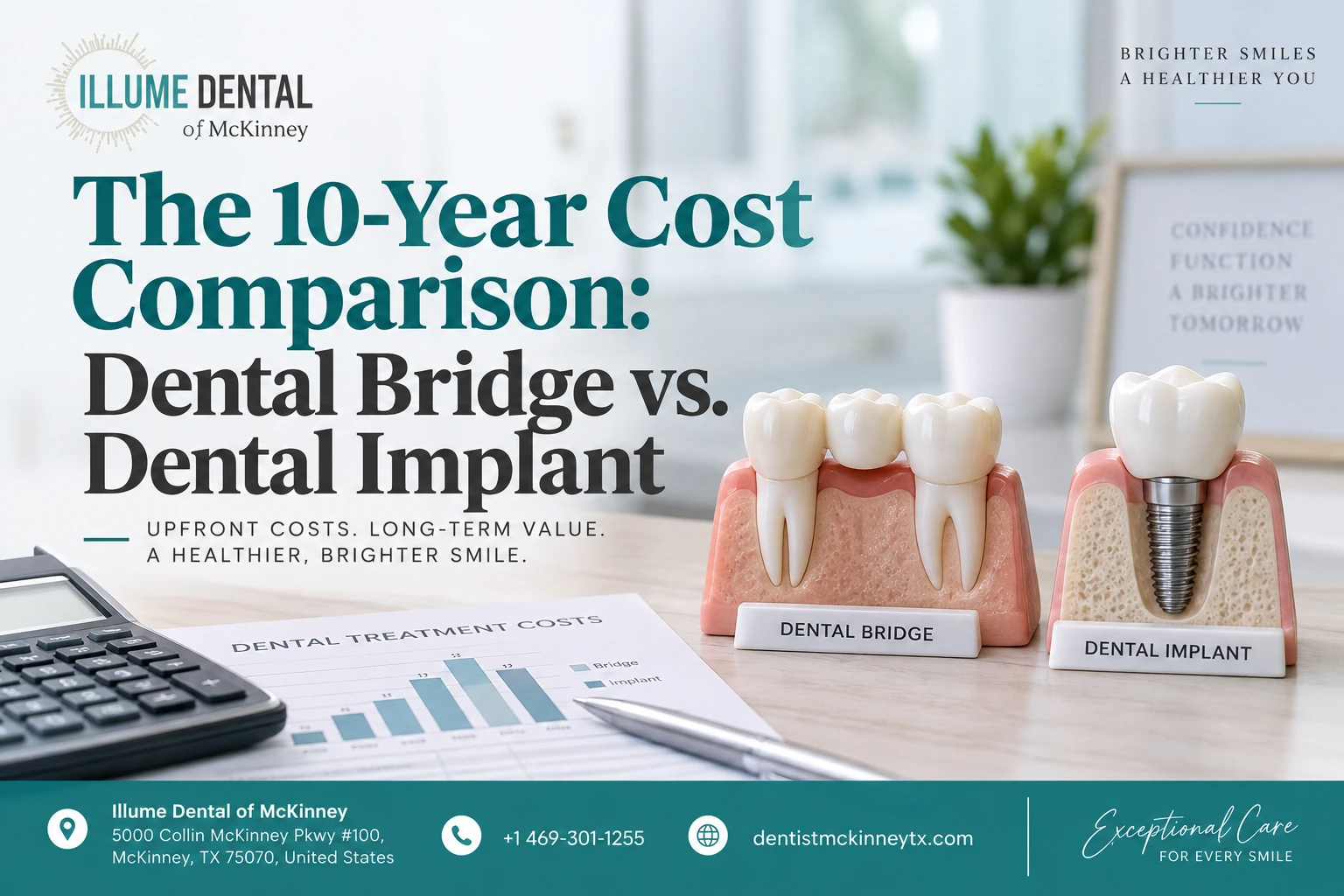
The 10-Year Cost Comparison: Dental Bridge vs. Dental Implant
If you are replacing one missing tooth, the usual financial advice sounds simple:
A bridge costs less now. An implant costs more now but lasts longer.
That is not always true.
Current pricing data shows that a traditional three-unit bridge and a single dental implant can start in surprisingly similar price ranges. The bigger financial difference often appears five, seven, or ten years later, when you consider whether the restoration needs to be repaired or replaced and what happens to the teeth beside it.
For patients in McKinney comparing the two options, here is the more useful way to think about it:
Over 10 years, an implant may be the better long-term value when the neighboring teeth are healthy and the implant remains successful. A bridge can still be the smarter financial choice when the neighboring teeth already need crowns, surgery is undesirable, or you need the tooth replaced more quickly.
There is no automatic winner.
Replace Your Missing Tooth Today
Thinking about a bridge or dental implant? Get professional guidance on cost, durability, and long-term value before deciding.
Dental Bridge vs. Implant: The Cost Difference Up Front
As of 2026, Illume Dental of McKinney lists a dental bridge at $5,007, before any insurance benefits. Illume’s published pricing also notes that implant placement itself is not performed in the office, so patients considering an implant would need an individualized surgical estimate from the implant provider.
For broader comparison, current national cost data reports approximately:
| Treatment | Current benchmark |
| Traditional dental bridge | $5,197 national average |
| Traditional bridge in Texas | $4,806 average |
| Illume Dental published bridge fee | $5,007 |
| Endosteal dental implant | $4,344 national average |
These figures are useful benchmarks not guaranteed treatment quotes. Implant costs can change significantly if you need an extraction, bone graft, surgical guide, abutment, sedation, or other treatment. Bridge costs also vary depending on materials and the condition of the supporting teeth.
There is another important pricing trap here.
Some implant advertisements quote only the implant post, while others quote the implant, abutment, and final crown together.
Before comparing two prices, ask:
“Does this price include everything required for me to leave with the final tooth?”
Otherwise, you may be comparing a complete bridge to only one component of an implant.
What Does the 10-Year Math Look Like?
This is where the comparison gets more interesting.
A bridge does not necessarily need to be replaced within 10 years. Cleveland Clinic estimates that dental bridges last about five to 15 years on average, with some lasting considerably longer when the supporting teeth remain healthy and the bridge is maintained well.
So there are two very different 10-year scenarios.
Scenario 1: Your bridge lasts the entire 10 years
Using Illume Dental’s current $5,007 published bridge fee as an example:
Initial bridge: $5,007
If that bridge remains healthy throughout the decade, your major restorative expense may still simply be the original $5,007, before insurance and routine dental care.
That can make the bridge an excellent financial decision.
Scenario 2: Your bridge fails and needs replacement
Suppose the same bridge needs to be replaced around year seven.
If we used today’s $5,007 fee again purely for illustration:
First bridge: $5,007
Replacement bridge: $5,007
Illustrative total: $10,014
And that deliberately ignores inflation.
It also assumes the supporting teeth can simply receive another bridge.
Sometimes they cannot.
If decay develops beneath one of the bridge crowns, the patient could also need:
- a new buildup;
- root canal treatment;
- a longer bridge;
- extraction of a supporting tooth; or
- ultimately an implant anyway.
That is where a bridge that looked less expensive at the beginning can become much more expensive over time.
This is an illustration, not a prediction that your bridge will fail. Plenty of well-designed, well-maintained bridges remain functional for 10 years or substantially longer.
What Happens to an Implant Over 10 Years?
Dental implants have a different cost pattern.
The initial treatment is more involved, but the implant fixture inside the bone has very good long-term survival.
A systematic review of contemporary dental implants estimated 10-year implant survival at about 96.4% in its conventional analysis and 93.2% in a more conservative sensitivity analysis.
Another long-term review specifically examining single implants found approximately 95% of implants remained in function after 10 years.
That does not mean 95% of patients go 10 years without spending another dollar.
The implant and the tooth attached to it are two different things.
Think of an implant restoration as having three major parts:
- the implant fixture inside the bone;
- the abutment connecting the restoration; and
- the visible crown.
The implant itself can remain healthy while the crown chips, loosens, wears, or eventually needs replacement.
The same long-term review found about 89.5% of the original single implant crowns were still surviving at 10 years, even though implant survival itself was higher.
So the realistic long-term promise is not:
“Get an implant once and never spend money on that tooth again.”
It is:
“The implant foundation has the potential to remain for a very long time, even if the restoration on top eventually needs maintenance or replacement.”
That is an important distinction.
The Simplest 10-Year Comparison
Here is a more realistic way to think about the economics:
| Over 10 years | Dental bridge | Dental implant |
| Initial cost | Often several thousand dollars | Often several thousand dollars |
| Surgery required | Usually no | Yes |
| Treatment of neighboring teeth | Usually requires crowns on adjacent teeth | Usually leaves adjacent teeth untouched |
| Typical longevity | About 5–15 years on average | Implant fixture frequently survives well beyond 10 years |
| Possible major 10-year expense | Replacement of entire bridge | Crown repair/replacement |
| Can supporting natural teeth decay? | Yes | Not applicable to the implant itself |
| Can the implant get a cavity? | No | No |
| Can gum/bone disease develop? | Yes | Yes |
| Bone preservation at missing tooth | Does not replace the root | Implant functions as a replacement root |
| Treatment speed | Usually faster | Usually months |
| Insurance friendliness | Often better | Highly plan-dependent |
The important word is possible.
No dentist can tell you in advance that a specific bridge will fail in year seven or that an implant will survive untouched for 20 years.
What we can do is compare the risks you are taking with each option.
Why the Neighboring Teeth Matter So Much
This may be the single most important factor patients overlook.
A traditional bridge replaces one missing tooth by placing crowns on the teeth on either side of the space.
That means those neighboring teeth need to be reshaped.
If those teeth are completely healthy, you are sacrificing healthy tooth structure to replace the missing tooth.
Cleveland Clinic identifies this as one of the primary disadvantages of a bridge, while an implant can replace the tooth without preparing the neighboring teeth.
Financially, that matters because a three-unit bridge is not really one tooth.
You now have three connected teeth whose long-term health affects the restoration.
If decay develops beneath one supporting crown, the whole bridge may have to come off.
But what if those neighboring teeth already need crowns?
Then the calculation changes.
Imagine you are missing one tooth, but both teeth beside the space already have:
- very large fillings;
- significant fractures;
- old crowns that need replacement; or
- enough structural damage that crowns are recommended anyway.
In that situation, preparing two perfectly healthy teeth is no longer the concern.
You may need those crowns regardless.
A bridge could potentially solve three restorative problems at once:
- crown the first damaged tooth;
- replace the missing tooth; and
- crown the second damaged tooth.
That is a situation where a bridge can make excellent clinical and financial sense.
This is why “implants are always better than bridges” is too simplistic.
When the Implant Usually Makes More Financial Sense
An implant becomes particularly attractive when:
Your neighboring teeth are healthy
If the teeth beside the space have never needed crowns, an implant allows you to leave them alone.
That has value beyond what appears on the treatment estimate.
You are relatively young
Someone replacing a tooth at age 35 has a very different lifetime calculation than someone replacing one at age 85.
If a bridge lasts 10 years, a younger patient may need it replaced several times over their lifetime.
A successfully integrated implant fixture could potentially remain through multiple generations of crowns.
You can clean and maintain it well
Implants cannot develop cavities, but they can develop inflammation and bone loss around them.
Good brushing, interdental cleaning, professional maintenance, and control of periodontal disease still matter.
You have enough healthy bone
Implants depend on adequate bone support.
If significant grafting is required, the upfront financial advantage can shift quickly.
When the Bridge May Be the Smarter Buy
There are also perfectly reasonable situations where we would not push someone toward an implant.
1. The neighboring teeth already need crowns
As discussed above, this can dramatically change the cost-benefit equation.
2. You want to avoid surgery
A bridge generally does not require implant surgery or months of bone healing.
For some patients, that alone is a meaningful advantage.
3. You want the tooth replaced quickly
Cleveland Clinic notes that bridge treatment can often be completed in a couple of visits over several weeks, while implant treatment involves surgery and several months of healing.
If you have an important life event coming up or simply do not want a prolonged treatment process a bridge may be much more practical.
4. Implant treatment would require substantial additional procedures
An implant quote can increase if you need:
- bone grafting;
- sinus augmentation;
- extraction;
- additional imaging;
- sedation; or
- more complicated surgery.
At some point, the financial argument for the implant becomes less clear.
5. Your anatomy or health makes implant surgery less predictable
Not everyone is an ideal implant candidate.
Your bone, gums, medical history, medications, smoking status, and ability to maintain the area all matter.
A good treatment plan starts with the patient not with the assumption that one replacement method is universally superior.
What About Insurance?
Insurance can completely change the short-term answer.
Illume Dental currently operates as an unrestricted or out-of-network practice but continues to file insurance claims and help patients maximize applicable out-of-network benefits. Its insurance guidance specifically recommends asking your carrier about:
- your annual maximum;
- deductible;
- percentage coverage for major services;
- implant coverage;
- waiting periods;
- missing-tooth clauses; and
- the maximum allowable charge for the procedure.
This is especially important with implants.
Some plans provide implant benefits.
Some provide limited benefits.
Some exclude implants entirely.
And even when insurance covers 50% of a procedure, that does not necessarily mean it will pay half of the dentist’s total fee. Annual maximums and plan allowances may limit the actual benefit.
For example, if your plan has a $1,500 annual maximum, a $5,000 procedure does not suddenly become a $2,500 procedure simply because your benefits booklet says “50% major services.”
Ask for an actual benefit estimate.
The Cost Nobody Puts on the Treatment Estimate
There is another difference between bridges and implants that is difficult to put into a spreadsheet:
What happens if something fails?
If an implant crown chips but the implant underneath is healthy, it may be possible to repair or replace the restoration while leaving the implant intact.
With a traditional bridge, a problem involving one supporting tooth can potentially affect the entire three-unit restoration.
That does not automatically make the implant better.
It does mean you should compare failure consequences, not only failure rates.
A systematic review looking specifically at the economics of single implants versus short-span tooth-supported bridges found that initial costs could be similar and that long-term financial outcomes were also broadly comparable. The authors concluded that factors beyond cost, particularly preserving healthy adjacent teeth, may ultimately be more important in treatment selection.
That is probably the fairest conclusion.
So Which One Is Cheaper After 10 Years?
There are three possible answers.
If the bridge lasts the full decade:
The bridge may be just as economical or more economical than an implant.
If the bridge needs to be replaced:
The implant can become significantly more attractive financially, particularly if the implant fixture remains healthy and only its crown requires maintenance.
If implant treatment requires bone grafting or other surgical procedures:
The bridge may remain less expensive, sometimes by a substantial amount.
This is why we would be skeptical of any dentist who claims that one treatment “always saves money.”
It depends on the starting condition.
Our Practical Rule for Choosing Between an Implant and a Bridge
If you are replacing one tooth between two healthy natural teeth, an implant deserves serious consideration even if the upfront investment is higher.
You avoid cutting down two healthy teeth, the implant has strong long-term survival data, and future crown maintenance can often be handled without replacing the implant fixture itself. Ten-year implant survival in systematic reviews is generally in the 90%-plus range.
If the neighboring teeth already need major restorative treatment, a bridge deserves equally serious consideration.
You may be able to replace the missing tooth while addressing teeth that need crowns anyway.
That is a much different clinical situation.
Five Questions to Ask Before Choosing
Before agreeing to either treatment, ask your dentist:
- Are the teeth beside the missing tooth healthy, or do they already need crowns?
- What exactly is included in my bridge or implant estimate?
- Will I need an extraction or bone graft before an implant?
- What does my insurance actually pay not just what percentage does the plan advertise?
- If this restoration fails in 7 to 10 years, what would probably need to be replaced?
Those five answers are much more useful than simply asking:
“Which one is cheaper?”
The Bottom Line for McKinney Patients
For a single missing tooth, the 10-year financial difference between a bridge and an implant is not as obvious as many patients expect.
Illume Dental currently lists a traditional dental bridge at $5,007, which is very close to current Texas and national bridge benchmarks. Implant pricing requires a separate surgical evaluation because Illume does not currently place the implant fixture in-office.
A bridge can be faster, avoid surgery, and make excellent financial sense especially when the teeth beside the space already need crowns.
An implant costs more in some cases and takes longer, but it avoids preparing healthy neighboring teeth and offers very strong long-term survival.
The right question is not:
“Which treatment costs less today?”
It is:
“Given the condition of my teeth, which option is most likely to leave me spending less and keeping a more healthy tooth structure over the next 10 years?”
If you are deciding between a bridge and an implant, Illume Dental of McKinney can evaluate the missing tooth space, the health of the neighboring teeth, your bite, and your bone before helping you compare the realistic costs and tradeoffs. If implant surgery is the better option, the surgical portion can be coordinated with an appropriate implant provider.
You should understand that whole picture before committing to either treatment.
Frequently Asked Questions
How much does a dental bridge cost in McKinney?
Illume Dental of McKinney currently publishes a fee of $5,007 for a dental bridge, although prices can change and treatment is specific to the individual patient. A current cost study places the Texas average for a traditional bridge around $4,806.
How much does one dental implant cost?
Current national data reports an average of about $4,344 for an endosteal implant, with a reported range from approximately $3,457 to $8,122. What is included varies, so confirm whether an estimate includes the implant surgery, abutment, crown, grafting, extraction, and related fees.
Does a bridge need to be replaced every 10 years?
No. Dental bridges average roughly five to 15 years, and some last longer with excellent care. Ten years should be viewed as a useful planning horizon, not an expiration date.
Will a dental implant last forever?
No dentist can promise that. Implants have excellent long-term survival, with systematic reviews reporting roughly 93% to 96% survival at 10 years, depending on how the data is analyzed. The crown attached to the implant may need maintenance or replacement even when the implant itself remains healthy.
Which lasts longer, an implant or a bridge?
In general, the implant fixture has the potential to last considerably longer. Cleveland Clinic notes that properly maintained implants can often last a lifetime, while bridges average about five to 15 years. The restoration placed on top of an implant does not necessarily last as long as the implant itself.
Is a bridge better if the neighboring teeth already have crowns?
Potentially, yes. If the teeth beside the gap already need crowns or substantial restorative treatment, one of the major disadvantages of a traditional bridge cutting down otherwise healthy neighboring teeth becomes much less important. Your dentist should evaluate each supporting tooth before making that decision.
Does dental insurance cover bridges or implants?
Many plans provide benefits toward bridges, while implant coverage varies more significantly. Annual maximums, waiting periods, missing-tooth clauses, deductibles, and out-of-network allowances can substantially change your actual cost. Illume Dental recommends verifying these details directly with your carrier before major treatment.
Make the Right Long-Term Choice
Compare the 10-year costs of a dental bridge and dental implant. Call today to discuss the option that fits your smile and budget.