
All-on-4 vs. Full-Mouth Dental Implants: What’s the Difference?
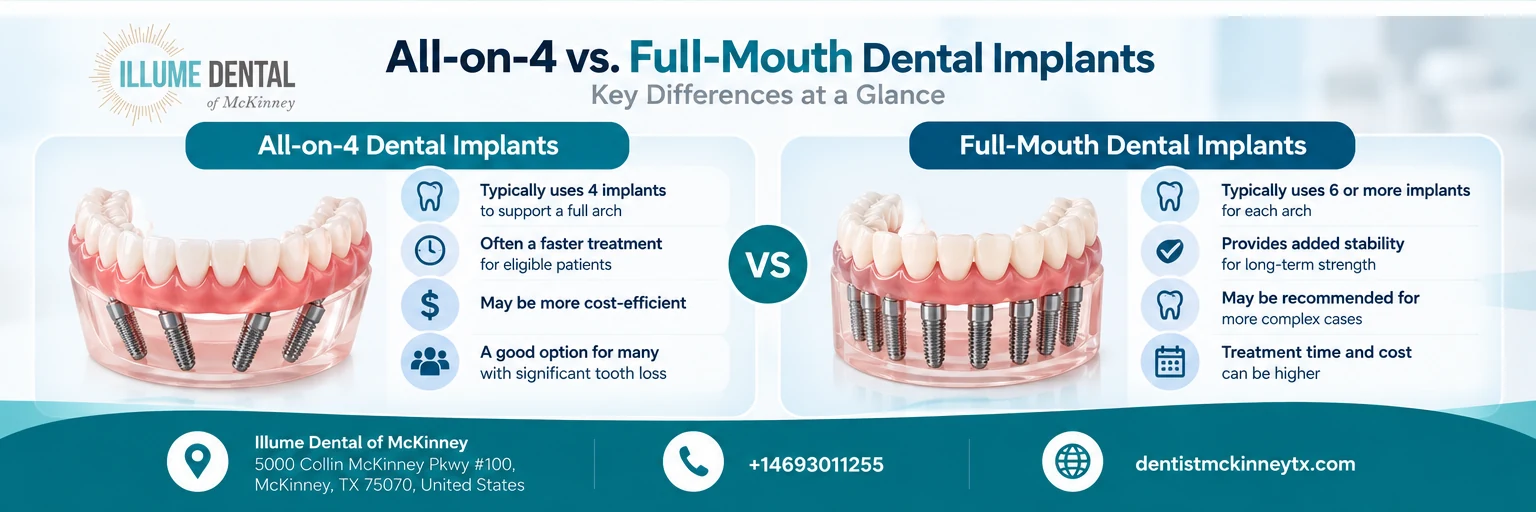
All-on-4® is one specific way to replace a full arch of teeth with dental implants. It uses four implants to support a fixed full-arch prosthesis in appropriately selected patients.
“Full-mouth dental implants,” on the other hand, is a broad consumer term rather than one single treatment. It may describe full-arch fixed bridges supported by four, five, six, or more implants, multiple implant-supported bridges or crowns, or other implant-based approaches used to replace most or all of a patient’s teeth.
So the real comparison is not simply four implants versus “full-mouth implants.”
It is:
Which implant and prosthetic design gives you the most appropriate result for your bone, bite, remaining teeth, anatomy, health, maintenance needs, and long-term treatment goals?
The number of implants is only one part of that decision.
Missing Most or All Your Teeth?
Explore All-on-4 and full-mouth dental implants with professional guidance. Call today to discuss your options.
Key Takeaways
- All-on-4® is a specific full-arch implant concept, not a completely separate category from full-mouth dental implants.
- The traditional All-on-4® concept uses four implants per treated arch: two anterior implants and two posterior implants that are typically tilted to make use of available bone and avoid certain anatomical structures.
- “Full-mouth dental implants” can describe several different treatment designs and does not tell you how many implants will be used.
- Four implants can successfully support a fixed complete-arch prosthesis in appropriately selected cases. Evidence has not established that simply using five or more implants automatically produces better implant or prosthesis survival.
- Same-day fixed teeth are possible with All-on-4® and other immediate-loading protocols only when appropriate clinical criteria and adequate implant stability are achieved.
- Neither approach is maintenance-free. Full-arch implant restorations require daily cleaning, professional follow-up, and eventual management of wear or mechanical and biological complications.
First, what does “All-on-4” actually mean?
All-on-4® is a treatment concept developed by Nobel Biocare for patients who are completely edentulous meaning they have no teeth in an arch or whose remaining teeth are considered unsalvageable as part of a comprehensive treatment plan.
The concept traditionally uses:
- two implants positioned more vertically toward the front of the jaw
- two posterior implants tilted up to approximately 45 degrees
- one fixed full-arch prosthesis supported by those four implants
Tilting the posterior implants can help make use of available bone while avoiding structures such as the maxillary sinus or the mandibular nerve in appropriately selected cases.
Importantly, four implants means four implants for one arch.
If both the upper and lower arches are treated with a four-implant concept, that would generally mean four implants in each arch, not four implants for the entire mouth.
What does “full-mouth dental implants” mean?
This term is less precise.
“Full-mouth dental implants” is commonly used to describe implant treatment that replaces most or all of a person’s teeth, potentially in both arches.
But there is no single procedure called “full-mouth dental implants.”
Depending on the patient, treatment could involve:
A fixed full-arch bridge supported by four implants
This may follow the All-on-4® concept or another four-implant protocol.
A fixed full-arch bridge supported by five, six, or more implants
Some treatment plans use additional implants depending on available bone, anatomy, prosthetic design, implant distribution, clinician preference, and other clinical considerations.
A systematic review comparing fixed complete-arch prostheses supported by fewer than five implants with those supported by five or more found no statistically significant difference in implant or prosthesis survival between the groups in the included studies. That does not mean four implants are appropriate for everybody; it means that “more implants” does not automatically translate into a better outcome.
Multiple implant-supported bridges or crowns
In some patients, particularly when portions of the natural dentition can be preserved or the restorative plan calls for multiple segments, implants may support several smaller restorations rather than one full-arch prosthesis.
That does not necessarily mean placing one implant for every missing tooth.
Implant-supported removable prostheses
Implants can also provide retention and support for removable overdentures. These are fundamentally different from fixed full-arch restorations because the patient removes the prosthesis for cleaning.
For that reason, patients comparing “full-mouth implants” should ask whether they are actually being offered a fixed bridge, a removable implant overdenture, or another design.
All-on-4 vs. Other Full-Mouth Implant Approaches
| Question | All-on-4® | Other full-mouth/full-arch implant approaches |
| What is it? | A specific fixed full-arch treatment concept | A broad category that includes multiple implant and prosthetic designs |
| Number of implants | Four per treated arch | Can vary considerably depending on the design |
| Implant positioning | Traditionally two anterior axial implants and two tilted posterior implants | May use axial, tilted, or differently distributed implants depending on the case |
| Restoration | Fixed full-arch prosthesis | May be a fixed full-arch bridge, segmented bridges/crowns, or a removable implant prosthesis |
| Same-day teeth | Fixed provisional teeth may be possible if immediate-loading criteria are met | May also be possible with other protocols when clinical conditions allow |
| Bone grafting | Concept is designed to maximize available bone and may avoid grafting in many cases | Some approaches may require grafting; others may not |
| Planning flexibility | Uses a defined four-implant full-arch concept | Wider range of implant numbers, positions, and prosthetic designs |
| Maintenance | Ongoing home and professional maintenance required | Ongoing maintenance required; specifics depend on the prosthesis |
| Cost | Depends on the complete case, not merely the number of implants | Depends on implant number, surgery, grafting, materials, temporary teeth, final prosthesis, and other factors |
Does All-on-4 mean four implants are always enough?
No.
Four implants are enough to support certain full-arch fixed restorations when the patient’s anatomy and treatment conditions are appropriate.
But the decision should not be made by starting with the number four and trying to make the patient fit the concept.
The clinician needs to consider:
- available bone volume and quality
- implant distribution
- upper versus lower jaw
- the position of the maxillary sinus and nerves
- bite forces
- space available for the prosthesis
- remaining teeth
- gum and peri-implant tissue health
- the design and material of the final restoration
- medical history
- tobacco use
- history of grinding or clenching
- ability to clean and maintain the restoration
The American College of Prosthodontists specifically notes that full-arch fixed implant restorations can differ in the number, inclination, and position of implants and that prosthetic design is a critical component of treatment.
Are six implants automatically better than four?
Not based on implant number alone.
This is an area where implant marketing can make the decision sound simpler than it really is.
A systematic review and meta-analysis evaluating complete-arch fixed prostheses found no statistically significant difference in implant or prosthesis survival when restorations supported by fewer than five implants were compared with those supported by five or more implants.
A 2024 systematic review specifically comparing fixed maxillary restorations supported by four versus six implants similarly reported no significant differences in implant survival, prosthesis survival, technical complications, or biological complications between the groups in the included evidence.
That does not mean four implants are always preferable.
There can be valid reasons to use additional implants in an individual treatment plan.
The better question is:
Why is this specific number and distribution of implants being recommended for my anatomy and restoration?
Can All-on-4 avoid bone grafting?
Sometimes and avoiding extensive grafting is one of the original goals of the concept.
The angled posterior implants are designed to make more effective use of available bone and avoid certain anatomical structures. Nobel Biocare describes All-on-4® as a graftless full-arch concept.
But patients should be careful with the phrase “no bone graft needed.”
It does not mean every person with severe bone loss is automatically an All-on-4 candidate without additional procedures.
The amount and location of remaining bone still need to be evaluated. Some patients may need grafting, a different implant configuration, another surgical approach, or a different restorative plan altogether.
Do you really get teeth in one day with All-on-4?
Potentially but there is an important distinction.
Patients who meet the criteria for immediate loading may receive a fixed provisional restoration on the day the implants are placed.
Nobel Biocare specifically qualifies its same-day protocol by stating that the patient must meet immediate-loading criteria and the implants must achieve adequate stability.
That same-day restoration is generally a provisional, not necessarily the final long-term prosthesis.
The tissues and implants still need to heal. The definitive restoration is generally completed according to the treatment plan after appropriate healing and restorative steps.
So “teeth in a day” should not be interpreted as:
surgery in the morning, completely finished permanent treatment by dinner.
What imaging is needed before full-arch implant treatment?
This kind of treatment requires more than a visual examination.
Current 2026 recommendations from the American Dental Association and American Academy of Oral and Maxillofacial Radiology recommend CBCT three-dimensional imaging for presurgical dental implant planning. CBCT is used to assess bone volume and the relationship of the implant sites to important anatomical structures.
The imaging is only one part of planning.
A thorough evaluation should also consider:
- your dental and medical history
- condition of any remaining teeth
- periodontal health
- bite
- available restorative space
- facial and smile considerations
- desired type of restoration
- ability to maintain the prosthesis
The treatment should effectively be planned backward from the teeth you need, rather than simply deciding where implants can physically fit.
What are the maintenance differences?
Neither option should be described as maintenance-free.
A fixed implant bridge does not get cavities the way natural tooth structure does, but the tissues and implants around it still require care.
Plaque can accumulate around implant components, and full-arch prostheses can also experience mechanical wear or complications over time.
The American College of Prosthodontists emphasizes ongoing maintenance of full-arch implant restorations and notes that prosthesis design affects the ability to manage both mechanical and biological complications.
Maintenance can include:
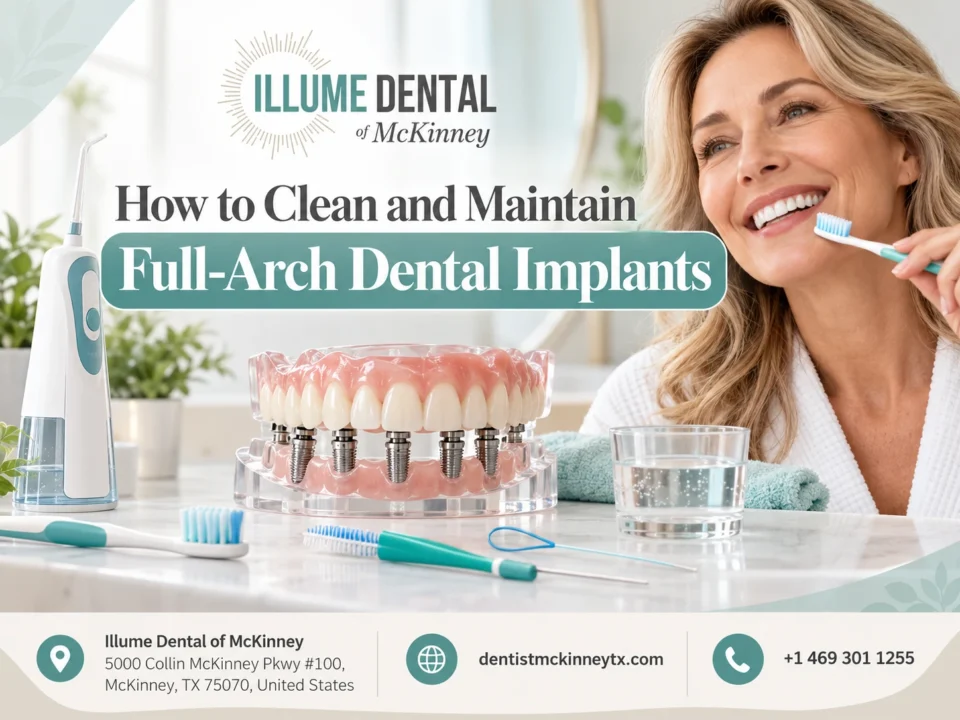
- cleaning underneath the fixed prosthesis every day
- cleaning around implant components
- professional examinations and hygiene visits
- monitoring the tissues and bone around the implants
- evaluating the bite
- checking screws, prosthetic teeth, frameworks, and restorative materials
- repairing or replacing worn components when necessary
A 2026 umbrella review of implant-supported complete-arch prostheses found high implant and prosthesis survival overall but also documented mechanical complications such as screw loosening and restorative material chipping, as well as biological complications including peri-implantitis.
In other words:
“Fixed” does not mean “maintenance-free” or “guaranteed for life.”
Can the fixed teeth be removed?
Not by the patient during normal daily use.
A fixed full-arch implant prosthesis stays attached to the implants rather than being removed every night like a conventional denture.
Many full-arch restorations are screw-retained, which allows a dentist to remove the prosthesis when clinically necessary for repair, evaluation, or management of complications.
The American College of Prosthodontists states that screw retention is desirable when possible because it can make mechanical and biological complications easier to manage.
That is different from a removable implant overdenture, which the patient takes in and out.
What are the potential downsides of All-on-4?
All-on-4 can be a useful full-arch option, but it is still a major restorative and surgical treatment.
Potential considerations include:
All four implants contribute to one connected restoration
The implants and prosthesis function as a system. If an implant develops a significant problem, the effect on the treatment plan depends on its position, the remaining implants, the prosthesis, and whether the problem can be managed.
The prosthesis will eventually need maintenance
Teeth or restorative materials can wear, chip, fracture, or require repair. Screws and other prosthetic components can also need attention.
Hygiene requires commitment
Cleaning beneath a full-arch fixed bridge is different from brushing individual natural teeth and must become part of the patient’s routine.
Not everyone can be immediately loaded
“Same-day teeth” depend on appropriate implant stability and other clinical factors.
Four implants are not automatically the right design for every jaw
Some patients may be better served by a different number or distribution of implants.
What are the potential downsides of other full-mouth implant approaches?
Using a different full-mouth design does not eliminate tradeoffs.
Depending on the treatment, possible disadvantages include:
- more implants and potentially more surgical sites
- grafting procedures in some cases
- longer or more complex treatment
- higher surgical or restorative costs
- more components requiring long-term maintenance
- difficulty repairing certain prosthetic materials or designs
- additional procedures before the final restoration can be completed
The number of implants should therefore not be used as the sole measure of how “advanced” or “durable” a treatment is.
What about the cost?
There is no reliable rule that says four implants will always be cheaper than another full-mouth design.
Using fewer implants can reduce one component of treatment, but implant number is only part of the total fee.
Full-mouth implant costs can also be affected by:
- whether one or both arches are treated
- tooth extractions
- bone grafting
- anesthesia or sedation
- number and type of implants
- provisional restorations
- final prosthetic material
- laboratory work
- surgical guides or digital planning
- complexity of the case
- follow-up and maintenance
- future repairs
Two treatment plans that both say “All-on-4” can therefore have very different total costs and may not include the same services or final prosthetic materials.
When comparing quotes, ask for an itemized explanation of what is actually included, especially whether the quoted fee includes the final restoration.
Which approach is right for you?
There is no responsible answer based only on the words “All-on-4” or “full-mouth implants.”
All-on-4 may make sense for an edentulous or soon-to-be-edentulous patient who has appropriate anatomy for a four-implant fixed full-arch restoration and wants to minimize certain grafting procedures.
Another full-arch design may make more sense when additional implants, different implant positions, segmented restorations, grafting, or another prosthetic approach better fits the anatomy and restorative goals.
And sometimes the most important question comes even earlier:
Should all of the remaining teeth actually be removed?
If some teeth have a reasonable long-term prognosis, preserving them may need to be discussed before committing to irreversible full-arch treatment.
A comprehensive treatment plan should explain why teeth are being retained or removed—not simply sell the patient on a particular implant package.
Questions to ask at your implant consultation
- Are you recommending All-on-4®, another four-implant design, or a different full-arch approach?
- How many implants are you recommending per arch, and why?
- Are any of my remaining teeth reasonably predictable to keep?
- What does my CBCT show about my available bone and anatomy?
- Will I need bone grafting?
- Are you planning a fixed or removable restoration?
- If I receive teeth on surgery day, are they provisional or final?
- What material will be used for my temporary and final teeth?
- What happens if one implant does not integrate?
- How is this prosthesis cleaned at home?
- What professional maintenance will I need?
- How are repairs handled if a tooth, screw, or part of the prosthesis breaks?
- What exactly is included in the treatment fee?
- Who performs the surgical and restorative portions of treatment?
How Illume Dental can help
For McKinney patients considering replacement of most or all of their teeth, the first step should be determining which teeth can reasonably be maintained, how much bone is available, and what type of final restoration makes sense before choosing a specific implant concept.
Illume Dental of McKinney’s current website lists both All-on-4 dental implants and full-mouth dental implant treatment among its implant services.
An implant consultation can help clarify the condition of your remaining teeth, gums, bone, bite, and existing restorations and allow you to compare the surgical, restorative, maintenance, timeline, and cost implications of the available options.
The goal should not be to choose whichever treatment name sounds more advanced.
It should be to understand why a particular design is appropriate for your mouth before committing to irreversible treatment.
Frequently Asked Questions
Is All-on-4 the same as full-mouth dental implants?
All-on-4® is one type of full-arch implant treatment.
“Full-mouth dental implants” is a broader term that may refer to several ways of replacing most or all teeth with implant-supported restorations.
If both arches are being treated, ask specifically what implant and prosthetic design is being proposed for each arch.
Does All-on-4 use only four implants for the whole mouth?
Not usually.
The All-on-4® concept uses four implants per treated arch.
If a patient receives an All-on-4-style restoration in both the upper and lower jaws, that generally means four implants in the upper arch and four in the lower arch.
Are four implants enough to replace an entire arch?
They can be in appropriately selected patients.
Clinical research supports fixed complete-arch prostheses on four implants. Systematic reviews have not demonstrated that five or more implants automatically provide superior implant or prosthesis survival compared with fewer than five implants.
That does not mean every patient should receive four implants. Bone, anatomy, implant distribution, restorative design, and individual risk factors determine the treatment plan.
Are six implants better than All-on-4?
There is no universal answer.
Research comparing four- and six-implant full-arch designs has not shown that the six-implant approach automatically produces better implant or prosthesis survival.
There may still be clinical reasons to recommend six implants in a specific case.
Can I get permanent teeth the same day as All-on-4 surgery?
Patients who meet immediate-loading criteria may receive fixed provisional teeth on the day of implant surgery.
That should not be confused with completing every stage of the definitive restoration in one day. The implants and tissues still need time to heal before the final restorative sequence is completed.
Does All-on-4 mean I will not need a bone graft?
Not necessarily.
The All-on-4® concept is designed to use available bone strategically and can avoid grafting in many cases. But severe or poorly positioned bone loss may require a different treatment approach or additional procedures.
A clinical examination and three-dimensional implant planning are needed before anyone can responsibly tell you that grafting will not be necessary.
Which lasts longer: All-on-4 or other full-mouth implants?
Implant numbers alone cannot answer that question.
Long-term outcomes depend on implant positioning and integration, prosthetic design and material, bite forces, health of the tissues around the implants, smoking and medical risk factors, home care, professional maintenance, and management of mechanical complications.
Both four-implant and higher-implant-count full-arch restorations have documented successful outcomes in appropriately selected patients.
Can All-on-4 teeth develop cavities?
The prosthetic teeth themselves do not develop tooth decay the way natural tooth structure does.
However, the implants and surrounding tissues can still develop biological problems, including inflammation and peri-implant disease, and the prosthesis can experience wear or mechanical complications.
Daily cleaning and professional maintenance therefore remain necessary.
Can an All-on-4 bridge be taken out?
A fixed All-on-4-style bridge is designed to remain in the mouth during normal daily use and is not removed by the patient.
When a screw-retained design is used, a dental professional can remove the restoration when clinically necessary for service, repair, or evaluation.
Considering Dental Implants?
Get clear answers about All-on-4 and full-mouth implant options. Call today to schedule your consultation.