
The Cost of Ignoring a “Small” Cavity: How a $180 Filling Can Turn Into a $3,000 Root Canal
A small cavity is usually the cheapest and easiest time to fix a tooth.
The problem is that cavities rarely stay small.
If decay is caught early, treatment may be as simple as a filling. If it reaches the nerve, the tooth may need a root canal, crown, or even extraction and replacement.
For many McKinney patients, the difference can look like this:
Small filling: about $180–$350
Root canal + crown: often $2,000–$3,000+
That is why “I’ll wait until it hurts” is usually the most expensive dental strategy.
Don’t Let a Small Cavity Get Expensive
Treat decay early before a simple filling becomes a costly root canal. Call today to protect your tooth.
Why Small Cavities Get Expensive
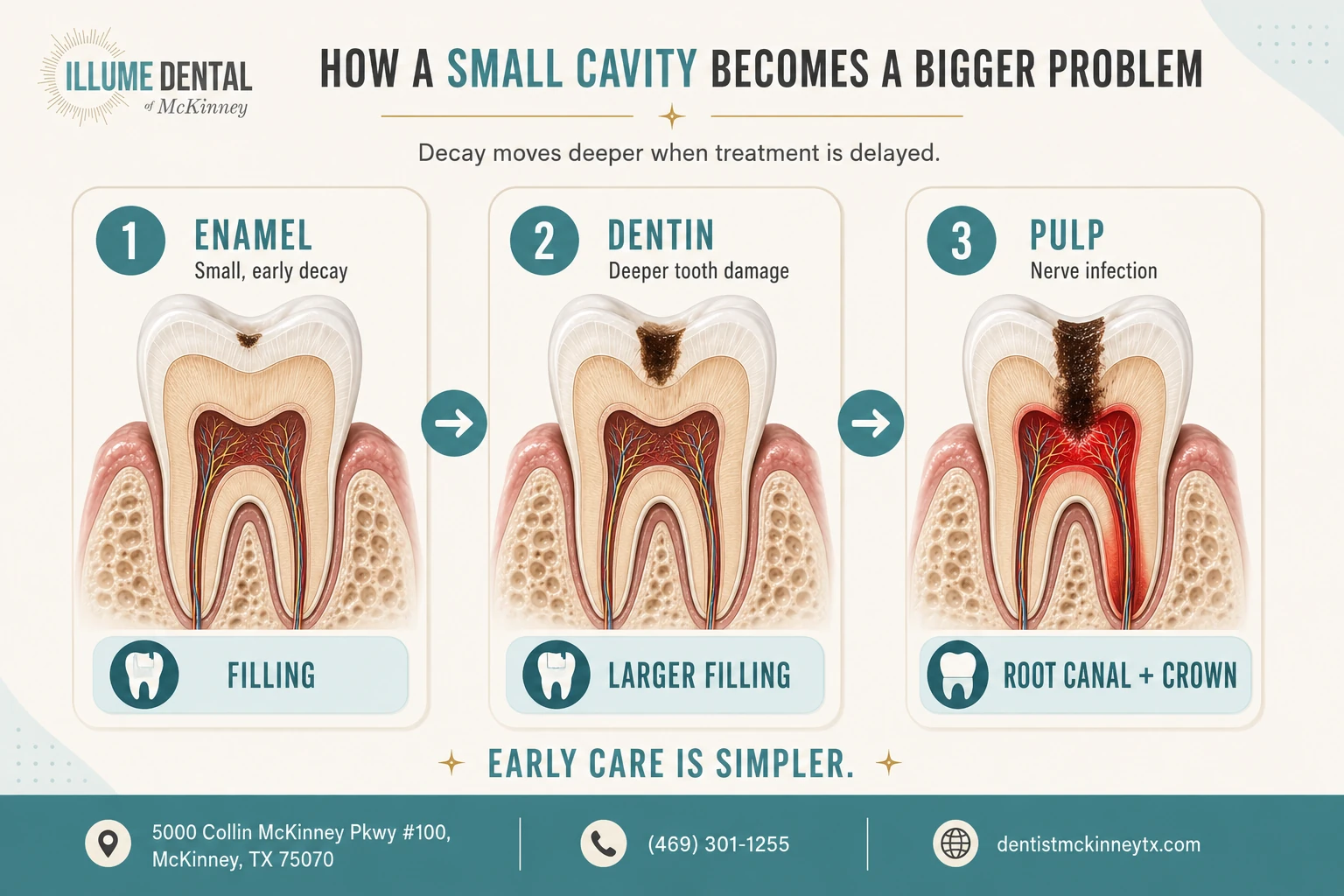
A cavity starts in the outer layer of the tooth. Early on, it may not hurt at all.
As decay moves deeper, it can reach the softer inner dentin and eventually the nerve. Once bacteria get into the nerve space, a simple filling usually is not enough anymore. This progression highlights the importance of timing in cavity treatment.
At that point, treatment may require:
- Root canal therapy
- A buildup to replace lost tooth structure
- A crown to protect the weakened tooth
- Antibiotics or emergency care in some cases
The tooth didn’t suddenly become expensive. It became more damaged over time.
Why Waiting for Pain Is a Bad Test
Pain is not a reliable early warning system.
Many cavities are painless until they are already deep. By the time you feel throbbing, sensitivity that lingers, swelling, or pain when biting, the tooth may need more than a filling.
A better rule:
If your dentist sees decay on an exam or X-ray, ask how deep it is and how soon it should be treated.
When a Filling May Be Enough
A filling may be appropriate when:
- The cavity is small to moderate
- The nerve is not infected
- Enough healthy tooth remains
- There is no crack or major structural damage
This is the stage where treatment is usually faster, less expensive, and more comfortable.
When It May Become a Root Canal
A root canal may be needed when:
- Decay reaches the nerve
- Pain lingers after hot or cold
- There is swelling or an abscess
- The tooth hurts when biting
- The tooth has deep decay under an old filling or crown
Root canals are not “bad.” They often save teeth. But they are usually the result of a problem that has become more advanced.
The Real Cost of Waiting
Waiting can cost more in several ways:
Money: A filling may be a few hundred dollars. A root canal and crown can be several thousand.
Time: One filling visit may become multiple appointments.
Comfort: Early treatment is usually easier than emergency treatment.
Risk: A tooth that could have been restored may eventually become non-restorable.
What McKinney Patients Should Do
If you have been told you have a small cavity, do not panic but do not ignore it either. Understanding why tooth decay is something you need to know about can help you make informed decisions before the problem becomes more serious.
Ask:
- How deep is the cavity?
- Is it close to the nerve?
- Can it be treated with a filling?
- What happens if I wait 3, 6, or 12 months?
- What will the total cost be with or without insurance?
A good dental office should answer those questions clearly before treatment.
Bottom Line
A small cavity is not an emergency, but it is a warning sign.
Treating it early is usually simpler, cheaper, and less stressful. Waiting until it hurts can turn a manageable filling into a root canal, crown, or tooth replacement.
If you are unsure whether a cavity needs treatment now, the safest next step is an exam and X-ray. Illume Dental of McKinney can help you understand how serious the decay is before you commit to treatment.
A $180 Filling Could Save You Thousands
Don’t wait for the pain to start. Schedule treatment now before the cavity becomes a bigger dental problem.