
5 Signs Your Old Silver Fillings Are Leaking (and Cracking Your Teeth)
A lot of adults in McKinney still have silver fillings placed 10, 20, or even 30 years ago.
Some are holding up surprisingly well.
Others are quietly damaging the tooth underneath.
The problem is that old fillings often fail slowly, not dramatically. Patients rarely wake up one morning thinking:
“My silver filling is leaking.”
Instead, they notice:
- occasional sensitivity
- a rough edge
- a random sharp pain
- food getting stuck
- or a cracked tooth that seemed to happen “out of nowhere”
In many cases, the filling had been weakening the tooth for years.
Protect your teeth before they break.
A simple filling replacement today could help prevent costly crowns or root canals later. Call now to book your visit.
First: Are Silver Fillings Dangerous?
Dental amalgam (silver fillings) has been used for decades and is still considered acceptable by major dental organizations for many patients.
The bigger issue today is often not toxicity.
It is age, expansion, breakdown, and structural stress.
Large old fillings can weaken the remaining tooth over time — especially molars under heavy chewing pressure.
Patients often ask specifically about mercury. Dental amalgam contains a small amount of elemental mercury bound within a stable metal alloy, and both the American Dental Association and the FDA consider it a safe option for most patients, including children over six. The trace vapor released during normal chewing is well below the levels associated with any known health effects for the general population. The FDA does recommend extra caution for a few groups — including pregnant women, nursing mothers, young children, and patients with a mercury sensitivity — who may want to discuss alternative filling materials with their dentist. True mercury poisoning from an intact amalgam filling is very rare; symptoms people search for under that term are far more often linked to broader environmental or occupational exposure, not a single filling. If a filling feels loose, looks corroded, or has visibly broken down, that is a structural problem worth having checked — not, on its own, a sign of mercury toxicity.
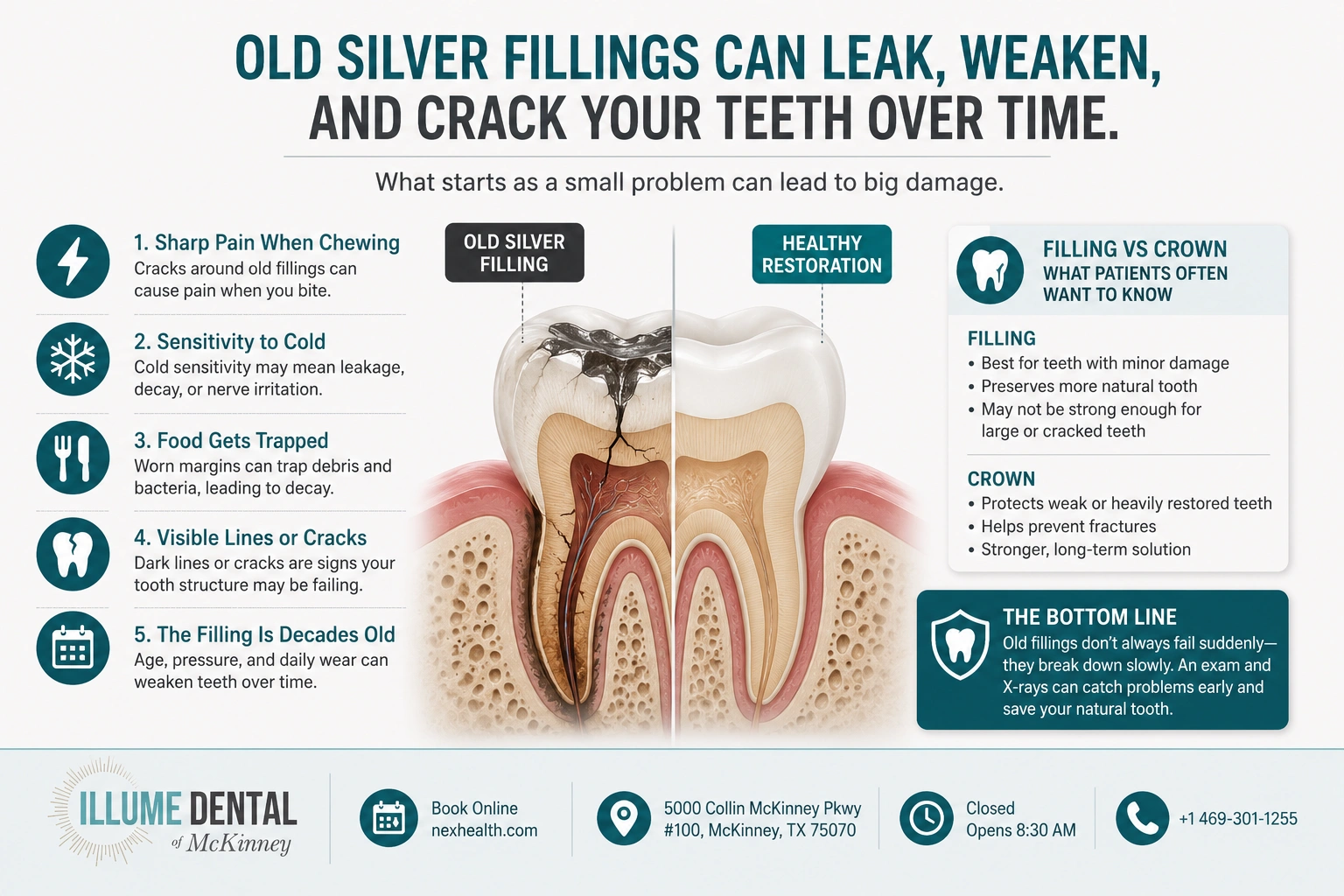
1. You Feel Sharp Pain When Chewing
One of the most common warning signs is:
- pain when biting
- sudden sensitivity on release
- or discomfort chewing hard foods
This can happen because old fillings expand and contract differently than natural tooth structure.
Over time, tiny cracks can form around the filling or through the tooth itself.
Patients often describe it as:
“It only hurts sometimes.”
That inconsistency is common with cracked teeth.
2. The Tooth Is Suddenly Sensitive to Cold
Cold sensitivity around an old filling may indicate:
- leakage
- decay under the filling
- microscopic gaps
- enamel cracking
- or nerve irritation
Not every sensitive tooth needs a crown or root canal.
But new sensitivity around aging restorations deserves evaluation before the damage worsens.
3. Food Constantly Gets Trapped Around the Filling
If floss keeps shredding or food packs between teeth near an old filling, the margins may be breaking down.
That can allow:
- bacteria
- decay
- and plaque buildup
To collect underneath or beside the restoration.
Many cavities under old fillings are not visible to patients at all. If decay develops around an older restoration, your dentist may need to focus on addressing cavity and dental work before the damage becomes more extensive.
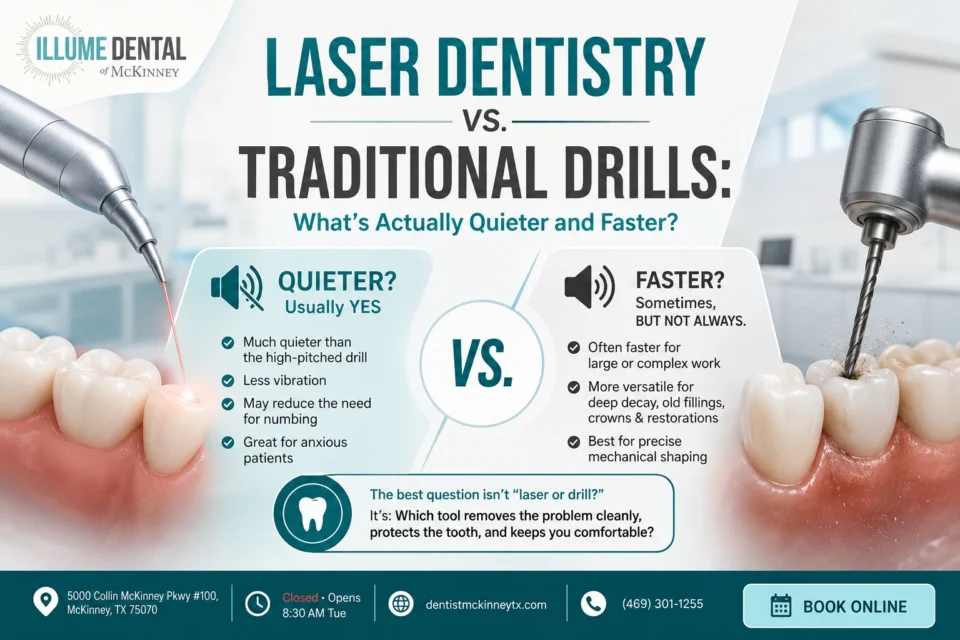
 Lasers can be much quieter than the high-pitched dental drill, which is why anxious patients often like them. They may…
4. You Notice Dark or Silver Lines on the Tooth
Large silver fillings can place stress on the remaining tooth structure over time.
Dentists often see:
- craze lines
- fractured cusps
- dark crack lines
- or undermined enamel
around older amalgam fillings.
Sometimes the filling itself is fine — but the surrounding tooth is not.
Patients often describe this simply as seeing silver lines on their teeth near an old filling. That description alone does not mean anything is wrong, but it is worth having a dentist confirm whether it is surface staining or an early crack.
5. The Filling Is Decades Old
This alone does not mean it must be replaced.
Some silver fillings last an impressively long time.
But very old restorations deserve monitoring because:
- teeth weaken with age
- chewing forces accumulate
- margins can open
- and cracks may develop silently
The danger is often not the filling “falling out.”
It is the tooth splitting unexpectedly.
Why Teeth Crack Around Large Silver Fillings
Silver amalgam fillings are strong under compression, but they do not bond to teeth the same way many modern materials do.
That means large fillings can act almost like wedges inside weakened tooth structure over time.
The larger the filling, the less natural the tooth remains to absorb pressure.
That is why heavily restored molars are often more vulnerable to fractures.
Does Every Old Silver Filling Need Replacement?
No.
Replacing healthy fillings unnecessarily can remove additional tooth structure.
A trustworthy dentist should evaluate:
- whether decay is present
- whether cracks are active
- whether the margins are failing
- and whether the tooth is structurally compromised
Some fillings can simply be monitored.
Others are one bite away from a major fracture. Regular preventive visits also give your dentist a chance to provide 3 things your dentist can do to help you stay cavity-free.
Filling vs Crown: What Patients Often Want to Know
If the tooth is still structurally strong, a new filling may work.
But if:
- cracks are spreading
- the filling is extremely large
- or too much tooth structure is missing
A crown may be the safer long-term solution.
The goal is preserving the tooth before it breaks beyond repair.
The Bottom Line
Old silver fillings are not automatically bad.
But aging restorations can leak, weaken teeth, and contribute to cracks that patients do not notice until significant damage occurs.
If you have old fillings with sensitivity, biting pain, visible cracks, or recurring food traps, an exam and X-rays can help determine whether the tooth is stable or beginning to fail. Illume Dental of McKinney helps patients understand when old fillings can safely stay — and when replacing them may prevent a much bigger problem later.
Frequently Asked Questions About Silver (Amalgam) Fillings
Can fillings leak?
Yes. Over time, the seal between a filling and the surrounding tooth can break down, letting saliva, bacteria, and food particles seep underneath. This is sometimes called a leaking filling, and it can allow new decay to develop out of sight.
What does a leaking filling look like?
A leaking or failing filling often shows up as a dark line at the edge of the filling, a rough or uneven margin, new staining, or a visible gap between the filling and the tooth. Some patients notice food catching in the same spot repeatedly.
Is a leaking filling dangerous?
A leaking filling is not an emergency on its own, but it is not something to ignore either. Left unchecked, it can allow decay to spread underneath the filling or weaken the tooth enough to crack. Having it evaluated early usually means a simpler fix.
Do silver fillings cause teeth to crack?
Large, older silver fillings do not bond to a tooth the way modern materials do, so they can act like a wedge inside tooth structure that has weakened over time. That makes heavily filled molars more prone to cracking, especially under everyday chewing pressure.
Are amalgam (silver) fillings safe? What about mercury?
Yes, according to the American Dental Association and FDA, amalgam fillings are considered safe for most patients. The small amount of mercury in the alloy releases only trace vapor during chewing, well below levels linked to health effects. The FDA suggests some added caution for pregnant women, nursing mothers, and young children, who may prefer to discuss alternatives with their dentist.
Are composite fillings better than amalgam fillings?
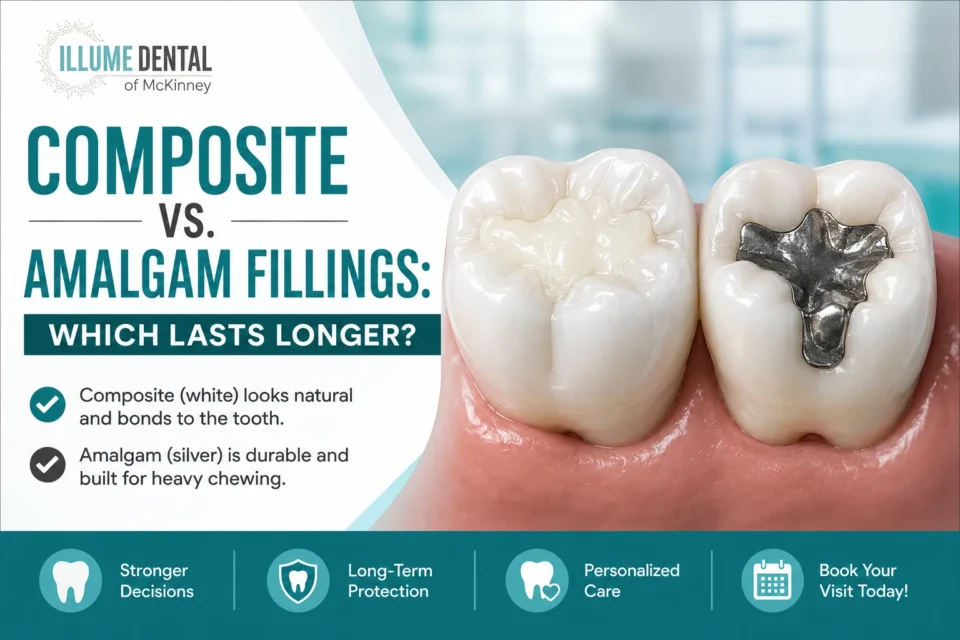
It depends on the situation. Composite (tooth-colored) fillings blend in visually and bond directly to the tooth, which can help preserve more natural structure. Amalgam is typically stronger under heavy chewing pressure and often lasts longer in large back-tooth restorations. Your dentist can recommend the better fit based on the size and location of the filling.
How do I know if my old filling needs to be replaced?
Not every old filling needs to come out. A dentist typically evaluates whether there is decay underneath, whether the margins are breaking down, whether cracks are present, and how much healthy tooth structure remains. Many fillings can simply be monitored at regular checkups rather than replaced right away.
Notice cracks or pain when chewing?
Leaking silver fillings can weaken your teeth over time. Call today for a professional exam and treatment options.