Same-Day Technology vs. Traditional Lab-Made Crowns
If your tooth needs a crown, you may be given what sounds like an obvious choice:
Get the crown in one appointment or wait a couple of weeks for a dental laboratory to make it.
Same-day wins, right?
Not necessarily.
Modern chairside CAD/CAM systems can produce excellent crowns without a temporary restoration or second appointment. Traditional laboratory-made crowns can also produce excellent results and may give the dentist and technician more flexibility with materials, color, characterization, and complicated cases.
The important point is this:
“Same-day” describes the workflow. It does not automatically tell you whether the crown will fit better, look better, or last longer.
Likewise, a crown being made by a dental laboratory does not automatically make it superior.
The better question is:
Which fabrication method gives this particular tooth the material, fit, esthetics, and design it actually needs?
Here is how the two approaches compare.
What Is a Same-Day Crown?
A same-day crown is generally made using a digital CAD/CAM workflow.
CAD/CAM stands for computer-aided design and computer-aided manufacturing.
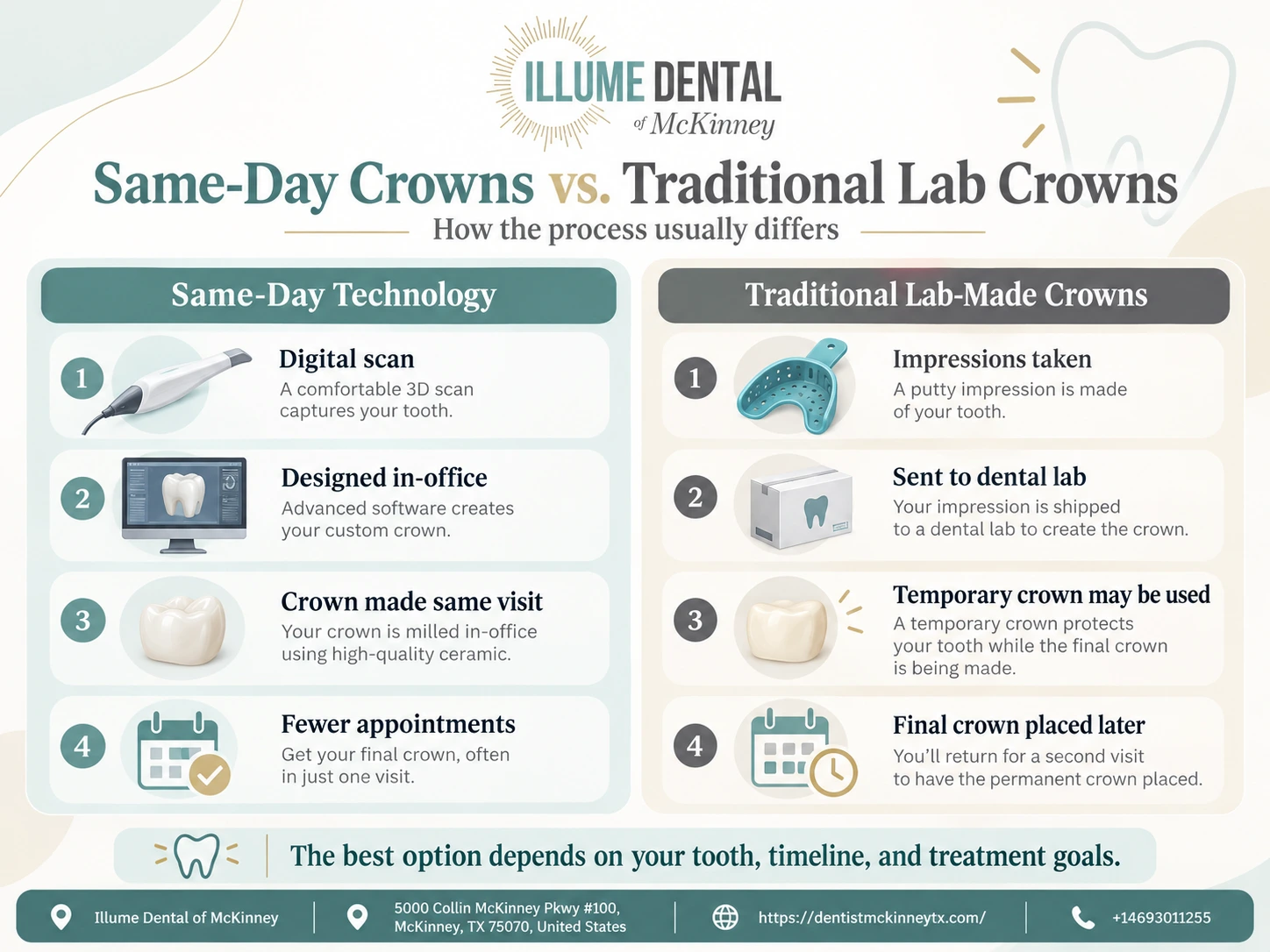
A typical appointment may look something like this:
- The dentist numbs and prepares the tooth.
- A digital scanner captures the prepared tooth, neighboring teeth, and bite.
- Software creates a three-dimensional model.
- The crown is designed digitally.
- A milling machine fabricates the restoration from a ceramic or other dental material block.
- Depending on the material, the crown may be polished, stained, glazed, or fired in a dental furnace.
- The dentist checks the fit, contacts, appearance, and bite.
- The crown is bonded or cemented.
In an appropriate case, all of that can happen during one visit.
That means you may leave with the final crown instead of a temporary.
What Is a Traditional Lab-Made Crown?
A laboratory-made crown usually involves at least two clinical appointments.
At the first visit, the dentist prepares the tooth and records its shape using either a digital scan or a traditional impression.
Then:
- The information is sent to a dental laboratory.
- A dental technician designs and fabricates the crown.
- You wear a temporary crown while the final restoration is being made.
- You return for another appointment.
- The temporary is removed.
- The dentist evaluates the final crown.
- The crown is cemented or bonded if everything looks appropriate.
Illume Dental of McKinney’s currently published crown process describes this laboratory workflow: a mold or digital scan is taken after tooth preparation, and a temporary crown protects the tooth while the personalized restoration is fabricated by a dental laboratory over the following weeks.
That distinction matters because digital dentistry and same-day dentistry are not the same thing.
A crown can be digitally scanned, digitally designed, and still be fabricated by an outside laboratory.
The Biggest Advantage of a Same-Day Crown: Convenience
For a busy McKinney professional or parent, this is not a trivial benefit.
A traditional crown can require:
- A preparation appointment
- Time wearing a temporary crown
- A second trip to the dental office
- Another round of getting numb in some cases
- Time away from work or family responsibilities
With a successful same-day workflow, you may eliminate much of that.
There is also no temporary crown to:
- Come loose
- Break
- Feel bulky
- Become sensitive
- Require an unexpected trip back to the dentist
If you have ever had a temporary crown come off the night before an important meeting, the appeal is obvious.
But Faster Does Not Automatically Mean Better
This is where dental technology marketing can get ahead of reality.
A milling machine does not diagnose the tooth.
Software does not decide whether you actually need a crown.
And a digital design does not automatically compensate for:
- A poorly prepared tooth
- Moisture or bleeding around the crown margin
- An inaccurate scan
- Inadequate material thickness
- An unfavorable bite
- Poor bonding technique
- Choosing the wrong material
- A crack that was not properly diagnosed
Research supports CAD/CAM crowns as a clinically legitimate option. A 2023 systematic review concluded that lithium-disilicate and zirconia crowns made with CAD/CAM and digital impressions could achieve clinically acceptable marginal and internal fit.
But the evidence does not support the simplistic claim that a computer-made crown is always more accurate.
A recent umbrella review found no statistically significant difference in average marginal gaps between conventionally fabricated and CAD/CAM crowns across the evidence it reviewed.
Translation:
Both workflows can produce excellent crowns. Execution matters.
Which Crown Fits Better?
Patients often hear that digital technology creates a “perfect fit.”
There is no such thing as a literally perfect dental crown.
Dentists evaluate factors such as:
- How closely the crown meets the tooth at its margins
- Internal adaptation
- Contact with neighboring teeth
- Bite
- Stability
- Whether the crown seats completely
Studies comparing fabrication methods generally show that both conventional and CAD/CAM methods can fall within clinically acceptable ranges.
A 2024 systematic review reported slightly smaller marginal discrepancies and better internal adaptation with CAD/CAM crowns in the included studies, but the differences were not statistically significant.
Another systematic review comparing pressed versus CAD/CAM lithium-disilicate crowns similarly found no statistically significant difference in marginal adaptation, with both techniques producing clinically acceptable results.
So if someone tells you:
“Same-day crowns fit better because computers are more accurate than dental labs,”
that deserves a little skepticism.
Digital technology can be highly precise.
So can an excellent laboratory.
The Material May Matter More Than Where the Crown Is Made
This is one of the most important parts of the comparison.
Patients tend to compare:
Same-day crown vs. lab crown.
Dentists often need to think:
What material should this particular tooth receive?
Crowns can be fabricated from materials including:
- Lithium disilicate
- Zirconia
- Layered ceramics
- Porcelain fused to metal
- Gold and other metal alloys
- Various newer CAD/CAM restorative materials
Different materials have different strengths.
Some prioritize esthetics.
Some prioritize fracture resistance.
Some require different preparation thicknesses.
Some can be bonded adhesively.
Some work particularly well when there is limited space.
A same-day office may have several excellent material choices—but a dental laboratory may have access to a broader range of materials and fabrication techniques.
That becomes important in complex cases.
Where Same-Day Crowns Can Be Excellent
Chairside fabrication can make a great deal of sense for an uncomplicated posterior tooth.
Imagine a molar with:
- A large failing filling
- Adequate remaining tooth structure
- No major esthetic challenge
- A clearly visible preparation
- Good moisture control
- A straightforward bite
- An appropriate ceramic material
This can be an excellent CAD/CAM case.
The dentist can prepare the tooth, scan it, design the restoration, fabricate it, evaluate it, and potentially deliver it without asking you to live with a temporary crown.
Convenience and quality do not have to be opposites.
Where a Dental Laboratory May Have the Advantage
Some cases benefit from having a skilled dental technician involved.
Highly visible front teeth
Matching one upper front tooth can be surprisingly difficult.
Natural teeth are not simply “white.”
They contain variations in:
- Translucency
- Opacity
- Surface texture
- Brightness
- Color
- Characterization
- How they reflect light
A laboratory technician may use multiple ceramic layers, custom staining, photography, and detailed characterization to reproduce those effects.
Can a same-day crown look beautiful?
Absolutely.
But when matching one highly visible front tooth is especially demanding, laboratory involvement may provide more flexibility.
Complicated color matching
If surrounding teeth contain unusual translucency, staining, internal color variations, or previous restorations, a simple shade selection may not be enough.
A lab technician can sometimes customize the restoration in ways that are difficult to reproduce from a single prefabricated ceramic block.
Certain complex restorative cases
Multiple crowns, bridges, implants, significant bite changes, and larger cosmetic cases may benefit from a laboratory workflow because there are more variables to coordinate.
When a particular material is preferred
The best material for the tooth may not be available in the dental office’s chairside system.
Choosing a less appropriate material just to meet a “same-day” promise would put convenience ahead of treatment planning.
That is backwards.
Does a Lab-Made Crown Mean Old-Fashioned Impressions?
Not anymore.
This distinction causes a lot of confusion.
You can have a digital impression and a lab-made crown.
The dentist scans your tooth rather than putting a tray full of impression material in your mouth.
The digital file is then sent electronically to the dental laboratory.
Illume Dental’s published crown information specifically notes that either a mold or digital scan may be used to capture the tooth before laboratory fabrication.
So the comparison is not necessarily:
High-tech digital crown vs. old-fashioned goop crown.
It may actually be:
Digital scan + chairside fabrication
versus
Digital scan + laboratory fabrication.
Both can be highly digital workflows.
What Is the Downside of Wearing a Temporary Crown?
Temporary crowns are useful, but they are temporary for a reason.
They protect the prepared tooth while the final crown is being fabricated.
During that period, they can occasionally:
- Come loose
- Fracture
- Feel rougher than the final crown
- Cause temporary sensitivity
- Make chewing awkward
- Allow minor tooth movement if lost for too long
Patients also usually need to be careful with sticky foods while wearing one.
This is a legitimate advantage of same-day treatment:
If the final restoration can be fabricated appropriately during the first appointment, eliminating the temporary eliminates an entire category of inconvenience.
Still, most properly managed temporary crowns do their job without major problems.
Wearing one for a couple of weeks is not inherently harmful.
What Happens If a Same-Day Crown Doesn’t Look Right?
You should not accept a crown simply because the milling machine already made it.
Your dentist should still evaluate:
- Fit
- Contacts
- Bite
- Shade
- Shape
- Surface
- Overall appearance
If something is unacceptable, adjustments may be possible.
In some situations, the crown may need to be remade.
The fact that a restoration was produced in the office does not mean convenience should override quality control.
For a visible cosmetic crown, you should also be involved in evaluating the appearance before final cementation whenever practical.
Can a Dental Lab Crown Come Back Wrong?
Of course.
Dental laboratories are not infallible either.
A crown may return with:
- A contact that is too tight
- A contact that is too light
- An incorrect shade
- A bite discrepancy
- An esthetic problem
- A fit issue requiring correction
Sometimes the dentist can adjust the crown.
Sometimes it needs to go back to the laboratory.
That may mean additional time in the temporary crown.
This is one area where chairside digital manufacturing has an obvious logistical advantage: if the dentist discovers a fabrication problem while you are still there, a replacement may sometimes be produced without shipping anything across town or across the country.
Which One Lasts Longer?
There is no responsible answer that says:
“Same-day crowns last X years and lab crowns last Y.”
Longevity depends on far more than where the restoration was manufactured.
Important factors include:
- Crown material
- Tooth preparation
- Remaining tooth structure
- Crown fit
- Cementation or bonding
- Your bite
- Grinding and clenching
- Where the crown is located
- Oral hygiene
- Decay risk
- Diet
- Whether the tooth had a root canal
- Future cracks or fractures
Research comparing CAD/CAM and conventional crown workflows generally supports CAD/CAM restorations as a viable clinical option, but differences in materials and study designs make sweeping superiority claims difficult.
The machine is only one part of the restoration’s success.
What About Zirconia Same-Day Crowns?
Zirconia is widely used because of its strength and increasingly good esthetics.
But zirconia manufacturing has an extra consideration.
Many zirconia restorations are milled in a partially sintered state and then require a high-temperature sintering cycle to achieve their final properties.
Newer furnaces and materials can make this process much faster than it once was, which makes same-visit zirconia possible in some offices.
But “same-day zirconia” is still not one universal product.
Different zirconias vary in:
- Strength
- Translucency
- Esthetics
- Sintering protocols
- Indications
Again, material selection should come before speed.
What About Same-Day Crowns for Front Teeth?
They can be done.
Whether they should be done depends on the case.
If several front teeth are being restored with a material that can be predictably characterized in the office, same-day technology may work beautifully.
If the dentist is trying to match one crown perfectly between two untouched natural front teeth, the case may deserve more customization.
This is where a talented ceramist can be valuable.
A useful question to ask is:
“How difficult is my shade match, and would a laboratory technician improve the result?”
A dentist who is focused on the outcome rather than the equipment should give you a straightforward answer.
Is One Option Better if You Grind Your Teeth?
Grinding changes the material discussion more than the fabrication discussion.
A patient who clenches or grinds heavily may need:
- A stronger material
- Adequate crown thickness
- Careful bite adjustment
- Thoughtful crown design
- A nightguard in appropriate cases
A chairside crown made from the right material may work well.
A lab-made crown made from an unsuitable material may not.
And vice versa.
If you have a history of broken teeth, cracked crowns, or chipped porcelain, tell your dentist before deciding on the restoration.
Is a Same-Day Crown More Expensive?
Not automatically.
The office has invested in scanners, design software, milling equipment, furnaces, materials, and training but it may also avoid an outside laboratory fee and eliminate a second clinical visit.
Some offices charge more for same-day convenience.
Some charge roughly the same.
Some laboratory-made crowns cost more because of the material or level of customization involved.
Dental insurance may also treat both restorations under the same general crown benefit.
So instead of asking:
“Which technology costs less?”
Ask:
“What is my total out-of-pocket cost for the crown you are recommending?”
Illume Dental currently publishes a dental crown fee of $1,701, while noting that prices can change and treatment costs depend on individual patient needs.
Insurance benefits, deductibles, annual maximums, and network status can all change what an individual patient actually pays.
Is the Same-Day Option Worth Paying More For?
Sometimes.
Suppose you would otherwise need to:
- Miss work twice
- Arrange childcare twice
- Drive across McKinney twice
- Wear a temporary for several weeks
- Get numb at another appointment
Paying somewhat more for a clinically appropriate one-visit restoration might have real value.
But if the proposed same-day crown costs substantially more, ask what you are actually paying for.
If the answer is simply “because it is same-day,” decide how much that convenience is worth to you.
Do not assume the more expensive option is automatically more durable.
Is the Lab-Made Option Worth Waiting For?
Sometimes that answer is also yes.
If your front tooth requires unusually demanding esthetics, a specific restorative material, extensive characterization, or coordination with several other restorations, waiting for a laboratory technician may produce benefits that matter more than saving an appointment.
Two visits are inconvenient.
Remaking a front crown you dislike every time you smile is considerably more inconvenient.
What Should Matter More Than Same-Day vs. Lab?
These questions:
Did you actually need a full crown?
Before arguing about how the crown should be fabricated, make sure a crown is the appropriate restoration.
Some teeth may be treatable with a filling, inlay, onlay, or other more conservative restoration.
How many healthy teeth are being preserved?
Technology does not justify unnecessary tooth removal.
Is the preparation clearly captured?
Whether using a scanner or conventional impression, the laboratory or software needs accurate information.
What material is being recommended?
Ask why that material fits your tooth, bite, and esthetic needs.
How will the crown be checked?
A crown should be evaluated clinically before final cementation.
What happens if you don’t like the result?
This is particularly important for visible teeth.
Understand the remake and adjustment process beforehand.
Same-Day vs. Lab-Made Crowns: The Practical Comparison
| Question | Same-Day CAD/CAM | Traditional Lab-Made |
| Final crown in one visit? | Often | Usually no |
| Temporary crown needed? | Usually no | Usually yes |
| Digital impression possible? | Yes | Yes |
| Second appointment? | Often avoided | Usually required |
| Excellent fit possible? | Yes | Yes |
| Wide choice of materials? | Depends on office system | Often broader |
| Complex custom characterization? | Possible, but system-dependent | Often a strength |
| Good for posterior crowns? | Often excellent | Excellent |
| Good for highly demanding front-tooth cases? | Can be | Lab may offer more customization |
| More durable automatically? | No | No |
| Better because it uses more technology? | No | No |
Questions to Ask Before Choosing
If your dentist offers both workflows, ask:
- What material would you use for the same-day crown?
- What material would the lab use?
- Is there a meaningful durability difference for my tooth?
- How difficult is the shade match?
- Would a dental technician improve the cosmetic result?
- Do I need a temporary lab option?
- How long would the lab crown take?
- Is there a price difference?
- What happens if the same-day crown needs to be remade?
- Which one would you choose for your own tooth, and why?
The last question can be especially revealing.
You are not asking which technology the dentist likes more.
You are asking which restoration makes sense for your specific tooth.
When We Would Be Cautious About a “Same-Day Is Always Better” Sales Pitch
Dental technology can genuinely improve patient care.
It can also become marketing.
Be cautious if you hear claims such as:
“Same-day crowns always fit better.”
The evidence does not establish that as a universal truth. Both CAD/CAM and conventional methods can achieve clinically acceptable fit.
“Lab crowns are outdated.”
Many sophisticated laboratory crowns begin with digital scans and are designed or manufactured using digital technology.
“You never need a dental technician anymore.”
For certain complex and highly esthetic cases, an experienced technician can still be extremely valuable.
“Our machine makes a perfect crown.”
No machine makes clinical judgment irrelevant.
Technology should improve dentistry.
It should not replace thinking.
For McKinney Patients Comparing Crown Options
For patients in McKinney, convenience matters.
Taking two mornings off work for one tooth may feel ridiculous if a reliable one-visit solution is available.
That is a completely reasonable consideration.
But speed should be one factor, not the entire treatment plan.
Illume Dental’s published crown workflow currently describes taking an impression or digital scan, providing a temporary restoration, and having the personalized final crown fabricated by a dental laboratory. The practice also reports using digital imaging and 3D scanning technology as part of restorative diagnosis and treatment planning.
That type of workflow can still be thoroughly modern.
The important question is whether the dentist is using the technology and fabrication method that best serves the tooth rather than chasing the shortest appointment count.
Frequently Asked Questions
Are same-day crowns as good as lab-made crowns?
They can be.
CAD/CAM crowns can achieve clinically acceptable fit and are a well-established restorative option. Lab-made crowns can also provide excellent fit, durability, and esthetics. The better choice depends on the tooth, material, cosmetic demands, and clinical execution.
Do same-day crowns last as long?
They can provide long-term service when appropriately designed, fabricated, and maintained. Longevity depends heavily on the restorative material, tooth condition, bite, preparation, cementation, and patient habits—not simply whether the crown was produced in one day.
Is a same-day crown weaker?
Not inherently.
Some chairside ceramics have excellent strength. What matters is whether the material chosen is appropriate for the tooth and has adequate thickness and support.
Are laboratory crowns more natural-looking?
Not automatically.
Same-day restorations can be highly aesthetic. However, complicated front-tooth shade matching and characterization may benefit from the additional customization available through an experienced dental laboratory.
Can a lab-made crown still use a digital scan?
Yes.
A dentist can digitally scan the prepared tooth and electronically send that information to the laboratory. Traditional laboratory fabrication does not necessarily mean traditional impression material. Illume Dental’s published crown workflow specifically notes the option of a digital scan.
Why would I choose two appointments if a same-day crown exists?
A laboratory workflow may provide access to a particular material, more complex fabrication, or additional cosmetic customization. In some cases, those benefits are worth the second visit.
Why would I choose the same-day instead?
Convenience is the obvious reason. You may avoid a temporary crown, a second appointment, and additional time away from work or family while still receiving an excellent restoration when the case is appropriate.
Does insurance cover same-day crowns differently?
Often the underlying crown procedure is what determines benefits rather than whether it was milled in the office, but insurance policies vary. Ask the office for a benefit estimate based on your specific plan.
Which is better for a back tooth?
Both methods can work very well.
A straightforward molar can be an excellent candidate for chairside CAD/CAM treatment. Material selection, remaining tooth structure, bite forces, grinding habits, and preparation design matter more than whether the milling machine is inside the dental office.
Which is better for a front tooth?
It depends on how demanding the cosmetic match is.
A same-day crown can look excellent, but a difficult single-front-tooth match may benefit from the customization and artistic input of a skilled dental laboratory technician.
The Bottom Line
Same-day crown technology solves a real problem:
It can give you a final restoration without weeks in a temporary or another trip to the dentist.
That is valuable.
But it does not make dental laboratories obsolete.
A high-quality laboratory can provide additional material choices, customization, and esthetic control that may matter considerably in the right case.
So do not choose your crown based only on how quickly it can be made.
Choose based on:
The tooth.
The material.
The fit.
The bite.
The aesthetic demands.
And the experience of the people designing and delivering it.
If a one-visit crown can meet those requirements, faster is a genuine advantage.
If a laboratory can produce a more appropriate restoration for the case, waiting may be the smarter decision.
At Illume Dental of McKinney, the useful conversation is not simply, “How fast can we make your crown?”
It is:
“What does this tooth need for the best chance of a predictable result?”
That is the question worth answering before anyone starts drilling.