
Inlays/Onlays vs. Traditional Crowns: Saving Your Natural Tooth Structure
If a tooth is too damaged for a filling, many patients assume the next step is automatically a crown.
Not always.
Sometimes an inlay or onlay can rebuild the damaged portion of the tooth without requiring the dentist to cover the entire tooth with a traditional crown. The potential advantage is simple: more healthy natural teeth can remain untouched.
That sounds automatically better but it is not quite that simple.
The most conservative restoration is the one that preserves healthy tooth structure and is strong enough to predictably protect what remains.
An onlay that is too conservative for a badly fractured tooth is not a victory if the tooth breaks six months later. And a full crown can be unnecessarily aggressive if most of the tooth is healthy and a smaller bonded restoration would predictably solve the problem.
The decision comes down to what is actually left of your tooth.
First: What Is the Difference Between an Inlay, an Onlay, and a Crown?
These restorations all repair damaged teeth, but they cover different amounts of tooth structure.
An inlay fits inside the tooth
Think of an inlay as a precisely fabricated filling.
It replaces damaged tooth structure between the cusps of the raised points of a back tooth without covering those cusps.
Inlays can be made from materials such as ceramic or composite resin and are typically fabricated outside the mouth or through a digital CAD/CAM workflow.
They are most useful when the center of the tooth needs substantial rebuilding but the surrounding cusps remain strong.
An onlay covers part of the chewing surface
An onlay is larger.
It replaces the damaged center of the tooth and covers one or more weakened cusps.
This gives the dentist the ability to protect vulnerable parts of the tooth without necessarily removing enough structure to place a full crown.
You may also hear terms such as:
- Partial crown
- Overlay
- Partial-coverage restoration
The terminology varies depending on exactly how much of the tooth is being covered.
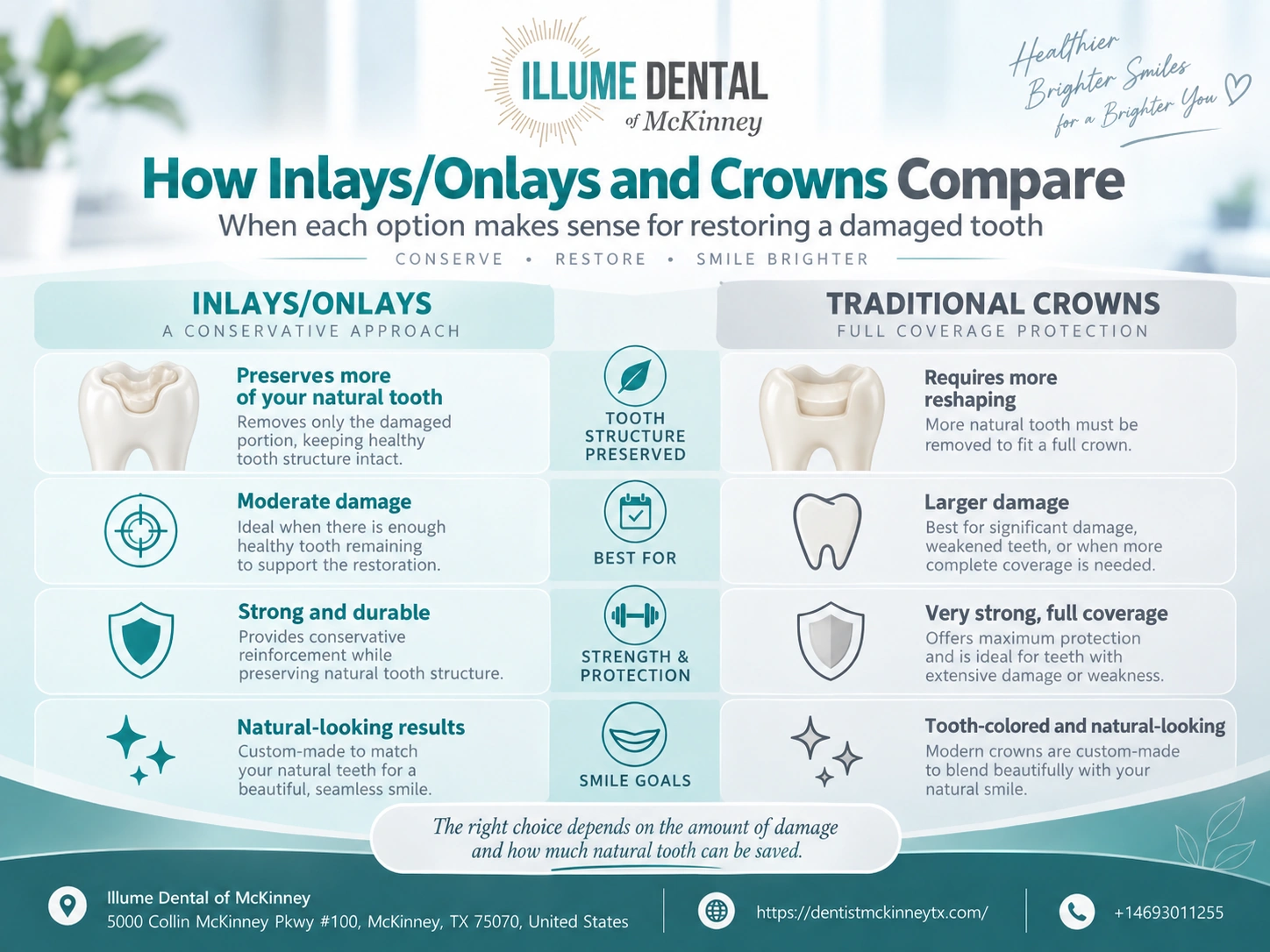
A traditional crown covers essentially the entire visible tooth
For a full crown, the tooth is prepared around its circumference so the restoration can fit over it.
Crowns can provide extensive protection for teeth that are heavily broken down, cracked, weakened, or already contain very large restorations.
The tradeoff is straightforward:
More tooth structure generally has to be prepared to make room for a full crown.
That preparation is irreversible.
Why Preserving Natural Tooth Structure Matters
Dental materials have become extremely good.
They are still not natural enamel.
Every time additional healthy tooth is removed, you have less original tooth available for whatever treatment that tooth may need later in life.
That matters because dentistry tends to have a progression.
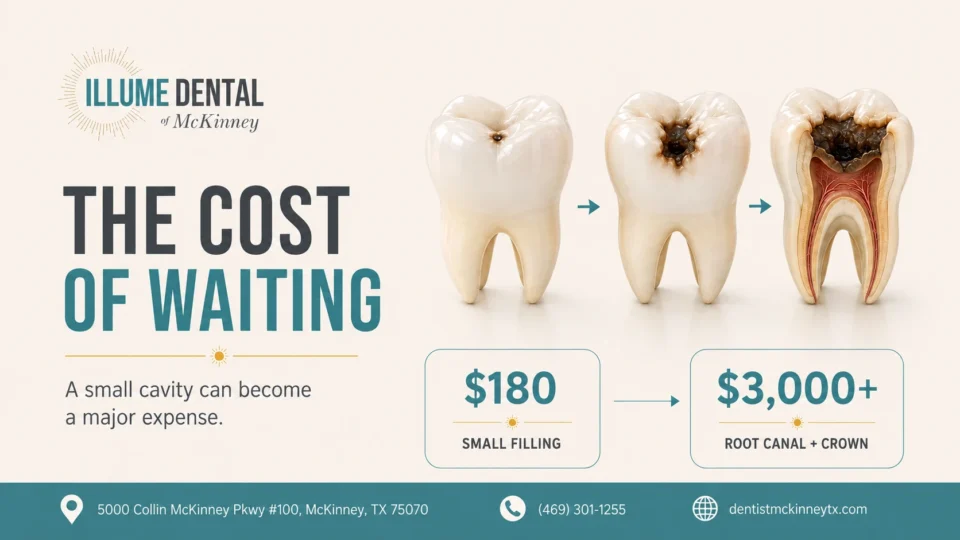
A small cavity may become a filling.
A very large filling may eventually require an onlay or crown.
A heavily damaged tooth may eventually require root canal treatment.
If the tooth becomes non-restorable, extraction may become necessary.
The goal is not to pretend dental work lasts forever.
The goal is to delay that progression whenever it is clinically reasonable.
A partial-coverage restoration can sometimes accomplish that by replacing only the weakened portions of the tooth while leaving strong enamel and dentin intact.
Research supports partial-coverage restorations as a legitimate restorative option rather than simply a “lesser crown.” Systematic reviews have found high survival rates for both crowns and inlays/onlays, although differences in study designs make direct long-term comparisons difficult.
So Why Doesn’t Every Dentist Use an Onlay Instead of a Crown?
Because not every tooth gives us enough healthy structure to preserve.
Imagine a house with one damaged wall.
You would not demolish all four walls simply because one needs repair.
But if three walls are collapsing and the foundation is compromised, carefully preserving one small section of drywall does not make the house safer.
Teeth work the same way.
An onlay becomes attractive when the dentist can identify strong, predictable tooth structure worth keeping.
A crown becomes more attractive when most of the tooth needs protection.
When an Inlay May Make Sense
An inlay may be appropriate when:
- A cavity or old filling is too large for a predictable direct filling
- The damage remains primarily within the center of the tooth
- The cusps are still strong
- There are no significant cracks requiring cuspal protection
- Enough enamel remains for reliable bonding
- The dentist can adequately isolate the tooth during treatment
One thing patients should know: modern bonded fillings have reduced how often traditional inlays are necessary.
If a defect is relatively modest, a high-quality direct composite filling may be simpler and less expensive.
Once a tooth becomes substantially weakened, an onlay that protects one or more cusps may make more sense than an inlay.
So the real decision is often not simply “inlay versus crown.”
It may be:
Filling vs. onlay vs. crown.
When an Onlay May Be the Sweet Spot
Onlays can be particularly useful when a tooth has substantial damage but still has healthy portions worth preserving.
For example, imagine a molar with:
- A very large old filling
- One cracked or weakened cusp
- Two other cusps that remain strong
- Healthy tooth structure around much of the outside of the tooth
A full crown might protect everything.
But it may also require preparing healthy areas that did not necessarily need to be removed.
An onlay could potentially replace the large filling, cover the compromised cusp, and leave stronger areas intact.
That is the appeal of partial-coverage dentistry.
Recent reviews suggest that appropriately selected posterior teeth restored with onlays or partial crowns can perform well, with short-term survival comparable to full crowns in available studies. Researchers also caution that long-term evidence is still less extensive than many patients assume.
In other words:
Onlays are not experimental. But they are also not automatically superior to crowns in every situation.
When a Traditional Crown Is Probably the Better Choice
There are situations where trying to preserve every last millimeter of tooth becomes false economy.
A crown may make more sense when:
Most of the tooth is already filling
Sometimes there is technically enamel left but very little of it is structurally useful.
If several walls of the tooth are thin, undermined, cracked, or largely composed of old restorative material, the tooth may need broader protection.
Multiple cusps are badly weakened
Back teeth absorb significant chewing forces.
If several cusps are at risk of fracturing, a restoration that covers the entire chewing surface may provide more predictable protection.
A crack extends significantly through the tooth
Cracked teeth require careful judgment.
A small fractured cusp may be treatable with an onlay.
A more extensive crack may require greater coverage.
And some cracks extend so deeply that neither an onlay nor a crown can reliably save the tooth.
That is why diagnosing the crack matters more than simply choosing the smallest restoration.
There is very little tooth structure remaining
Bonding technology is impressive, but it does not eliminate basic engineering.
The dentist still needs enough healthy tooth to support and retain the restoration.
The existing crown already removed most of the tooth
If a tooth already has a full crown, replacing that crown with an onlay usually does not magically restore the tooth structure that was removed years earlier.
Once natural tooth is prepared away, it does not grow back.
The opportunity to choose partial coverage is most meaningful before the tooth has already been prepared for a full crown.
What About Teeth That Have Had Root Canals?
This is one of the most interesting areas of modern restorative dentistry.
Historically, many posterior root-canal-treated teeth were routinely restored with full crowns.
Today, bonded onlays and other partial-coverage restorations may be considered for some endodontically treated teeth when enough sound structure remains.
Systematic reviews have reported favorable short- to medium-term outcomes for appropriately selected root-canal-treated posterior teeth restored with cuspal-coverage onlays. However, researchers also note limitations in the available evidence and the need for longer-term data.
The practical takeaway is:
A root canal does not tell you everything you need to know about the final restoration.
What matters is how much healthy tooth remains, where it remains, whether the tooth is cracked, and what forces that tooth will experience.
For one patient, an onlay may be appropriate.
For another, a full crown may be much more predictable.
Isn’t a Crown Stronger?
That question sounds simple, but “stronger” can mean several things.
A full crown provides extensive coverage.
That can be very useful when the remaining tooth needs extensive reinforcement.
But placing a crown also requires removing additional tooth structure.
An onlay relies more heavily on adhesive bonding and preservation of the existing tooth.
So instead of asking:
“Which restoration is stronger?”
A better question is:
“Which design gives this particular tooth enough protection while sacrificing the least healthy structure?”
That is a much more clinically useful question.
Can Onlays Actually Protect Against Tooth Fracture?
That is one of their main purposes.
When one or more cusps have become weakened, an onlay can cover them and redistribute chewing forces.
Interestingly, a 2023 systematic review comparing onlays with crowns in heavily restored posterior teeth found insufficient evidence to declare one universally superior, but the included studies suggested that failures involving onlays may sometimes be less catastrophic and more repairable than failures involving full crowns. The authors emphasized that stronger evidence is still needed.
That distinction matters.
A dental restoration should not only be judged by whether it eventually fails.
We should also care about what happens to the tooth when it fails.
What Materials Are Used for Inlays and Onlays?
Modern partial restorations may be fabricated from several materials.
Common options include:
- Lithium-disilicate ceramic
- Other dental ceramics
- Resin-based CAD/CAM materials
- Composite-based materials
- Gold in some situations
There is no universally “best” material.
The choice depends on factors such as:
- How much tooth remains
- Where the restoration is located
- How hard you bite
- Whether you grind your teeth
- Available enamel for bonding
- Esthetic expectations
- Restoration thickness
- The dentist’s workflow
Recent research on ceramic partial-coverage restorations shows generally favorable performance, but results vary by material and study design. Ceramic fracture and loss of retention remain among the complications dentists monitor over time.
Are Onlays More Comfortable Than Crowns?
During the procedure, the experience may feel fairly similar.
Both usually involve:
- Numbing the tooth.
- Removing decay and defective restorative material.
- Preparing the tooth.
- Capturing an impression or digital scan.
- Fabricating the restoration.
- Bonding or cementing it into place.
The difference is primarily how much of the tooth must be prepared.
If your dental office uses digital impressions, both onlays and crowns can often be scanned without traditional impression trays.
Depending on the technology available and the clinical situation, some restorations may also be fabricated through a same-day CAD/CAM workflow.
Does an Onlay Last as Long as a Crown?
This is where marketing claims need some restraint.
Both can last many years.
A systematic review examining inlays, onlays, and crowns found five-year survival above 90% across the restoration categories evaluated, although the researchers could not make a reliable head-to-head comparison because the available studies were too different from one another.
Other reviews have similarly found encouraging results for partial-coverage restorations while emphasizing limitations in long-term evidence.
What determines longevity in the real world includes much more than the name of the restoration:
- How much healthy tooth remained
- Whether decay was completely controlled
- Quality of the bond or cementation
- Restoration design
- Material selection
- Your bite
- Grinding or clenching
- Oral hygiene
- Diet
- Future cavities
- Regular dental maintenance
A badly selected onlay can fail.
So can a badly selected crown.
Is an Onlay Cheaper Than a Crown?
Not necessarily.
This surprises patients because an onlay covers less tooth.
But you are not primarily paying for the amount of porcelain involved.
An indirect onlay can require many of the same steps as a crown:
- Tooth preparation
- Digital scanning or impressions
- Restoration design
- Laboratory or CAD/CAM fabrication
- Ceramic material
- Adhesive bonding
- Bite adjustment
- Clinical time
Depending on the dental office, material, insurance plan, and procedure, the fees for an onlay and crown may be relatively close.
Insurance can complicate the comparison further because plans may reimburse partial-coverage restorations differently.
So if your primary goal is simply finding the cheaper restoration, ask for the actual treatment estimate.
Do not assume “smaller restoration” automatically means “smaller bill.”
If They Cost About the Same, Why Choose an Onlay?
Because the potential benefit is not necessarily financial.
It is biologic.
You may be able to keep more of your own healthy tooth.
That can matter enormously over decades.
Imagine needing dental work at 35.
The question is not only whether the restoration survives until 45.
You also care about what options remain at 55, 65, and beyond.
Preserving usable tooth structure today can sometimes leave more options available if the restoration eventually needs repair or replacement.
Is More Conservative Dentistry Always Better?
No.
This deserves to be said clearly.
“Conservative dentistry” sounds so appealing that it can become a marketing phrase.
Patients hear:
“We save more tooth.”
And understandably assume that must always mean better dentistry.
But leaving structurally compromised tooth simply so we can claim that less was drilled is not truly conservative.
If a cusp is likely to fracture, protecting it can be more conservative than waiting for it to break.
If extensive cracks require broader coverage, a crown may protect the tooth better.
If the tooth cannot predictably support either restoration, extracting it may eventually be the more responsible discussion.
Conservative treatment means removing no more healthy tissue than necessary not refusing to remove tissue that genuinely needs to be treated.
What About Grinding and Clenching?
Your bite matters enormously.
Patients who grind or clench may put much greater forces on ceramic restorations than they realize.
That does not automatically disqualify you from an onlay.
But the dentist may need to consider:
- Which cusps require coverage
- Restoration thickness
- Material selection
- Your bite pattern
- Whether opposing teeth are natural or restored
- Whether a nightguard is appropriate
If your previous restorations repeatedly chip or break, simply changing from a crown to an onlay will not necessarily solve the underlying force problem.
The restoration and the bite have to be considered together.
How Does a Dentist Decide Between a Filling, Onlay, and Crown?
There should not be one arbitrary cutoff.
Instead, the dentist evaluates what remains after decay, fractures, and old restorations are considered.
The decision often comes down to questions like:
How much healthy enamel remains?
Enamel can provide an excellent bonding surface for adhesive restorations.
Are the cusps strong or undermined?
A large filling beneath a thin cusp can leave that cusp vulnerable to fracture.
Is the tooth cracked?
The location and extent of the crack may change the restoration completely.
How much of the tooth is already restorative material?
A tooth that appears large externally may contain surprisingly little natural structure.
What does the patient’s bite look like?
A heavily loaded molar requires different planning than a tooth that experiences relatively modest forces.
Can the tooth be kept clean and dry during bonding?
Bonded restorations are technique-sensitive. Moisture contamination can compromise adhesion.
What happens if the restoration fails?
Dentists should consider not only immediate success but also whether future failure is likely to leave the tooth repairable.
Questions Worth Asking Before You Agree to a Crown
If a dentist recommends a full crown and you still have substantial natural tooth remaining, it is reasonable to ask:
“Could this tooth be restored with an onlay instead?”
That does not mean your dentist’s crown recommendation is wrong.
It means you want to understand the reasoning.
Other useful questions include:
- Which parts of my tooth are actually weak?
- Are any cusps cracked?
- How much healthy tooth would need to be removed for the crown?
- Would an onlay protect the tooth adequately?
- If not, why not?
- Does grinding affect the recommendation?
- Can you show me the problem on my X-ray, photograph, or scan?
A thoughtful dentist should be able to explain the difference without making it difficult for ask.
When You Probably Shouldn’t Fight for an Onlay
There is also a point where patients can become too focused on avoiding a crown.
If the tooth is extensively fractured, badly decayed, structurally compromised, or lacks adequate remaining support, choosing a smaller restoration simply because it removes less tooth may increase your risk of another failure.
Saving tooth structure is valuable.
Saving weak tooth structure at all costs is not.
Sometimes the full crown really is the conservative decision because it provides the protection necessary to keep the tooth.
For McKinney Patients Comparing Their Restorative Options
Adults in McKinney often arrive for a second opinion after hearing:
“That filling is too big. You need a crown.”
Sometimes that is exactly right.
But there is a useful question between those two treatments:
Is there enough healthy tooth left for a bonded partial-coverage restoration?
Modern adhesive dentistry has expanded what dentists can sometimes accomplish without placing a full crown.
That does not mean every damaged molar deserves an onlay.
It means treatment should be based on the actual tooth rather than an automatic rule that “large filling equals crown.”
For patients trying to avoid unnecessary dental work while still choosing a restoration that has a realistic chance of lasting, that distinction matters.
Frequently Asked Questions
What is the biggest difference between an onlay and a crown?
An onlay covers only the portions of the tooth that need additional protection, while a traditional crown covers essentially the entire visible portion of the tooth.
Is an onlay better than a crown?
Neither is universally better.
An onlay may be better when there is significant healthy tooth structure worth preserving. A crown may be more predictable when the tooth is extensively weakened, fractured, or heavily restored.
Does getting an onlay require less drilling?
Often, yes. Partial-coverage restorations are designed to preserve portions of healthy teeth that do not need to be removed. Exactly how much preparation is required depends on the tooth and restoration design.
Are onlays stronger than fillings?
An onlay can provide additional protection when a tooth has become too structurally compromised for a direct filling, particularly when one or more cusps need coverage.
Can an onlay replace a large filling?
Sometimes. If a large filling has weakened a cusp or the remaining tooth needs more support, an onlay may be considered.
Can an onlay be used instead of a crown after a root canal?
In selected teeth, yes. Available research suggests partial-coverage restorations can perform well on appropriately selected root-canal-treated posterior teeth, but the decision depends heavily on remaining tooth structure and the extent of damage.
Can an onlay fix a cracked tooth?
Sometimes.
It depends on where the crack is and how far it extends. Some cracks can be protected with cuspal coverage. Others require a full crown, root canal treatment, or in severe cases may make the tooth impossible to predictably restore.
Are onlays covered by dental insurance?
Some dental insurance plans provide benefits for inlays and onlays, but coverage varies substantially. Your plan may classify the procedure differently from a crown, so ask for a treatment estimate rather than assuming the benefits will be identical.
Why didn’t my previous dentist offer an onlay?
There can be many reasons.
The tooth may not have been an appropriate candidate. The dentist may use a different restorative philosophy or workflow. Certain materials or technologies may not have been available. And in some cases, a crown genuinely may have offered the more predictable result.
How do I know if I really need a crown?
You usually cannot determine that from the size of an old filling alone.
The dentist needs to evaluate the remaining tooth structure, cracks, decay, cusps, bite, X-rays, and sometimes photographs or a digital scan.
The Bottom Line
The goal of restorative dentistry should not be to remove as much tooth as possible so a crown can fit.
It also should not be to preserve every millimeter of tooth regardless of whether that tooth is strong enough to survive.
The goal is:
Preserve as much healthy natural tooth as reasonably possible while giving the damaged tooth enough protection to function predictably.
For some teeth, that means a filling.
For others, it means an inlay or onlay.
And sometimes a traditional crown is still the right answer.
If you have been told you need a crown and want to understand whether a partial-coverage restoration is realistic, Illume Dental of McKinney can evaluate the remaining tooth structure, cracks, old restorations, and bite and explain why one option may be more predictable than another.
The best restorative plan should not simply tell you what can be done.
It should explain what needs to be removed, what can safely be saved, and why.