
Why Your Gums Bleed When It’s Windy in North Texas: Cedar Fever, Dry Mouth & Inflammation
If you live in McKinney long enough, you start noticing the pattern.
A cold front comes through. The wind picks up. Your nose gets stuffy. Your eyes itch. You wake up with your mouth feeling like sandpaper.
Then you brush your teeth and notice pink in the sink.
It is tempting to blame the weather:
“The cedar pollen is making my gums bleed.”
That is probably not what is happening.
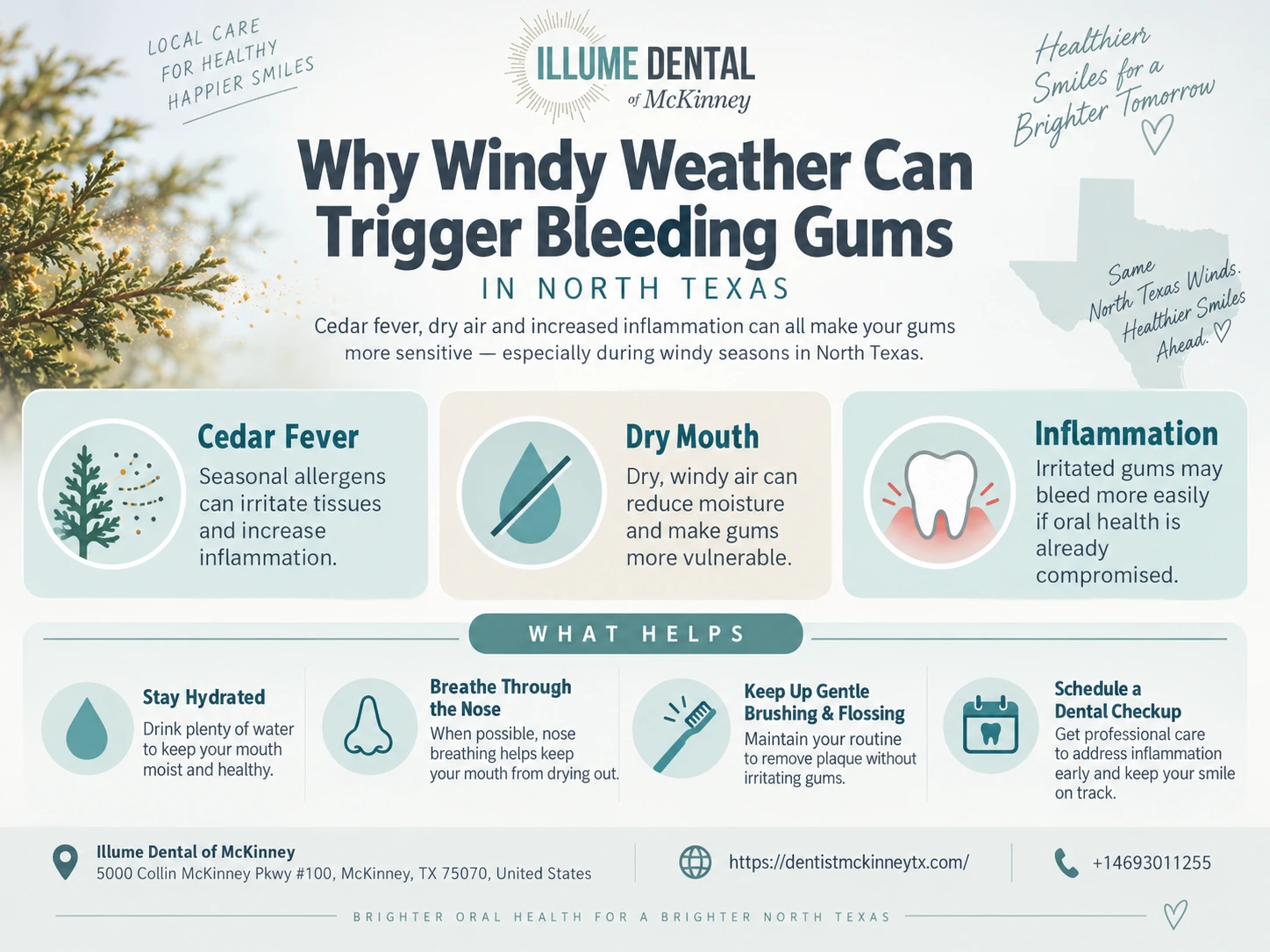
Wind and cedar pollen do not directly make healthy gums bleed. Bleeding gums are usually a sign that the gum tissue is already inflamed. North Texas allergy season can make that inflammation more noticeable by causing nasal congestion, mouth breathing, dry mouth, and sometimes medication-related dryness.
In other words:
Cedar fever may be the aggravating factor. It usually is not the underlying dental cause.
That distinction matters because waiting for allergy season to end will not necessarily fix gingivitis or periodontal disease.
Why Windy North Texas Days Can Feel So Much Worse
“Cedar fever” is the common Texas name for an allergic reaction to pollen from juniper trees, particularly Ashe juniper or “mountain cedar.”
North Texans can be affected even when much of the Ashe juniper is farther south.
Texas A&M Forest Service explains that cedar pollen is wind-dispersed and can travel long distances. Release commonly intensifies after winter cold fronts, when conditions become dry and windy and large amounts of pollen can enter the air at once.
North Texas health sources continue to describe winter cedar fever as a regional problem. Parkland Health notes that North Texas experiences overlapping allergy seasons throughout the year, including winter cedar pollen, spring tree pollen, summer grasses, and fall ragweed.
So the pattern is real:
Cold front → dry wind → airborne pollen → allergy symptoms.
The mistake is assuming the next step is:
pollen → bleeding gums.
There are several steps in between.
What Is Actually Making the Gums Bleed?
Healthy gum tissue generally should not routinely bleed when you brush or floss.
The National Institute of Dental and Craniofacial Research identifies red, swollen, tender, and easily bleeding gums as common signs of gingivitis and periodontal disease. The usual starting point is bacterial plaque accumulating around the teeth and triggering inflammation in the gums.
That is the underlying issue in many patients.
Then allergy season arrives.
Your nose becomes congested.
You start breathing through your mouth.
Your mouth gets drier.
Perhaps you start taking an antihistamine or decongestant.
Now tissue that was already mildly inflamed becomes more irritated and noticeable.
When you brush or floss, it bleeds.
The weather did not create gum disease overnight.
It may have exposed a problem that was already developing.
The Cedar-Fever-to-Bleeding-Gums Chain
The easiest way to understand the connection is step by step.
Step 1: Cedar pollen triggers nasal allergies
Cedar fever can produce:
- nasal congestion;
- runny nose;
- sneezing;
- itchy or watery eyes;
- scratchy throat;
- fatigue; and
- sinus discomfort.
North Texas tends to experience its strongest cedar problems during the winter, with January commonly being a particularly difficult period. Wind can carry pollen from areas with dense juniper populations into North Texas.
Step 2: A blocked nose encourages mouth breathing
If you cannot comfortably breathe through your nose, you compensate.
You open your mouth.
That can happen throughout the day, but it is especially noticeable while sleeping.
You may wake up with:
- dry lips;
- a sticky mouth;
- bad breath;
- a dry tongue;
- a scratchy throat; or
- gums that feel tender.
The American Dental Association notes that dry-mouth symptoms can become worse during sleep and can be exacerbated by mouth breathing.
Step 3: Mouth breathing dries the oral tissues
Saliva is doing much more than keeping your mouth comfortable.
It helps:
- lubricate oral tissues;
- wash debris away;
- buffer acids;
- control the oral environment; and
- protect teeth and soft tissues.
When the mouth becomes persistently dry, those protective functions are reduced. The ADA notes that dry mouth can increase the risk of dental decay, oral infections, and periodontal problems.
That does not mean one night of mouth breathing gives you gum disease.
The concern is repeated dryness on top of existing plaque and inflammation.
Step 4: Allergy medication can add another layer of dryness
Here is the part many patients miss.
You may treat your cedar symptoms with an antihistamine or decongestant and then notice that your mouth feels even drier.
That is not imaginary.
The ADA specifically lists antihistamines and decongestants among medications that can contribute to or worsen dry mouth.
So a North Texas patient can get hit from both directions:
Congestion encourages mouth breathing.
Medication may reduce oral moisture further.
If your gumline is already inflamed, the dry environment can make it feel much less forgiving.
Does Mouth Breathing Really Affect the Gums?
There is evidence of an association, although we should be careful about how strongly we describe it.
A 2026 systematic review examining children and adolescents found that mouth breathers showed more gingival bleeding, plaque accumulation, and gingival changes than non-mouth breathers across the observational studies included. The researchers appropriately described the relationship as an association rather than proof that mouth breathing alone causes periodontal disease.
Adult research has also found higher gingival inflammation and bleeding in mouth breathers, particularly around the upper front teeth.
That location makes intuitive sense.
If you sleep with your lips apart, the gums around your upper front teeth can spend hours exposed to moving, relatively dry air.
But this still does not turn mouth breathing into the root cause of every bleeding gum.
Plaque and existing inflammation remain major parts of the picture.
Cedar Fever Inflammation and Gum Inflammation Are Not the Same Thing
This is another distinction worth making.
Cedar fever is an allergic immune response to pollen.
Gingivitis is primarily an inflammatory response of the gums to bacterial plaque at the teeth and gumline.
Both involve inflammation.
That does not mean inflammation “travels” from your sinuses into your gums and makes them bleed.
It is more accurate to think of them as two processes happening at the same time.
During cedar season:
- your nasal tissues may be inflamed from allergies;
- congestion may cause mouth breathing;
- your mouth may become dry;
- medications may contribute to dryness;
- plaque may remain around your gums;
- already-inflamed gums may become easier to notice.
So when someone says:
“My allergies make my gums bleed,”
the better interpretation may be:
“My allergy routine is creating conditions that make my existing gum inflammation more obvious.”
That is a much more useful dental explanation.
What If My Gums Only Bleed During Allergy Season?
That does not necessarily mean you have advanced gum disease.
You may have mild gingivitis that becomes more symptomatic when your mouth is dry.
Gingivitis is the earliest form of gum disease and is often reversible when plaque is consistently removed through effective brushing and cleaning between the teeth. NIDCR notes that plaque-related gingivitis commonly presents with red, swollen gums that bleed easily.
Imagine your gums are healthy enough that you barely notice a problem most of the year.
Then January arrives.
You are:
- sleeping with your mouth open;
- drinking more coffee because allergies are ruining your sleep;
- taking allergy medication;
- drinking less water than you do during a Texas summer; and
- perhaps brushing quickly because your gums feel sore.
The gums may cross the threshold from quiet inflammation to obvious bleeding.
That is useful information.
Your body is giving you a reason to look more closely.
Should You Stop Flossing if Your Gums Bleed?
Usually, no.
This is one of the most common mistakes patients make.
They floss.
The gums bleed.
They assume:
“Flossing is hurting my gums.”
So they stop cleaning between the teeth.
Plaque stays there.
The gums become more inflamed.
The next time they floss, they bleed even more.
NIDCR specifically explains that cleaning between the teeth helps disrupt plaque before it hardens into calculus. Plaque buildup contributes to gingivitis, while hardened tartar requires professional removal.
The important qualification is technique.
Do not snap floss violently into the gums.
Guide it gently between the teeth, curve it around the tooth, and clean along the side of the tooth near the gumline.
If gentle daily cleaning continues to produce significant bleeding after a week or two or if the bleeding is getting worse rather than better, have the gums examined.
What Should You Do Differently During Cedar Fever Season?
You do not need an elaborate “North Texas gum detox.”
A few boring habits usually matter much more.
1. Keep brushing even when the gums are tender
Brush gently twice a day with fluoride toothpaste.
Tender gums need plaque removal, not neglect.
Avoid scrubbing harder because you see blood. More pressure does not cure gingivitis.
2. Clean between your teeth every day
Floss, interdental brushes, or another appropriate interdental cleaner can help disrupt plaque in places a toothbrush cannot reach.
If you have not flossed regularly in months, some initial bleeding is not surprising.
Persistent bleeding is the reason to investigate not the reason to quit.
3. Pay attention to dry mouth
If cedar season leaves you waking up parched, treat dry mouth as an oral-health issue rather than merely an annoyance.
NIDCR recommends practical strategies such as:
- drinking water regularly;
- chewing sugar-free gum to stimulate saliva;
- limiting excessive caffeine;
- avoiding tobacco and alcohol; and
- using a humidifier at night when dryness is a problem.
4. Do not stop allergy medication just because your mouth feels dry
Dry mouth can be a side effect of some antihistamines and decongestants, but that does not mean you should discontinue medication your healthcare professional recommends.
Instead, mention the dryness to your physician, pharmacist, dentist, or allergist.
There may be ways to manage the symptom without abandoning effective allergy treatment.
5. Manage the nasal allergy itself
If you are chronically unable to breathe through your nose, the dental office can identify what that is doing to your mouth but we are not the right people to manage uncontrolled allergic rhinitis.
Persistent nasal congestion belongs in a conversation with your physician, allergist, or ENT specialist.
Texas A&M recommends monitoring pollen conditions and reducing exposure during high cedar-pollen periods, particularly around the dry, windy conditions that often follow cold fronts.
Why Your Front Gums May Look Worse Than the Back
Some mouth breathers notice that the gums around their upper front teeth look redder or bleed more easily than the gums toward the back.
There is research supporting that pattern.
An observational study of young adults found higher gingival inflammation and bleeding among mouth breathers, with the upper anterior or front region showing particularly high levels.
Again, that does not prove that air alone is creating disease.
But it makes sense that the tissues sitting directly behind an open upper lip would experience more drying.
If you repeatedly wake up with your upper front gums:
- red;
- shiny;
- swollen;
- tender; or
- bleeding,
mention the mouth breathing at your dental visit.
It is relevant.
When Bleeding Is Probably More Than “Cedar Fever”
There is a point where blaming the weather becomes risky.
Schedule a dental evaluation if you notice:
- bleeding gums throughout the year;
- gums that bleed without brushing or flossing;
- persistent redness or swelling;
- bad breath that does not improve;
- gum recession;
- pus around a tooth;
- increasing spaces between teeth;
- loose teeth;
- pain when chewing; or
- bleeding that continues despite consistent, gentle oral hygiene.
Periodontal disease can progress from inflamed gums into destruction of the tissues and bone supporting the teeth. In advanced cases, teeth can loosen or eventually be lost.
The good news is that bleeding gums often show up much earlier than that.
That is exactly why they are worth paying attention to.
What If the Bleeding Is Sudden or Unusually Heavy?
Not all oral bleeding is periodontal disease.
Bleeding can also be affected by:
- trauma;
- certain medications;
- medical conditions affecting clotting;
- hormonal changes;
- nutritional problems; or
- other health conditions.
If your gums suddenly begin bleeding heavily without an obvious dental reason especially if you are also noticing unexplained bruising, nosebleeds, or bleeding elsewhere contact an appropriate medical professional.
A dental office can assess the gums.
It should not pretend every bleeding problem begins with plaque.
Will a Dental Cleaning Fix It?
Sometimes.
If the problem is straightforward gingivitis with plaque and tartar buildup, a professional cleaning plus improved home care may be enough to get the inflammation under control.
But if the infection has progressed below the gumline into periodontitis, a routine cleaning may not be adequate.
Your dentist or hygienist may need to evaluate:
- periodontal pocket depths;
- bleeding locations;
- recession;
- tartar below the gumline; and
- bone levels on appropriate X-rays.
That determines whether you need preventive cleaning or more involved periodontal treatment.
This is another reason not to self-diagnose the problem as “dry winter gums.”
Dryness may be making the gums angry. It does not tell you how healthy the supporting tissues actually are.
Does Drinking More Water Cure Bleeding Gums?
No.
Hydration can make a dry mouth feel substantially better and helps support normal oral moisture.
It does not remove tartar.
It does not clean plaque from between the teeth.
It does not treat established periodontal disease.
Think of water as supportive care, not periodontal treatment.
The same applies to humidifiers, sugar-free gum, and dry-mouth rinses.
They can help improve the oral environment when allergy season is drying you out.
They do not replace brushing, interdental cleaning, professional assessment, or treatment when gum disease is present.
Does Mouthwash Help?
Potentially but mouthwash should not become a way to avoid cleaning the teeth.
The ADA emphasizes that mouthrinse does not replace optimal brushing and interdental cleaning. Some rinses can offer additional benefits for certain oral-health concerns, while other products are designed specifically to relieve dry mouth.
If your mouth is already extremely dry, ask your dentist which product makes sense rather than automatically choosing the strongest, most “burning” rinse on the shelf.
Your gums do not need to feel scorched for a product to be effective.
What About Children Who Mouth-Breathe During Allergy Season?
Parents should pay attention here too.
Children with chronic nasal allergies can become habitual mouth breathers, particularly at night.
The recent 2026 systematic review on children and adolescents found mouth breathing was associated with increased gingival bleeding, plaque accumulation, and gingival changes in the available observational research.
If your child:
- regularly sleeps with their mouth open;
- snores;
- wakes with a very dry mouth;
- constantly seems congested; or
- has chronically red gums,
bring it up with both the child’s dental and medical providers.
The dentist can address the oral findings.
The pediatrician, allergist, or ENT can evaluate why nasal breathing is difficult.
Simply telling a child to “close your mouth” while sleeping does not solve chronic nasal obstruction.
Five Questions to Ask if Your Gums Bleed During Cedar Season
If the problem seems to appear every North Texas winter, ask:
- Do my gums bleed because they are inflamed, or do they actually look healthy?
- Do I have plaque or tartar below the gumline?
- Am I showing signs of dry mouth or mouth breathing?
- Could any of my allergy medications be contributing to oral dryness?
- Do I need a routine cleaning, improved home care, or actual periodontal treatment?
Those questions will get you much closer to the real problem than:
“Am I allergic to the wind?”
The Bottom Line for McKinney Patients
North Texas wind can absolutely make cedar fever miserable.
Texas A&M notes that juniper pollen can travel long distances and that release often intensifies after cold fronts bring dry, windy conditions.
That allergy cycle can congest your nose.
Congestion can make you breathe through your mouth.
Mouth breathing can dry your oral tissues.
Antihistamines and decongestants can contribute additional dryness.
And research suggests mouth breathing is associated with more gingival inflammation and bleeding in some populations.
But this is the important part:
Cedar fever is not a good explanation for repeatedly bleeding gums by itself.
Bleeding usually means the gum tissue is inflamed, and plaque-related gingivitis is one of the most common reasons.
So if your gums only seem to “act up” when North Texas gets cold, dry, and windy, do not panic but do not ignore them either.
Improve the dry-mouth environment.
Keep cleaning gently.
Manage the allergy with the appropriate medical provider.
And if the bleeding persists, have someone actually look at the gums.
If you are unsure whether you are dealing with simple gingivitis, dry-mouth irritation, or early periodontal disease, Illume Dental of McKinney can evaluate the gum tissue, check for tartar and periodontal pockets, and explain whether the problem needs treatment or simply better maintenance.
The goal is not to blame the cedar.
It is to figure out why your gums were vulnerable enough to bleed in the first place.
Frequently Asked Questions
Can cedar pollen directly make my gums bleed?
There is not good evidence that airborne cedar pollen directly causes healthy gum tissue to bleed. Cedar allergies can indirectly contribute through nasal congestion, mouth breathing, and dry mouth. Bleeding gums themselves are more commonly associated with gingival inflammation.
Why do my gums bleed more when the weather is dry and windy?
Dry, windy periods can coincide with heavy cedar-pollen exposure in Texas. If allergies block your nose, increased mouth breathing can dry oral tissues. Research has associated mouth breathing with greater gingival inflammation and bleeding, although mouth breathing should not be considered the sole cause of gum disease.
Can antihistamines cause bleeding gums?
Antihistamines are better known for contributing to dry mouth, not directly causing gum bleeding. Dryness can reduce saliva’s protective effects and may aggravate an already inflamed oral environment. The ADA lists antihistamines and decongestants among medications that can worsen oral dryness.
Is cedar fever common in McKinney and North Texas?
Yes. North Texas experiences winter cedar-pollen problems even though particularly dense Ashe juniper populations are farther south and west. Pollen is carried by wind over significant distances, and regional health sources identify winter cedar fever as an established North Texas allergy trigger.
What months are worst for cedar fever?
In Texas, cedar pollen is primarily a winter issue. Texas A&M reports that pollen production commonly peaks around mid-January before tapering toward early March.
Will drinking water stop my gums from bleeding?
Water can help relieve dry mouth but does not treat plaque, tartar, or periodontal disease. If bleeding is caused by gingivitis, effective plaque removal and appropriate professional care are more important.
Should I stop flossing when my gums bleed?
Usually not. Plaque left between the teeth contributes to gingivitis. Gentle daily interdental cleaning helps disrupt that plaque. Persistent or heavy bleeding should be evaluated rather than managed by permanently avoiding the area.
Can sleeping with my mouth open hurt my gums?
Chronic mouth breathing is associated with oral dryness and has been associated with increased gingival inflammation and bleeding in research. The effect may be particularly noticeable around the upper front teeth.
How long should I wait before seeing a dentist about bleeding gums?
If bleeding is mild and you have recently restarted flossing, consistent gentle oral hygiene may improve mild gingivitis. If bleeding persists, occurs spontaneously, becomes heavy, or comes with swelling, recession, bad breath, loose teeth, or pain, schedule a dental evaluation rather than waiting for allergy season to end.