
The price of “Biocompatible” Fillings vs. Traditional Composites.
If you have been researching dental fillings, you may have come across terms like “biocompatible,” “BPA-free,” “bioactive,” “metal-free,” or “holistic” fillings usually with the suggestion that they are healthier than a standard tooth-colored filling.
The obvious question is: How much more do they cost, and is the upgrade actually worth paying for?
Here is the first thing patients should know:
“Biocompatible filling” is not one standardized type of dental filling.
It is a broad term that different dental offices may use for very different materials. Sometimes it simply means a carefully selected tooth-colored composite. Sometimes it refers to a composite advertised as BPA-free or free of certain resin ingredients. Other times, the dentist may be talking about glass ionomer, a newer “bioactive” restorative material, or even a ceramic restoration.
That difference matters because there is no single price for a biocompatible filling.
For most McKinney patients comparing direct tooth-colored fillings, the more useful question is:
What exactly is the material, why is your dentist recommending it, and how much does that specific choice add to your bill?
Considering Biocompatible Fillings?
Compare your options, costs, and materials with a dental professional. Call today to discuss the right filling for your smile.
The Short Answer: What Do Composite Fillings Cost?
As a general benchmark, a standard tooth-colored composite filling in Texas will often fall somewhere in the roughly $175 to $500+ per tooth range before insurance, depending heavily on how many surfaces of the tooth need to be restored.
That is a broad range for a reason.
A 2025 Texas dental membership fee schedule, for example, listed posterior composite fillings from about $175 for one surface to $305 for four surfaces. A separate Texas public-health fee schedule for 2026 lists posterior composite fees from roughly $274 to $522, illustrating how much pricing can vary between fee structures and providers. These are market benchmarks, not Illume Dental’s quoted fees.
Another 2026 cost database puts the average uninsured composite filling in Texas at approximately $248, although an individual patient’s actual cost can be considerably higher or lower.
What about a “biocompatible” composite?
There is no reliable universal surcharge.
A dental office could:
- charge exactly the same price as its other composite fillings;
- charge somewhat more because it stocks a specialty material;
- include the material as part of a premium restorative protocol; or
- be referring to an entirely different type of restoration that costs significantly more.
So if someone tells you that a “biocompatible filling costs $___,” without naming the actual material, that number is not particularly useful.
Aren’t Regular Composite Fillings Already Biocompatible?
Generally, yes which is why the terminology can become confusing.
The American Dental Association recognizes resin-based composites, glass ionomers, resin-modified glass ionomers, and amalgam among established categories of direct restorative materials. Resin composites have been used for decades and are designed for use inside the mouth.
That does not mean every composite has an identical chemical formula.
Different products can contain different:
- resin monomers;
- fillers;
- bonding agents;
- initiators;
- additives; and
- other ingredients.
Some patients specifically seek materials without certain compounds because of a known allergy, previous reaction, personal preference, or concern about chemical exposure.
That is a legitimate conversation to have with your dentist.
But “biocompatible” should not automatically be interpreted as “safe,” while conventional composite means “unsafe.”
The ADA notes that resin composites can contain compounds such as Bis-GMA, UDMA and TEGDMA, and that small amounts of unreacted components can potentially be released. It also notes that potential BPA exposure from dental restorations is considered minor compared with typical environmental and dietary exposure.
In other words, material selection deserves thoughtful discussion not scary marketing.
Why Can Two Fillings on the Same Tooth Have Different Prices?
The cost of the raw filling material is only one part of what you are paying for.
1. How large the cavity is
Dentists generally describe fillings by the number of tooth surfaces involved.
A small cavity affecting one surface usually costs less than a filling wrapping around two, three, or four surfaces.
That is one of the biggest reasons a friend may say, “My filling only cost $200,” while yours costs considerably more.
They may not be comparable restorations at all.
2. Which tooth needs treatment
A small front-tooth restoration is very different from rebuilding several surfaces of a molar that handles heavy chewing forces.
Material choice, isolation and shaping become increasingly important as the restoration gets larger.
3. How difficult the tooth is to isolate
Composite works best when the dentist can keep the treatment area appropriately controlled and dry while bonding the material. Moisture can interfere with resin bonding, which is one reason composite placement can be more technique-sensitive.
Good restorative dentistry is therefore not just about which tube of composite the dentist buys.
Technique matters.
4. The specific material being used
Premium composites can have different handling characteristics, filler technologies and formulations.
A dental practice that deliberately stocks a less commonly used restorative material may have higher material costs.
But this is where patients should ask a simple question:
“What am I getting for the additional fee?”
There should be a clearer answer than “it’s more natural.”
5. Your dental insurance
Dental insurance can complicate this comparison.
Composite restorations are commonly billed according to the tooth and number of surfaces restored. For example, 2026 coding guidance identifies D2391 as a one-surface posterior resin-based composite restoration.
Your insurance company may therefore base its payment on its allowed fee for that procedure rather than on the particular brand or formulation your dentist chooses.
If a practice charges extra for a specialty material, that difference may potentially become an out-of-pocket expense, depending on your plan.
Ask for an estimate before treatment if that distinction matters to you.
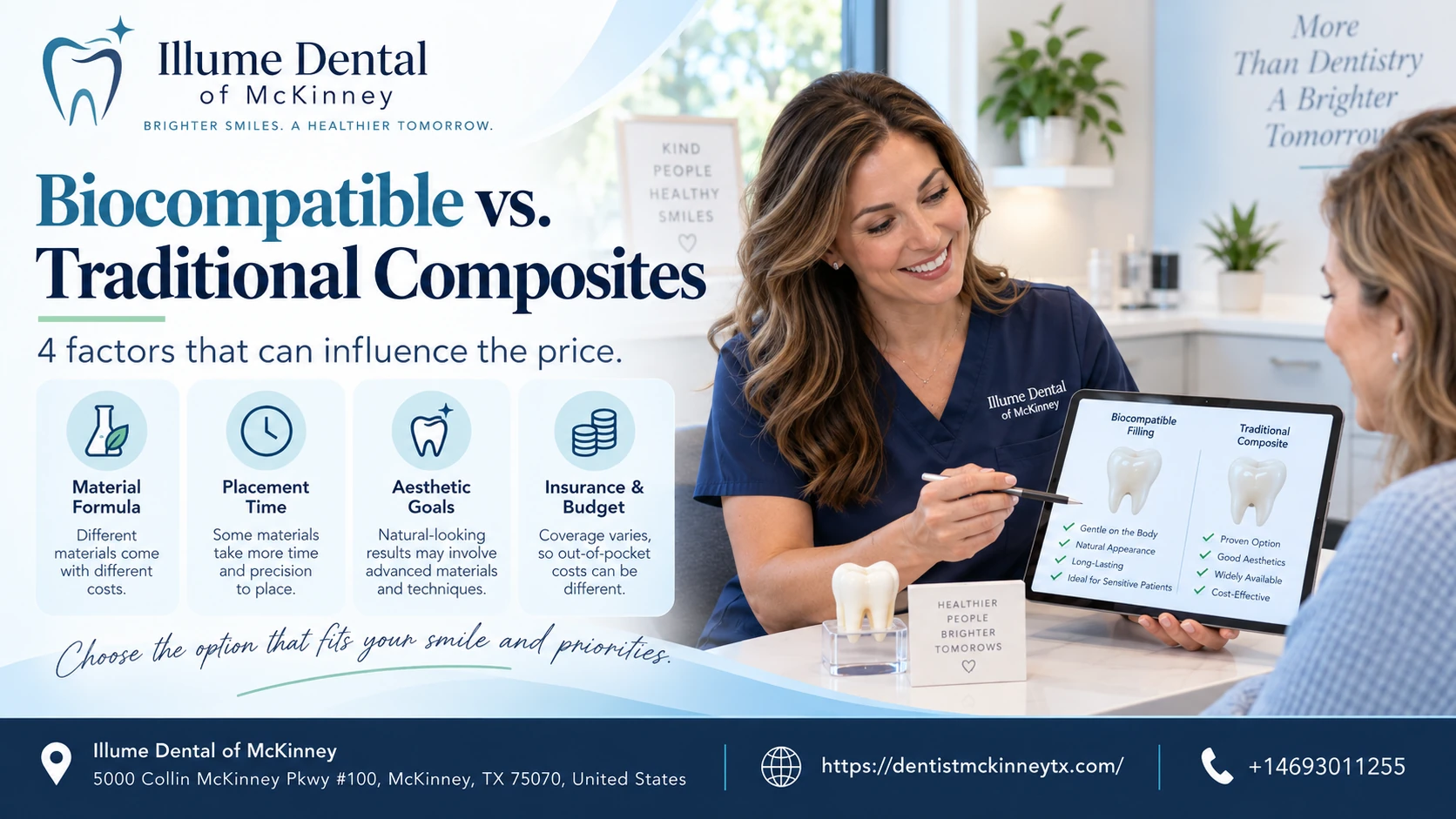
Traditional Composite vs. Specialty “Biocompatible” Composite
| Question | Traditional composite | Specialty “biocompatible” composite |
| Tooth-colored? | Yes | Usually |
| Metal-free? | Yes | Usually |
| Directly bonded to the tooth? | Usually | Usually |
| Standardized material category? | Yes resin-based composite | No; “biocompatible” is a broad label |
| Proven option for routine fillings? | Yes | Depends on the specific product |
| Typically covered by dental benefits? | Often, subject to plan | Coverage may still be based on standard composite benefits |
| Costs more? | Baseline | Sometimes, but not always |
| Better for everyone? | No material is ideal for every situation | No |
The most important takeaway is that you cannot evaluate a “biocompatible” filling from that word alone.
Ask for the product or material category.
 One reason many patients delay Botox is not fear of injections. It is budgeting. Whether you are considering Botox for:…

What About “Bioactive” Fillings?
This is another term worth separating from “biocompatible.”
Some newer restorative products are marketed as bioactive, meaning they are designed to interact with the surrounding tooth environment in ways such as releasing ions or supporting remineralization.
That sounds promising and some of the technology genuinely is promising.
But patients should be careful about assuming newer automatically means clinically superior.
The ADA has noted that evidence surrounding bioactive restorative materials still includes substantial laboratory research and that standardized clinical evidence remains limited for some claims and materials.
That does not mean bioactive materials are bad.
It means your dentist should be able to explain why that material makes sense for your particular tooth rather than simply relying on the word “bioactive.”
Is Ceramic a “Biocompatible Filling”?
Sometimes a patient asking for the most “biocompatible” restoration is actually being offered ceramic.
That is a different financial conversation.
A ceramic inlay or onlay is usually made outside the tooth or digitally milled and then bonded into place. It is not simply a premium version of an ordinary direct composite filling.
Ceramic restorations can cost substantially more because the fabrication process, materials and procedure are different. The ADA similarly distinguishes indirect ceramic restorations from direct composite fillings.
So when comparing estimates, make sure you are comparing:
composite versus composite, not a $250 direct filling against a much more involved ceramic restoration.
When Paying More for a Specialty Material May Make Sense
There are situations where the material discussion deserves extra attention.
For example:
- you have a documented sensitivity or allergy to a dental material;
- you previously reacted to a restorative product;
- you specifically want to avoid a particular resin component;
- your dentist believes another material offers an advantage for the location of your cavity;
- you understand the evidence and limitations and simply prefer a specific formulation.
In those situations, paying somewhat more may be perfectly reasonable.
The important part is knowing what you are buying.
When the Premium May Not Be Worth It
Be more cautious when the argument sounds like:
“Regular composite is toxic, and ours isn’t.”
That is too simplistic.
Dental materials involve tradeoffs. Even materials described as “biocompatible” contain chemicals and have limitations.
You should also be skeptical if a dentist cannot tell you:
- the actual material being used;
- what ingredients it avoids;
- why avoiding those ingredients matters in your case;
- how its durability compares with conventional composite;
- whether there is good clinical evidence behind the claimed benefit; and
- exactly how much extra you will pay.
Those are reasonable patient questions not challenges to your dentist.
Does a More Expensive Filling Last Longer?
Not necessarily.
Material matters, but so do:
- cavity size;
- bite forces;
- grinding or clenching;
- moisture control during placement;
- decay risk;
- oral hygiene; and
- how many healthy teeth remain.
The ADA’s review of direct restorative materials has found limited evidence for major longevity differences among several established restorative options in many clinical situations. Patient and case-specific factors can be extremely important.
That is why choosing a filling based exclusively on a label or price tag misses the bigger issue.
A meticulously placed conventional composite may be a better investment than a more expensive specialty material used in the wrong situation.
Five Questions to Ask Before Paying Extra for a “Biocompatible” Filling
Before agreeing to an upgrade, ask:
- What is the exact material you plan to use?
- How is it different from your regular composite?
- Why are you recommending it for my tooth?
- Is there evidence that it performs better for my situation?
- What will I actually pay after insurance?
A good dentist should be comfortable answering all five.
What Should McKinney Patients Expect?
For patients in McKinney and throughout North Texas, the size of the restoration will usually influence the bill more than the phrase printed on the filling material.
A relatively small one-surface composite restoration may cost a few hundred dollars before insurance. A large multi-surface restoration can cost considerably more. Current Texas pricing references show just how wide those fees can be.
What you should not assume is that every filling marketed as “biocompatible” automatically deserves a large premium.
Find out exactly what it is first.
If you are choosing between a conventional composite and another restorative material, Illume Dental of McKinney can help you understand what is being placed in your tooth, why it is being recommended, what alternatives exist, and what the expected cost will be before treatment begins.
The goal should not be to buy the fanciest filling.
It should be to choose a restoration that makes sense for your tooth, your health priorities, your budget and the way you expect that tooth to function.
Frequently Asked Questions
Are BPA-free fillings more expensive?
Sometimes, but not necessarily. Pricing is determined by the dental practice and the specific material it uses. There is no standardized nationwide “BPA-free filling surcharge.”
Are regular composite fillings toxic?
Calling conventional composite fillings “toxic” is misleading. Resin composites are established dental restorative materials. Like many medical materials, they contain chemical components that have been studied for biological effects, but the ADA notes that exposure from properly cured dental restorations is small.
Does insurance cover biocompatible fillings?
Insurance will often evaluate the procedure as a resin-based composite restoration rather than paying extra because a product is marketed as “biocompatible.” Coverage varies significantly by plan, so request a benefit estimate if your dentist charges an additional material fee.
Are glass ionomer fillings more biocompatible than composite?
They are simply different materials with different advantages and limitations. Glass ionomers can release fluoride and can be useful in certain situations, but they generally have lower fracture resistance than composite and are not appropriate for every high-stress restoration.
Are bioactive fillings better than regular composite?
Not automatically. Bioactive restorative materials are an evolving area of dentistry, and some claims have stronger evidence than others. The material should be selected based on the tooth and the clinical problem rather than the marketing terminology alone.
Should I replace my current fillings with “biocompatible” ones?
Usually not simply because another material has a more appealing label. Removing a functioning restoration also removes additional tooth structure. Replacement makes more sense when a filling is failing, leaking, fractured, associated with recurrent decay, or when there is another specific clinical reason for treatment.
How can I get an exact filling price at Illume Dental of McKinney?
The exact cost depends on which tooth needs treatment, how many surfaces are involved, the restorative material selected and your insurance benefits. An examination and, when appropriate, an X-ray allow the dentist to determine what the tooth actually needs before giving you a meaningful estimate.
Need a Safer Filling Option?
Ask about biocompatible and traditional composite fillings. Schedule your consultation today for personalized recommendations.