
Dental Implants vs. Bridges: The 15-Year ROI Comparison
When patients compare a dental implant and a bridge, they often ask the wrong first question:
“Which one is cheaper?”
The better question is:
“Which one is likely to cost me less, protect more tooth structure, and create fewer problems over the next 15 years?”
That is where the comparison changes.
The Short Answer
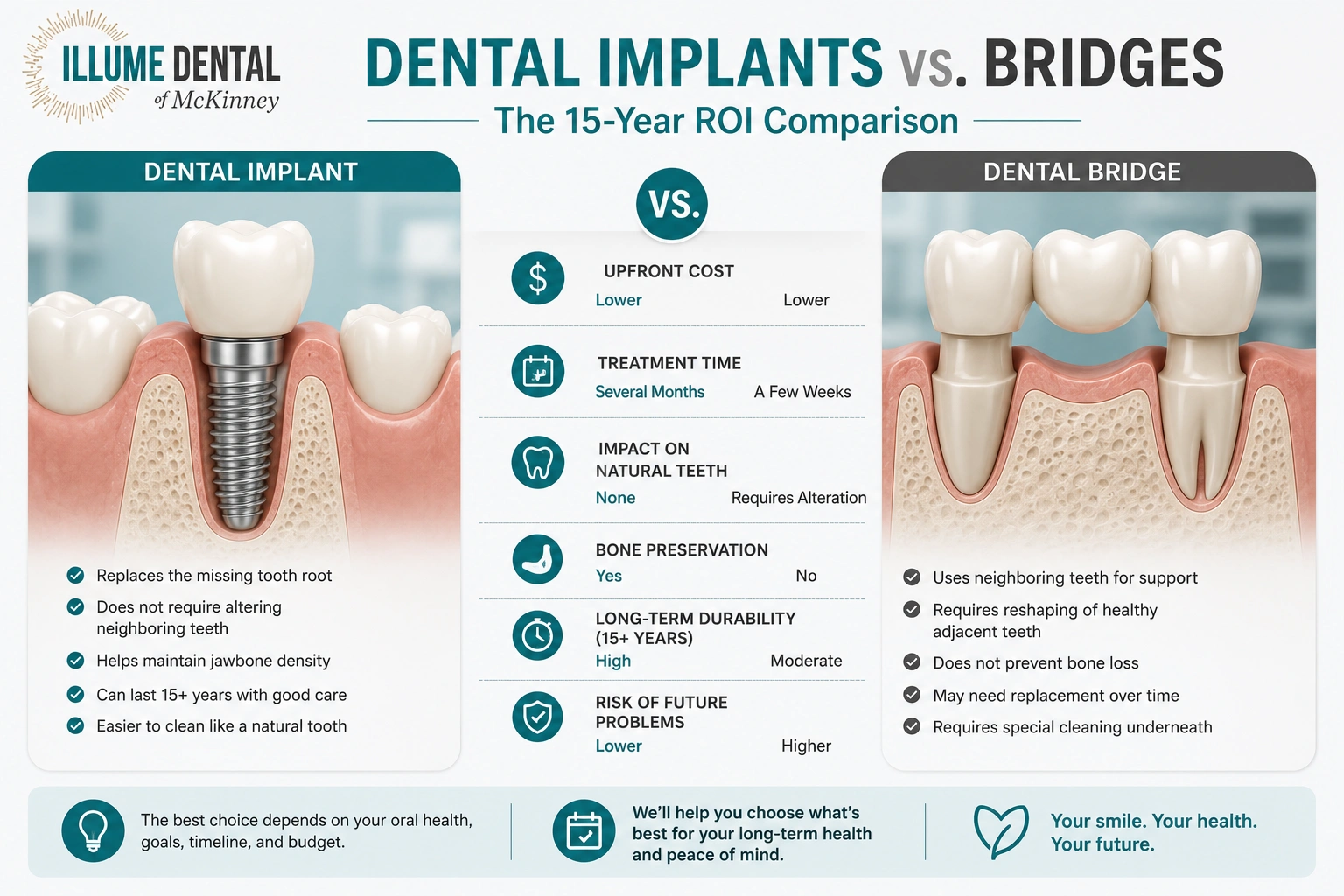
A dental bridge usually costs less upfront. A dental implant often costs more at the beginning, but may offer better long-term value because it does not require shaving down the neighboring teeth and can last longer with good maintenance.
That does not mean implants are always better.
A bridge may be the smarter choice if the neighboring teeth already need crowns, the patient is not a good surgical candidate, bone is limited, or the budget/timeline does not allow for implant treatment.
Ready to Replace Your Missing Tooth?
Get honest recommendations, lasting solutions, and quality dental care. Call today to schedule your consultation.
Upfront Cost: Bridge Usually Wins
A traditional three-unit bridge replaces one missing tooth by using the two neighboring teeth as anchors.
It may cost less upfront than an implant, especially if no bone grafting or surgery is involved.
But the tradeoff is important:
A bridge requires reducing the teeth on both sides of the missing tooth.
If those teeth are already heavily filled or cracked, that may be reasonable. If they are healthy, it is a bigger sacrifice.
15-Year Cost: Implant Often Wins
Over 15 years, the financial picture can shift.
A bridge may need replacement if it develops:
- decay under the crowns
- cement failure
- gum recession
- porcelain fracture
- root canal problems on supporting teeth
- bite-related damage
If one anchor tooth fails, the entire bridge can fail.
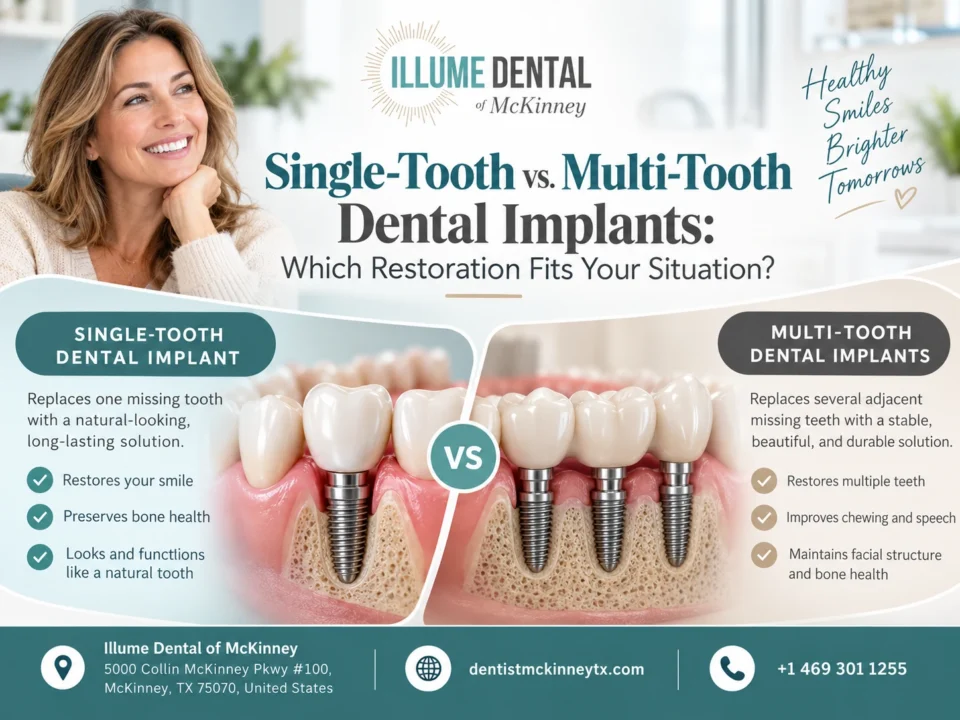
An implant is different. It replaces the missing tooth without depending on neighboring teeth. The crown on the implant may eventually need replacement, but the adjacent natural teeth are not cut down to support it.
That preservation is part of the ROI.
The Hidden Cost of a Bridge
The biggest “cost” of a bridge is not always money.
It is a tooth structure.
To make a bridge, the dentist must shape the teeth on either side of the gap. Once that enamel is removed, it is permanent.
That can increase future risk of:
- sensitivity
- decay around crown margins
- root canals
- crown replacement
- fracture of supporting teeth
For a patient with two healthy neighboring teeth, that is a major consideration.
 If your jaw clicks every time you yawn, chew, or open your mouth wide, you're probably wondering one thing: Should…
The Hidden Cost of an Implant
Implants have their own tradeoffs.
An implant may require:
- 3D imaging
- surgical placement
- healing time
- bone grafting
- extraction
- abutment
- final crown
- possible maintenance visits
Treatment can take several months. It is not instant.
Implants can also fail, especially with smoking, uncontrolled diabetes, poor home care, untreated gum disease, or heavy grinding.
So the ROI is strongest when the patient is a good candidate and maintains it well.
Timeline Comparison
A bridge is usually faster.
Many patients can receive a bridge in a few weeks.
An implant usually takes longer because the implant needs time to integrate with the bone before the final crown is placed. Depending on bone quality and whether grafting is needed, the process may take several months.
If speed matters most, a bridge may win.
If long-term independence from the neighboring teeth matters most, an implant often wins.
Comfort and Function
Both options can feel natural when done well.
A bridge is fixed in place and does not come out. An implant is also fixed and often feels closest to a natural tooth because it is supported by the jawbone instead of adjacent teeth.
Cleaning is different.
A bridge requires special flossing underneath the false tooth. An implant is cleaned more like a natural tooth, though still requires careful maintenance.
Best Candidates for a Bridge
A bridge may make sense if:
- the neighboring teeth already need crowns
- the patient wants a faster solution
- surgery is not ideal
- bone grafting would be extensive
- budget is the main limitation
- the missing tooth area is not ideal for an implant
Best Candidates for an Implant
An implant may make sense if:
- the neighboring teeth are healthy
- there is enough bone or grafting is reasonable
- the patient wants a long-term solution
- the patient can tolerate a longer timeline
- gum health is stable
- home care is good
- grinding is controlled with a night guard if needed
The 15-Year ROI Bottom Line
Bridge: lower upfront cost, faster treatment, but higher risk to neighboring teeth and possible replacement costs.
Implant: higher upfront cost, longer timeline, but better preservation of adjacent teeth and often stronger long-term value.
The right choice depends on your teeth, bone, health, budget, timeline, and risk tolerance.
If you are replacing a missing tooth in McKinney, Illume Dental of McKinney can help you compare the true 15-year cost of an implant versus a bridge — not just the first invoice.
Find the Right Solution for Your Smile
Every smile is different. Call today for a personalized evaluation and discover whether implants or bridges are right for you.