
Problems With “Mail-Order” Aligners: Why We End Up Fixing DIY Orthodontic Cases Every Month
The appeal is easy to understand.
A company promises straighter teeth without office visits, without traditional orthodontic appointments, and often at a fraction of the cost of Invisalign.
You take impressions at home, receive aligners in the mail, and start moving your teeth.
It sounds convenient.
It sounds affordable.
And sometimes, it works.
But here’s the reality many consumers don’t hear:
Moving teeth is not the same thing as creating a healthy bite.
That’s why dental offices across the country including here in McKinney regularly see patients who started with mail-order aligners and eventually needed professional treatment to fix the results.
DIY Aligners Didn’t Go as Planned?
Don’t let alignment problems get worse. Get dentist-supervised treatment designed around your smile.
The Short Answer
Mail-order aligners can sometimes correct minor cosmetic alignment issues.
However, they generally lack one critical component:
Ongoing clinical supervision.
When teeth don’t move as predicted and teeth frequently don’t, problems can develop that are difficult and expensive to correct later.
The Question Most Patients Never Ask
Most marketing for DIY aligners focuses on one thing:
“Can they make my teeth look straighter?”
But dentists and orthodontists ask a different question:
“What happens to the bite while the teeth are moving?”
A smile can appear straighter while creating new problems involving:
- Bite alignment
- Tooth wear
- Jaw discomfort
- Uneven pressure during chewing
- Gum recession
- Tooth mobility
Straight teeth are important.
Healthy function is even more important.
Why Teeth Don’t Always Move According to the Computer Simulation
One of the biggest misconceptions about aligners is that digital treatment plans predict exactly what will happen.
They don’t.
The simulation is a prediction.
Real-life factors include:
- Bone density
- Root anatomy
- Patient compliance
- Existing dental work
- Gum health
- Individual biology
This is why Invisalign and professionally supervised aligner treatment include periodic evaluations.
When teeth aren’t tracking properly, adjustments can be made.
With a mail-order system, those issues may go unnoticed until treatment is complete.
The Three Problems We See Most Often
1. Front Teeth Look Better, Back Teeth Don’t Touch
This is one of the most common complaints.
Patients finish treatment and notice:
- Front teeth meet first
- Back teeth no longer touch properly
- Chewing feels different
They achieved cosmetic improvement but lost proper bite function.
Fixing this often requires additional aligner therapy or orthodontic treatment.
2. Teeth Stopped Tracking
Aligners only work when teeth move as expected.
When they don’t, patients may notice:
- Gaps between teeth and aligners
- Teeth rotating incorrectly
- Spaces opening unexpectedly
Without regular in-person monitoring, these issues can continue throughout treatment.
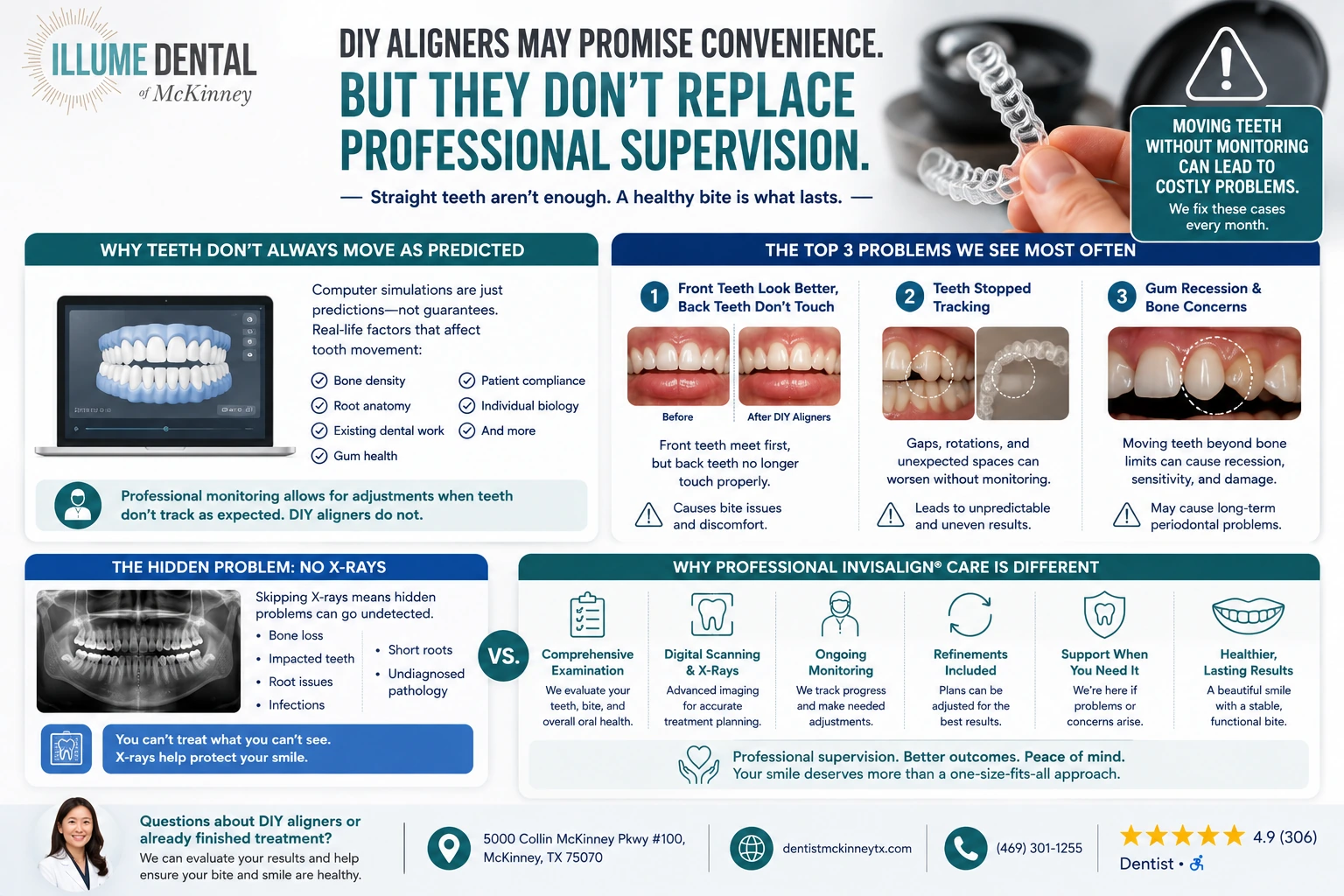
3. Gum Recession and Bone Concerns
Not every tooth can safely move in every direction.
Moving teeth beyond the limits of available bone support can contribute to:
- Gum recession
- Exposed roots
- Increased sensitivity
- Long-term periodontal concerns
This is one reason X-rays are such an important part of treatment planning.
The Hidden Problem: No X-Rays
Many DIY aligner systems historically began treatment without comprehensive diagnostic imaging.
That’s a concern because X-rays help identify:
- Bone loss
- Impacted teeth
- Root problems
- Existing infections
- Short roots
- Undiagnosed pathology
Teeth may appear healthy from the outside while significant issues exist underneath.
Moving teeth without fully understanding those conditions can create avoidable complications.
Why Professional Invisalign Costs More
Many consumers compare prices and conclude:
“They’re both clear aligners. Why is Invisalign more expensive?”
The difference isn’t just the plastic trays.
Professional treatment often includes:
- Comprehensive examination
- Digital scanning
- Diagnostic X-rays
- Bite analysis
- Progress monitoring
- Mid-course corrections
- Refinement aligners
- Emergency support if something goes wrong
You’re paying for clinical oversight not just aligners.
Can Mail-Order Aligners Ever Work?
Yes.
Some patients achieve acceptable cosmetic improvements.
The challenge is that it’s difficult for a consumer to determine whether they are truly a good candidate.
Many people who think they have a simple alignment issue actually have:
- Bite discrepancies
- Crowding
- Jaw relationships
- Hidden dental concerns
that require more comprehensive evaluation.
What McKinney Patients Tell Us
Many patients who seek corrective treatment say some version of the same thing:
“My teeth look straighter, but something feels off.”
Or:
“I thought I was saving money, but now I need treatment again.”
Not every DIY aligner patient has a bad experience.
But when problems occur, correcting them is often more expensive than doing it properly from the beginning.
Before Choosing Any Clear Aligner System, Ask These Questions
- Will a dentist or orthodontist review my X-rays?
- Who monitors my progress?
- What happens if my teeth don’t move as planned?
- What if my bite changes?
- Is there a local provider I can see if problems arise?
- What is included if refinements are needed?
If those questions are difficult to answer, that’s worth paying attention to.
The Bottom Line
Mail-order aligners appeal to consumers because they’re convenient and often less expensive upfront.
But straightening teeth without ongoing clinical supervision can create problems that don’t become obvious until treatment is complete.
The goal isn’t simply straighter teeth.
The goal is a healthy smile, a stable bite, and long-term oral health.
If you’re considering clear aligners or if you’ve already completed DIY aligner treatment and something doesn’t feel right an evaluation can help determine whether your teeth, bite, and jaw are functioning the way they should.
At Illume Dental of McKinney, Dr. Eileen Chen-Mizuuchi and the team can evaluate existing aligner results, identify potential concerns, and help you understand your options before small bite issues become larger problems.
Frequently Asked Questions
Are mail-order aligners the same as Invisalign?
No. While both use clear aligners, Invisalign treatment includes in-person diagnosis, monitoring, and adjustments from a dental professional.
Can mail-order aligners damage teeth?
Problems are uncommon but can occur, particularly when tooth movement affects bite function, gum health, or teeth move unpredictably.
Why are X-rays important before moving teeth?
X-rays help identify underlying issues that cannot be seen from photos or impressions alone, including bone loss, root problems, and hidden dental conditions.
Can a bad aligner result be fixed?
Often, yes. However, corrective treatment may require additional aligners, orthodontic treatment, or restorative dental work depending on the situation.
How do I know if my bite changed?
Common signs include difficulty chewing, back teeth not touching, jaw discomfort, teeth hitting unevenly, or a feeling that your bite no longer fits together naturally.
Mail-Order Aligners Causing Problems?
Get your smile back on track with professional orthodontic care. Call today for a personalized evaluation.