
How Much Do Porcelain Veneers Cost in McKinney, TX?
2026 Price Guide
Most adults asking about porcelain veneers are really asking three things: How much will this actually cost, will the result look natural, and will I regret doing it?
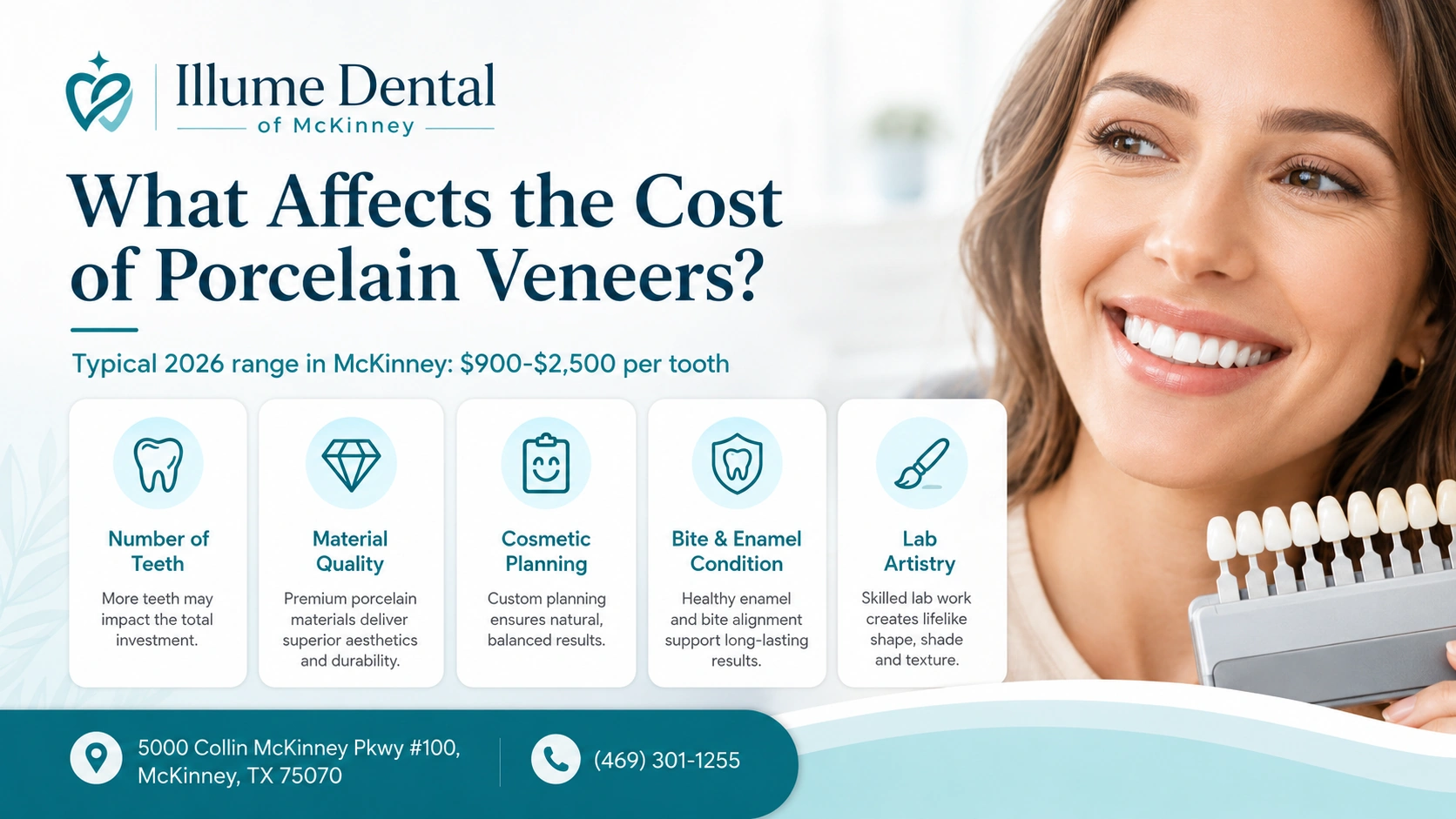
In McKinney, TX, porcelain veneers typically cost about $900 to $2,500 per tooth in 2026, with many cosmetic cases landing around $1,200 to $1,800 per tooth depending on the dentist, lab, materials, and complexity of the smile design. Local and Texas pricing guides show McKinney and Texas veneer costs generally tracking near national averages, with published ranges from about $816 to $2,550 per tooth in McKinney and $744 to $2,325 per tooth across Texas.
For a simple estimate:
| Veneer Case | Typical 2026 Cost Range in McKinney |
| 1 porcelain veneer | $900–$2,500 |
| 2 front teeth | $1,800–$5,000 |
| 4 upper front teeth | $3,600–$10,000 |
| 6 upper front teeth | $5,400–$15,000 |
| 8 upper teeth / smile makeover | $7,200–$20,000+ |
These are general planning ranges, not a diagnosis or quote. The exact cost depends on your teeth, bite, goals, and whether any dental problems need to be treated first.
Want Your Exact Veneer Price, Not Just a Range?
Get a free virtual consult with Illume Dental of McKinney. We'll review your smile goals and give you a clear, personalized quote. Call today.
Why Porcelain Veneers Cost So Much
Porcelain veneers are not just “covers” placed over teeth. Done well, they are custom cosmetic restorations designed to change tooth color, shape, length, symmetry, and sometimes minor spacing.
The cost usually reflects several things:
The dentist’s cosmetic planning. Veneers are highly visible. A small difference in shape, thickness, color, or gum-line balance can make the result look natural—or fake.
The dental lab quality. High-quality porcelain veneers are typically made by a skilled ceramic lab. Better ceramics and better artistry usually cost more.
The number of teeth involved. One veneer is often harder to match perfectly to nearby natural teeth. Multiple veneers may cost more overall but can create a more balanced smile.
Your bite and enamel condition. If you grind your teeth, have worn enamel, crowding, gum recession, or old dental work, the case may require more planning.
Whether treatment is cosmetic or restorative. A veneer used only to improve appearance is usually priced and covered differently than a restoration needed because of tooth damage.
Porcelain Veneers vs. Composite Veneers: Cost Difference
Patients often compare porcelain veneers with composite bonding because composite usually costs less.
| Option | Typical Cost | Lifespan | Best For |
| Composite bonding / composite veneers | Often lower, commonly a few hundred to $1,500 per tooth | Shorter; more stain-prone | Small chips, minor gaps, budget-conscious cosmetic changes |
| Porcelain veneers | About $900–$2,500 per tooth | Often 10–20 years with good care | Larger smile changes, better stain resistance, more durable aesthetics |
Composite can be a good option, especially for small repairs. But it stains more easily and usually does not last as long as porcelain. Porcelain costs more upfront, but it often looks more lifelike and holds its color better over time.
Does Dental Insurance Cover Porcelain Veneers?
Usually, no.
Most dental insurance plans consider porcelain veneers cosmetic when they are done to improve color, shape, or smile appearance. That means insurance often pays little or nothing.
There are exceptions. If a veneer is being used to restore a cracked, damaged, or structurally compromised tooth, your plan may consider partial coverage. But patients should not assume coverage until the dental team reviews the plan and submits the proper documentation.
A good dental office should help you understand:
- Whether your insurance is likely to contribute
- What portion is cosmetic versus restorative
- What your out-of-pocket cost may be
- Whether financing or phased treatment makes sense
What Can Increase the Cost of Veneers?
Your veneer estimate may be higher if you need:
Gum treatment first. Inflamed or uneven gums can affect the final look.
Whitening before veneers. If only some teeth are getting veneers, whitening the natural teeth first may help the final color match.
Replacement of old fillings or crowns. Existing dental work may need to be corrected before veneers are placed.
Bite protection. Patients who clench or grind may need a nightguard to protect the veneers.
More detailed smile design. Digital scans, mockups, trial smiles, and custom shade work may add cost but can also reduce surprises.
The cheapest veneer is not always the best value. Poorly planned veneers can look bulky, feel uncomfortable, irritate the gums, or fail early.
 Botox is no longer just a cosmetic treatment for forehead lines. Many patients in McKinney are now getting Botox for:…

When Porcelain Veneers Are Worth Considering
Porcelain veneers may be a good fit if you have:
- Deep stains that whitening will not fix
- Worn or short teeth
- Small gaps
- Mild shape or size differences
- Minor chips
- Uneven front teeth
- Old bonding that keeps staining or breaking
- A healthy bite and enough enamel to support veneers
They are especially useful when the problem is mostly cosmetic and the teeth are otherwise healthy. For patients focused on enhancing your smile by exploring dental veneers, this treatment can offer a versatile way to address several appearance concerns at once.
When Veneers May Not Be the Right Choice
This is where patients need honest guidance.
Porcelain veneers may not be the best first step if you have:
- Active cavities
- Gum disease
- Severe crowding
- Major bite problems
- Heavy grinding that is not managed
- Very little enamel
- Teeth that actually need crowns
- Expectations for a “perfect” smile without maintenance
Veneers are also not reversible in the same way whitening is. In many cases, a small amount of enamel is reshaped so the veneer can fit properly. Once that is done, the tooth will generally need a veneer or similar restoration long term.
Porcelain Veneers vs. Crowns: Which Costs More?
Porcelain veneers and crowns can sometimes fall into similar price ranges, but they solve different problems.
A veneer covers mainly the front surface of the tooth. It is usually chosen for cosmetic improvement when the tooth is still strong.
A crown covers the entire tooth. It is usually recommended when the tooth is cracked, heavily filled, weakened, or structurally compromised.
If your tooth needs strength, a veneer may be the wrong treatment even if it looks appealing cosmetically. If your tooth is healthy and you only want to improve appearance, a crown may remove more tooth structure than necessary.
The right choice depends on the condition of the tooth, not just the price.
How Many Veneers Do Most Patients Need?
It depends on how wide your smile is and what you want to change.
Some patients need one veneer for a single chipped or discolored tooth. Others need 4 to 8 veneers across the upper front teeth for a balanced cosmetic result. A full smile makeover can involve more teeth, especially if lower teeth show when speaking or smiling.
A practical rule: the more teeth that show when you smile, the more important symmetry becomes.
How Long Do Porcelain Veneers Last?
Porcelain veneers often last 10 to 20 years with good care, though no cosmetic dental work lasts forever. Public dental cost guides commonly describe porcelain veneers as a longer-lasting option than composite veneers, which may need repair or replacement sooner.
Longevity depends on:
- Oral hygiene
- Bite forces
- Grinding or clenching
- Diet habits
- Gum health
- Whether you wear a nightguard if recommended
- The quality of the planning and placement
Veneers can chip, debond, stain at the edges, or need replacement over time. They are durable, not indestructible.
Red Flags When Shopping for Cheap Veneers
Be careful with unusually low veneer pricing, especially from social media providers or non-dentist “veneer techs.” The American Dental Association and news reports have warned patients about unlicensed veneer providers because improper treatment can lead to pain, tooth damage, nerve injury, and tooth loss.
Before choosing a provider, ask:
- Is the person placing the veneers a licensed dentist?
- Will I get X-rays and a full exam first?
- Will my bite be evaluated?
- What material is being used?
- Is this composite, porcelain, or something else?
- What happens if a veneer breaks or feels wrong?
- Will I see a preview or mockup before treatment?
Cheap veneers can become very expensive if they damage healthy teeth.
A Practical Budget Example
Let’s say you are considering veneers for your upper front teeth.
A 4-veneer case may cost roughly $3,600 to $10,000.
A 6-veneer case may cost roughly $5,400 to $15,000.
An 8-veneer case may cost roughly $7,200 to $20,000+.
That range is wide because there is a big difference between a simple cosmetic enhancement and a complex smile makeover involving bite issues, old dental work, gum asymmetry, or custom ceramic layering.
How to Know Your Real Veneer Cost
The only reliable way to know your veneer cost is to have a cosmetic consultation that includes an exam, photos, bite evaluation, and a discussion of your goals.
A trustworthy veneer consultation should answer:
- Are veneers appropriate for my teeth?
- How many teeth need treatment?
- Do I need whitening, gum treatment, Invisalign, bonding, crowns, or fillings first?
- What are the risks in my case?
- What will maintenance look like?
- What happens if I only do 2 veneers instead of 6 or 8?
- What is the total fee before I start?
If a practice gives you a price without looking closely at your teeth, bite, and smile, that number is only a guess.
Bottom Line
In McKinney, TX, porcelain veneers usually cost about $900 to $2,500 per tooth in 2026, with many complete smile cases costing several thousand dollars depending on the number of teeth involved. The biggest cost drivers are case complexity, ceramic quality, lab work, cosmetic planning, and whether your teeth are healthy enough for veneers in the first place.
Veneers can be a beautiful, long-lasting option. They can also be the wrong treatment if the tooth needs a crown, orthodontics, gum care, or bite correction first.
If you are considering porcelain veneers in McKinney, the safest next step is a cosmetic exam and honest treatment plan before committing to anything permanent. Illume Dental of McKinney, led by Dr. Eileen Chen-Mizuuchi, helps North Texas patients understand their options clearly before moving forward.
FAQ: Porcelain Veneers Cost in McKinney, TX
How much is one porcelain veneer in McKinney?
A single porcelain veneer in McKinney typically costs about $900 to $2,500 per tooth in 2026. A single front tooth can sometimes be more challenging because the color and shape must match the neighboring natural teeth very closely.
How much do 8 porcelain veneers cost?
Eight porcelain veneers may cost about $7,200 to $20,000+ depending on the dentist, lab, materials, and complexity of the case.
Are veneers cheaper than crowns?
Sometimes they are similar in price. The bigger difference is purpose. Veneers are usually cosmetic and cover the front of the tooth. Crowns cover the whole tooth and are usually used when the tooth needs more structural protection.
Are veneers covered by insurance?
Usually not when they are cosmetic. Insurance may contribute if the veneer is needed to restore a damaged tooth, but coverage depends on your plan and documentation.
Are porcelain veneers permanent?
They are considered a long-term and usually irreversible treatment because enamel may be reshaped. Veneers will likely need replacement at some point in the future. Because veneers are a long-term investment, many patients weigh the upfront cost of about $900 to $2,500 per tooth against a lifespan that is often 10 to 20 years with good care.
Do veneers hurt?
Most patients tolerate veneer treatment well. Local anesthetic may be used during tooth preparation. Some temporary sensitivity can happen, especially if enamel is reshaped.
How many veneers do I need for a smile makeover?
Many patients choose 4, 6, or 8 upper veneers, depending on how many teeth show when they smile. Some only need one or two. The right number depends on your smile width, tooth color, and cosmetic goals.
What is the cheapest alternative to veneers?
Composite bonding is usually less expensive than porcelain veneers. Whitening may also be a lower-cost option if the main concern is tooth color. However, neither option can solve every issue that veneers can address.
Can I get veneers if my teeth are crooked?
Mild unevenness may be corrected with veneers. Moderate or severe crowding may need Invisalign or orthodontic treatment first. Placing veneers on poorly positioned teeth can create bulky or unnatural results.
How do I avoid fake-looking veneers?
Choose a dentist who evaluates your bite, uses quality materials, plans the shape carefully, and does not push a one-size-fits-all “perfect white” smile. Natural veneers are about proportion, translucency, gum balance, and facial harmony—not just brightness.
How much do veneers cost in Texas?
Published pricing guides put porcelain veneers at roughly $744 to $2,325 per tooth across Texas and about $816 to $2,550 per tooth in McKinney. In McKinney, porcelain veneers typically cost about $900 to $2,500 per tooth in 2026, and the exact fee depends on the dentist, lab, materials, and the complexity of your smile design.
How much do veneers cost for 2 front teeth?
Two porcelain veneers on the front teeth typically cost about $1,800 to $5,000, and four upper front teeth about $3,600 to $10,000. Front teeth are the most visible in your smile, so color matching and shape planning matter, and a cosmetic exam is the only way to get an exact number.
How much is a full set of porcelain veneers?
A full smile makeover with 8 upper porcelain veneers may cost about $7,200 to $20,000+. Many patients choose 4, 6, or 8 upper veneers depending on how many teeth show when they smile, and the total can rise if lower teeth are included or if gum, bite, or old dental work needs attention first.
How much do composite veneers cost?
Composite veneers (composite bonding) often cost less, commonly a few hundred dollars to $1,500 per tooth, compared with about $900 to $2,500 per tooth for porcelain. The tradeoff is that composite stains more easily and usually does not last as long.
How much do veneers cost with insurance?
Dental insurance usually pays little or nothing toward cosmetic veneers, so your out-of-pocket cost may be close to the full fee. If a veneer is needed to restore a cracked or damaged tooth, your plan may contribute part of the cost. Ask your dental office to review your plan before treatment so you know what to expect.
Wondering What Veneers Cost in McKinney?
Get a personalized consultation and find out your best options. Call today to start your smile upgrade.