
Do I Need a New Night Guard After Getting a Dental Crown?
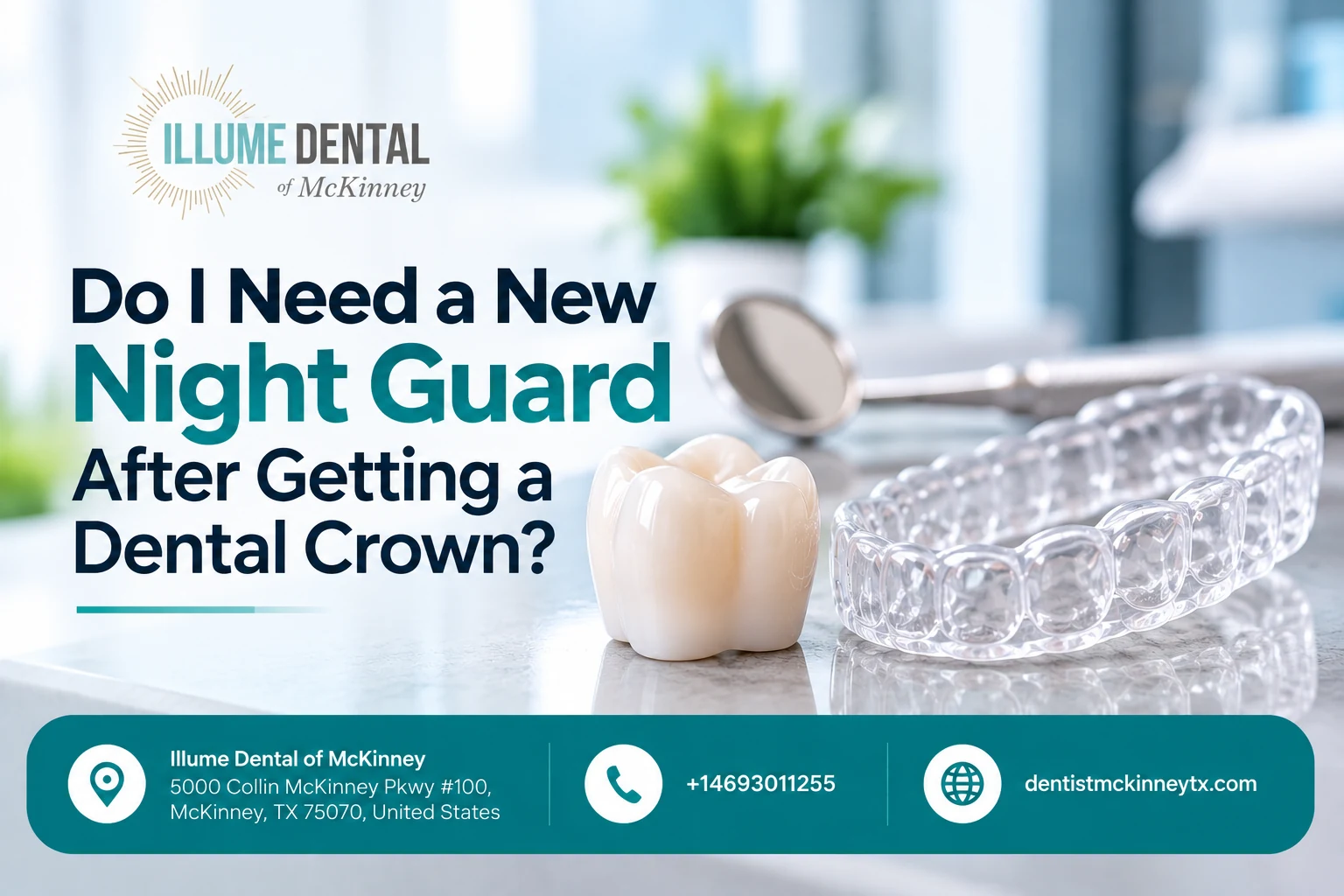
Getting a dental crown does not automatically mean you need a new night guard. However, a custom night guard is made to fit the shape and position of your teeth, and a crown restores or changes the contour of one of those teeth. If the new crown changes the fit enough, your existing guard may need to be adjusted or remade.
If your night guard still seats completely, feels comfortable, and your dentist confirms that the fit and bite remain appropriate, you may be able to continue using it.
If the guard suddenly feels unusually tight, will not seat completely, rocks, causes localized pressure, or seems to catch around the new crown, do not force it into place. Have your dentist check it first.
Does Your Night Guard Still Fit?
A new crown can change how your night guard fits. Schedule a quick evaluation before wearing it again.
Key Takeaways
- A new crown does not automatically require a new night guard.
- Custom night guards and occlusal splints are designed around the specific anatomy of your teeth, so changing the shape of a tooth can affect the appliance’s fit.
- An existing night guard can sometimes be professionally adjusted rather than completely replaced.
- If a guard no longer fits correctly, your dentist should evaluate both the appliance and the new crown before you continue wearing it.
- If you grind or clench your teeth, continuing to protect your teeth and restorations may still be important after crown treatment. The ADA defines an occlusal guard as an appliance that can protect teeth and dental restorations from biting forces.
Why can a crown change the way a night guard fits?
A dental crown covers a prepared tooth and restores its shape, size, appearance, and function.
A custom night guard, also called an occlusal guard or occlusal splint, is fabricated to fit the teeth closely. More sophisticated splints are also designed so the upper and lower teeth contact the appliance in a controlled way.
That means even a relatively small change to the shape of a crowned tooth can potentially change:
- how easily the night guard goes on
- how securely it stays in place
- where the appliance contacts the teeth
- how your upper and lower teeth meet against the guard
That does not mean something went wrong with the crown. A crown can fit properly in your mouth while still being slightly different from the tooth shape your older night guard was originally made around.
Do I always need a brand-new night guard?
No.
There are generally three possibilities after a crown is placed.
Your existing night guard still fits
If the guard seats completely and remains comfortable and stable, your dentist may determine that no change is necessary.
Your existing night guard can be adjusted
Some professionally made occlusal appliances can be adjusted when the fit or bite has changed. The American College of Prosthodontists notes that splints can be adjusted or replaced as needed.
Whether adjustment is appropriate depends on the appliance material, design, location of the crown, and how much the fit has changed.
The night guard needs to be remade
If the existing appliance cannot seat correctly, cannot be adjusted while maintaining an appropriate fit, or no longer functions as intended, making a new guard may be the better option.
A dentist needs to make that decision after checking the appliance in your mouth. There is no universal rule that every crown requires a replacement guard.
What should a night guard feel like after crown treatment?
A custom night guard should fit securely without causing excessive pressure or pain.
Cleveland Clinic notes that poorly fitting mouth guards can cause soreness in the teeth, gums, or jaw and that dentists can evaluate and adjust an appliance when necessary.
After receiving a crown, contact your dentist if the night guard:
- no longer goes completely into place
- rocks or feels unstable
- suddenly feels much tighter than before
- creates significant pressure on the crowned tooth
- causes new tooth, gum, or jaw discomfort
- feels noticeably different when you bite into it
- catches around the new crown when you try to remove it
Trying to force an appliance that clearly no longer fits is not a useful test. The safer approach is to have the crown and guard checked together.
What if the night guard fits but my bite feels different?
That deserves an evaluation too.
A night guard does more than simply cover your teeth. Depending on its design, the biting surface of the appliance may be adjusted so the teeth contact it in a specific way. The American College of Prosthodontists describes occlusal splints as customized appliances intended to control interaction between the teeth while the jaw moves.
If your night guard fits over the new crown but your bite against the guard suddenly feels uneven, your dentist can determine whether:
- the crown needs evaluation
- the night guard needs adjustment
- both are functioning normally and you simply need time to adapt
Avoid trying to grind, trim, heat, bend, or reshape a professionally made night guard yourself.
Why is a night guard still important if I have a crown?
If you have bruxism, habitual grinding or clenching the purpose of an occlusal guard is generally to protect your teeth and restorations from excessive forces.
The ADA specifically defines an occlusal guard as a removable appliance used to protect the teeth, periodontal tissues, implants, TMJ, and/or restorations from occlusal forces.
Cleveland Clinic also recommends that people who clench or grind discuss custom mouth guards with their dentist as part of caring for dental crowns.
That matters because putting a crown on a damaged tooth does not make nighttime grinding disappear.
If bruxism contributed to tooth wear, fracture, or restorative problems in the first place, protecting the new restoration may remain part of the long-term plan.
What if I have a temporary crown?
A temporary crown and a final crown are not necessarily identical in contour.
If you are currently wearing a temporary crown, ask your dentist whether you should continue using your existing night guard during the temporary phase. Do not assume that an appliance that fits or does not fit the temporary crown will behave exactly the same once the final crown is placed.
Instructions can vary depending on the crown, the night guard, and the tooth being treated.
When should you see your dentist?
You do not necessarily need a separate appointment simply because you received a crown. Ideally, bring your night guard with you when the crown is delivered so your dentist can evaluate its fit.
If that was not done, contact the office if:
- the guard no longer fits after the crown
- the crown feels unusually high when you bite
- the crowned tooth is increasingly painful
- the night guard creates significant pressure in one area
- the crown feels loose
- the guard suddenly becomes difficult to insert or remove
- you develop persistent jaw discomfort after the change
Some temperature sensitivity or gum tenderness can occur for a short period after crown placement, but persistent or worsening pain deserves evaluation.
Questions to ask at your visit
- Does my current night guard still fit correctly over the new crown?
- Does the bite against the guard need to be adjusted?
- Can my existing night guard be modified safely, or should it be replaced?
- Is there any sign that grinding or clenching contributed to the tooth needing a crown?
- How often should my night guard and crown be checked for wear?
- What changes should make me stop wearing the appliance and call the office?
How Illume Dental can help
If you already wear a night guard and are getting a new crown, bring the appliance with you to your dental visit.
Illume Dental of McKinney can evaluate how the crown fits within your bite and whether your existing guard continues to seat and function appropriately. Illume Dental provides restorative dental treatment, including dental crowns, and also evaluates concerns related to bruxism and bite-related dental problems in McKinney.
The goal is not to replace a night guard unnecessarily. It is to make sure the crown and the appliance work together without creating unwanted pressure or leaving a restoration unprotected.
Frequently Asked Questions
Will every dental crown require a new night guard?
No.
There is no standard rule that a night guard must be replaced every time a crown is placed. Because custom appliances fit the anatomy of the teeth, the existing guard should be checked after the crown is completed.
Some guards continue to fit normally, some can be adjusted, and some need to be replaced.
Can a dentist adjust my old night guard to fit a new crown?
Sometimes.
Professional occlusal splints can be adjusted in appropriate situations, but whether yours can be modified depends on its material, design, current condition, and how much the fit changed after crown placement.
Your dentist should make that determination rather than attempting an at-home adjustment.
What if my night guard is suddenly very tight around my new crown?
Do not force it.
Custom guards should fit securely, but an appliance that suddenly will not seat completely or creates significant localized pressure should be evaluated. Poorly fitting mouth guards can cause soreness in the teeth, gums, or jaw.
Bring the guard to your dentist so the fit can be checked.
Should I bring my night guard to my crown appointment?
Yes, this is practical whenever possible.
Having the appliance available allows the dentist to see how it fits after the crown has been placed and determine whether adjustment or replacement is necessary.
Does a night guard protect dental crowns?
An occlusal guard can help protect restorations from forces generated by grinding and clenching. The ADA’s definition of an occlusal guard specifically includes protecting dental restorations from occlusal forces.
A night guard does not make a crown indestructible, and it does not eliminate bruxism, but it may be part of protecting teeth and restorations in patients who grind or clench.
What if my crown feels high even without the night guard?
Contact your dentist.
A crown should restore comfortable function. If the new tooth feels like it contacts before your other teeth, chewing remains uncomfortable, or the bite continues to feel noticeably abnormal, the crown and your bite should be evaluated rather than assuming the night guard is the only issue.
Protect Your New Crown
Your night guard may need an adjustment after a new crown. Call today to make sure your crown and bite stay protected.